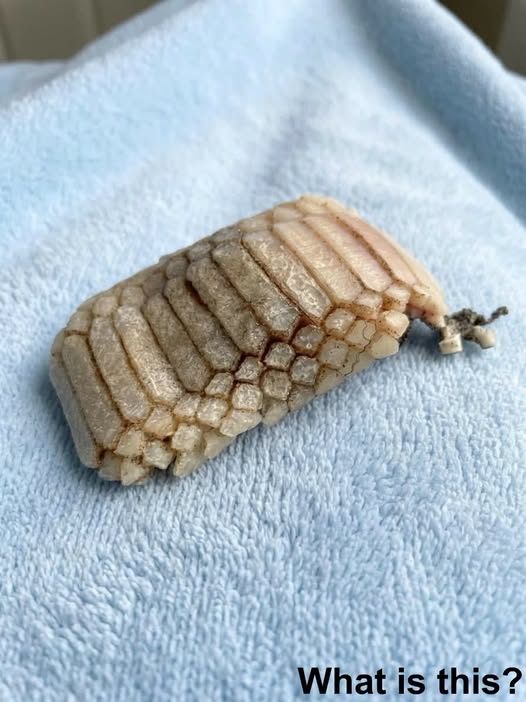
If you saw this lying in the surf, your heart might stop for a second. It looks like a shredded alien jaw, a broken biological machine, or a piece of something that simply shouldn’t be alive. Beachgoers snapped photographs, stared from a cautious distance, and argued online about what they were seeing. Some imagined sea monsters, others suggested mutations or the remains of an unknown deep-sea animal. But the truth behind the bizarre object is far stranger—and far more beautiful—than most people expected.
What washed up wasn’t a monster at all, but the unfamiliar underside of a chiton, a quiet armored mollusk that spends much of its life gripping wave-battered rocks. Seen from underneath, the animal looks dramatically different from the simple shell-like creature people might notice while exploring a rocky shoreline. Its broad muscular foot and surrounding structures create an appearance that can seem almost mechanical.
That powerful foot is one of the secrets to the chiton’s survival. Life along rocky coastlines can be brutally demanding. Waves repeatedly crash against exposed surfaces with enough force to sweep away animals that cannot hold on. Chitons survive by pressing their bodies tightly against rocks, using their muscular foot to create an extremely strong grip.
From above, however, the same animal appears surprisingly modest.
A chiton’s back is protected by eight overlapping shell plates. These plates provide protection while still allowing the animal enough flexibility to move across uneven surfaces. Rather than forming one rigid shell, the segmented design allows the body to bend as the chiton slowly travels over rocks searching for food.
Much of that food consists of algae and other material growing across submerged surfaces. The chiton grazes using a specialized feeding structure known as a radula—a ribbon-like organ covered with rows of tiny teeth.
And those teeth are where the story becomes even more remarkable.
Chiton teeth can contain magnetite, an extremely hard iron-based mineral. This reinforcement helps the animal repeatedly scrape food from hard rock without immediately wearing down its feeding structures. As older teeth become worn, newer ones develop and replace them, allowing the chiton to continue grazing throughout its life.
That extraordinary biological engineering is hidden inside an animal most beachgoers would barely notice.
There is something almost contradictory about the chiton. From above, it looks ancient, quiet, and uncomplicated—a small armored creature slowly moving across stone. Turn it over, examine its anatomy more closely, and suddenly you discover specialized structures designed to survive one of the most physically demanding environments along the coast.
Its strange appearance isn’t evidence of something monstrous.
It’s evidence of adaptation.
Every feature serves a purpose. The overlapping plates provide armor while maintaining flexibility. The muscular foot helps resist powerful waves. Its feeding apparatus allows it to scrape stubborn material from rock, while mineral-strengthened teeth provide the durability needed to repeat that process again and again.
Even its ancient appearance tells a larger story.
Chitons belong to a lineage of mollusks with a body design that has persisted for an extraordinarily long period of evolutionary history. While the coastline around them changes—rocks erode, tides rise and fall, storms reshape beaches—the basic survival strategy remains remarkably effective.
That is why the object in the surf can produce such different reactions depending on what we know about it.
Without context, it looks frightening.
With context, it becomes ingenious.
The same ocean waves that carve cliffs, move stones, and reshape entire shorelines have also created intense evolutionary pressure on the creatures living there. Animals that cannot tolerate those forces disappear from exposed environments. Those that remain often possess remarkable adaptations hidden beneath seemingly ordinary appearances.
The chiton is one of those survivors.
It doesn’t need enormous claws, powerful jaws, or dramatic speed. Its survival depends on something quieter: holding on when the ocean tries to pull it away, protecting itself beneath flexible armor, and patiently grazing across the rocks beneath the waves.
What initially resembles an alien object therefore becomes something much more fascinating once its identity is understood.
It is a reminder of how easily unfamiliar biology can trigger fear. Humans naturally try to compare strange shapes with things we already recognize. Teeth, jaws, claws, monsters—our imaginations fill in the gaps before knowledge has a chance to catch up.
But nature is often stranger than the frightening explanation.
The next time something bizarre appears at the water’s edge, it may be worth looking twice before deciding what it must be. Beneath the unsettling shapes and unfamiliar textures could be an ordinary animal displaying an extraordinary piece of evolutionary engineering.
What looks like a nightmare washed ashore might actually be a glimpse into one of nature’s oldest lessons: survival doesn’t always have to look beautiful to be brilliant.