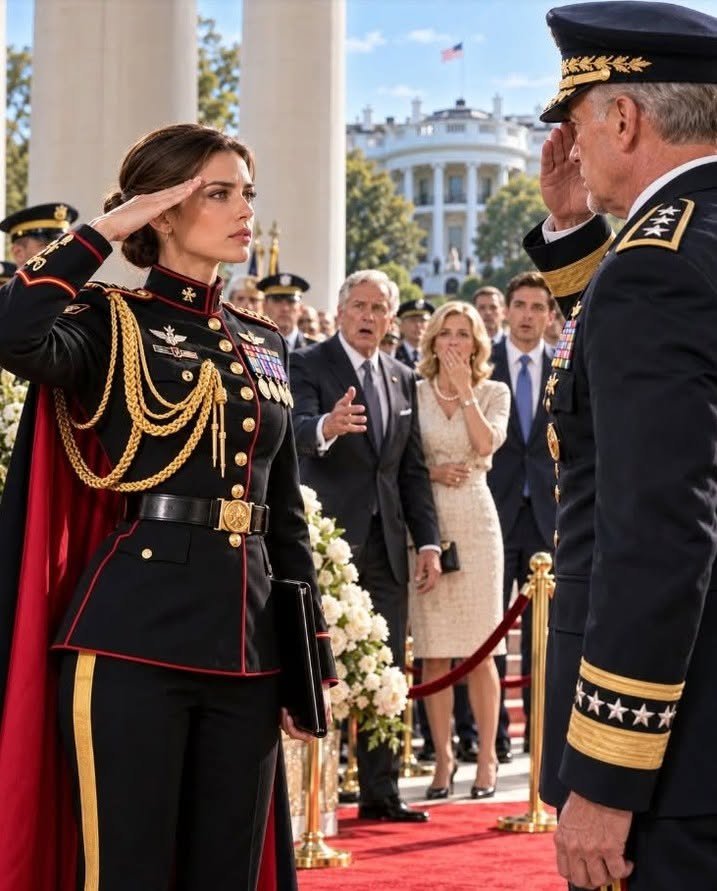
The File That Carried My Name
General Hale lowered his hand, but the room around us remained frozen in the awkward silence that follows a truth no one expected to witness.
“Colonel,” he said, his voice gentler now, “the Secretary has been waiting for you in the Roosevelt Room.”
“I’m ready.”
His gaze shifted briefly toward my father.
Victor had recovered enough to stand straight again. Lorraine was beside him, her lips pressed into a thin line, while Blake stared between us as if someone had quietly changed the rules of a game he had assumed he understood.
General Hale turned back to me.
“Walk with me.”
I followed him through the reception corridor.
Only after the doors closed behind us did he speak again.
“You all right?”
“Yes.”
“That was not the question.”
I almost smiled. “Then yes. I’m steady.”
He nodded, accepting the answer because he knew the difference between composure and peace.
We continued toward the secure conference wing, our footsteps muted by the carpet.
“What is this meeting about?” I asked.
“You’ll be briefed inside.”
“That usually means it’s complicated.”
“It is.”
“Dangerous?”
“Not in the way you mean.”
I glanced at him.
General Hale had a habit of choosing words carefully. During the six years I had worked with him, I had learned that when he said something was not dangerous, it usually meant the danger was political, professional, or personal.
Sometimes all three.
“Does my father know I’m here?” I asked.
“He knows now.”
“Was my attendance connected to him?”
“No.”
The answer came quickly enough to reassure me.
Then he added, “But his company is involved.”
I stopped walking.
Hale took another step before realizing I wasn’t beside him. He turned.
“Involved how?”
“Caldwell Defense Systems is one of three firms being considered for a classified communications modernization contract.”
“I know.”
“You knew?”
“I read the procurement summary last night.”
“And you didn’t tell me?”
“I didn’t know you would be here until this morning.”
That was true. General Hale had never been careless with information, especially information that might place me in an awkward position.
Still, my pulse had begun to change.
“What does this have to do with me?”
“You’ll hear it from the Secretary.”
The secure doors opened after Hale presented his credentials. Inside, the atmosphere shifted. The brightness of the public reception areas gave way to muted lighting, soundproof walls, and the quiet efficiency of people who had learned not to waste words.
A deputy secretary stood near the conference table with two civilian attorneys and a woman I recognized as the department’s inspector general.
The Secretary of Defense sat at the far end.
She rose when I entered.
“Colonel Caldwell.”
“Madam Secretary.”
“Thank you for coming.”
The formality was familiar. The attention was not.
I took the empty chair indicated for me.
General Hale sat along the wall, not at the table. That told me this meeting belonged to my chain of responsibility, not his.
The Secretary folded her hands.
“You were brought here because of your work with the Strategic Communications Evaluation Group. Last month, your team identified inconsistencies in the performance data submitted by two vendors competing for the Sentinel Relay program.”
“I remember.”
“Your report questioned whether the discrepancies were technical errors or deliberate alterations.”
“Yes, ma’am.”
“You recommended an independent validation process before any contract was awarded.”
“I did.”
The inspector general slid a folder toward me.
“Since then, our office has discovered that the same inconsistencies appear in supporting documents provided by Caldwell Defense Systems.”
I looked down at the folder but didn’t open it.
The name sat on the cover in black letters.
Caldwell Defense Systems.
For a moment, I was no longer in the White House. I was eight years old, sitting at a school desk while the teacher handed out permission slips. Every child had been asked to write the name of a parent or guardian at the top.
I had left mine blank.
Not because I didn’t know my father’s name.
Because I had learned not to write it where someone might ask questions.
“Am I being asked to investigate my father’s company?” I asked.
“No,” the Secretary said. “You are being asked to advise whether the technical evidence requires further review. The investigation itself will be handled by the inspector general and the contracting authority.”
“That distinction may not matter once people learn who I am.”
“It matters to us,” General Hale said.
I looked at him.
He leaned forward slightly.
“You didn’t receive this assignment because you are Victor Caldwell’s daughter,” he said. “You received it because you identified a problem before anyone else did.”
The words should have steadied me.
Instead, they brought a different kind of unease.
“What happens if I recuse myself?”
“Your recommendation will be reassigned,” the Secretary said. “No one will fault you for that.”
“And if I stay?”
“You will disclose the relationship in writing. Every communication will be documented. You will not participate in any final decision involving the contract.”
I opened the folder.
The first pages contained graphs and performance summaries. The numbers were familiar. I had seen them during my earlier review, though the discrepancies now appeared more pronounced. The transmission reliability rates did not match the raw test logs. Someone had rounded one set of figures upward, but not consistently.
That mattered.
In technical reporting, inconsistency could reveal anything from carelessness to an attempt to hide underperformance.
I turned another page.
“Who certified these results?”
The deputy secretary pointed to a signature block.
“Dr. Elaine Mercer, Caldwell Defense Systems’ chief systems engineer.”
I knew the name. Dr. Mercer had testified before a congressional committee the previous year. She had a reputation for precision and an almost stubborn commitment to documented evidence.
“She wouldn’t sign altered data,” I said.
The inspector general met my eyes.
“That is one of the reasons this is complicated.”
A sealed evidence sleeve rested beneath the folder.
I looked at it.
“What is that?”
“An internal memorandum recovered from a secure file server at Caldwell Defense Systems.”
The room seemed to narrow.
“Why is it being shown to me?”
“Because the memorandum references your original evaluation,” the inspector general said. “And because it contains a notation that may explain how the discrepancy occurred.”
I waited.
She opened the sleeve and removed a single page.
The document was only half a page long. Most of it was technical language, but one handwritten line appeared in the margin.
Do not alter the results. If the review proceeds, provide the original data directly to Colonel Caldwell.
I read the sentence twice.
My name was typed below it.
Colonel Maya Caldwell.
Not my father’s handwriting. I would not have recognized it even if it had been. Victor had never written me enough to leave a memory of his penmanship.
“Who wrote this?” I asked.
“We don’t know,” the inspector general said. “The note was scanned into the system without a user ID. The metadata was stripped.”
“Why would someone inside the company instruct people to send the data to me?”
“That is what we’re trying to determine.”
I examined the page again.
The handwriting was small and deliberate. The letters leaned slightly to the right. There was no signature.
“Could it have been planted?”
“It could have been.”
“Could someone have used my name because they knew about the family connection?”
“That is also possible.”
The Secretary watched me carefully, but there was no pressure in her expression.
I appreciated that.
She wasn’t asking me to perform loyalty. She was asking me to choose a professional boundary.
“I’ll remain involved in the technical review,” I said. “But I want the relationship disclosed before I see anything else.”
“It already has been,” the inspector general said.
I looked at her.