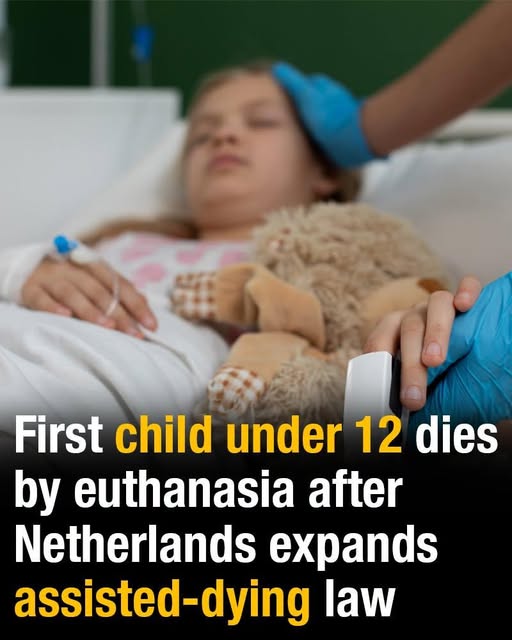
A child is dead, and a country is at war with its conscience.
In the Netherlands, a terminally ill child under the age of 12 was legally helped to die for the first time under newly established regulations, igniting one of the most emotionally charged ethical debates in recent memory. For some, the decision represents the ultimate act of compassion, a final effort to spare a child from relentless suffering when medicine can no longer offer hope. For others, it represents a deeply troubling moral boundary, one they believe society should never cross regardless of the circumstances. The law speaks of dignity, unbearable suffering, and carefully regulated medical decisions. Critics hear something very different, fearing that even the most compassionate intentions can lead to consequences that are impossible to reverse.
The case has forced families, physicians, lawmakers, ethicists, and ordinary citizens to confront questions that have no simple answers. How should society respond when modern medicine can no longer heal, relieve pain, or offer even the smallest possibility of recovery? Is compassion measured by preserving life at all costs, or by ending unbearable suffering when every available treatment has failed? These questions have divided opinions not only within the Netherlands but around the world, touching deeply held beliefs about life, medicine, faith, and personal autonomy.
At the center of the discussion is not politics or ideology, but a child whose identity has remained private out of respect for the family’s wishes. Their short life has become the focus of an international conversation that reaches far beyond one individual case. While the details remain confidential, the circumstances have brought renewed attention to the difficult decisions faced by families caring for children with terminal illnesses and severe, untreatable pain.
Under the Dutch framework, euthanasia for children between the ages of 1 and 12 is permitted only under extremely limited circumstances. Physicians must conclude that the child’s suffering is unbearable, that there is no realistic prospect of recovery, and that no reasonable medical alternative exists to relieve that suffering. The process is designed to apply only to exceptionally rare situations in which every available treatment has been exhausted and the child’s condition cannot be improved.
The decision itself is not made by a single individual. Doctors, parents, and—when the child’s age and medical condition make it possible—the child participate in discussions surrounding the decision. Medical professionals are expected to carefully explain the diagnosis, prognosis, and available options before any course of action is considered. The intention is to ensure that the process remains thoughtful, deliberate, and centered on the child’s welfare rather than influenced by external pressures.
Multiple safeguards exist before and after the procedure. Medical documentation must support the diagnosis and demonstrate that no humane alternative remains. Independent review mechanisms evaluate whether legal and medical requirements have been satisfied. Specialized review committees, which may include physicians, legal experts, and ethicists, examine each case after the fact to determine whether every safeguard was properly followed. Prosecutorial oversight also remains part of the system, reinforcing accountability throughout the process.
Supporters argue that these protections make the law one of the most carefully regulated medical decisions imaginable. They believe the policy exists not to shorten life unnecessarily but to address the extraordinarily rare situations in which continued treatment cannot offer recovery and only prolongs profound suffering. In their view, allowing families and physicians to respond compassionately under strict legal oversight reflects respect for both medicine and human dignity.
Opponents, however, remain deeply concerned. They argue that intentionally ending a child’s life, even under carefully regulated circumstances, crosses an ethical line that society should never accept. Many worry about the long-term implications of expanding eligibility, questioning whether standards that begin narrowly defined could evolve over time. Others believe advances in pain management, palliative care, and hospice medicine should remain the sole focus, regardless of how difficult the circumstances become.
The debate extends beyond legal language into questions of culture, morality, and personal belief. Religious leaders, medical organizations, disability advocates, bioethicists, and legal scholars often approach the issue from different perspectives, each emphasizing values they believe deserve protection. For some, preserving life remains the highest moral obligation. For others, preventing prolonged and irreversible suffering carries equal ethical importance. Neither perspective dismisses the seriousness of the decision, but each reaches different conclusions about what compassion ultimately requires.
For healthcare professionals, these situations represent some of the most emotionally demanding responsibilities they may ever encounter. Physicians devote their careers to preserving life and relieving suffering, yet terminal illnesses can sometimes place those goals in painful tension. Families, meanwhile, face unimaginable choices while caring for children they desperately wish they could save. No legal framework can eliminate the emotional weight carried by those involved.
As news of the case spread internationally, many people found themselves reflecting not only on the law itself but on the broader challenges posed by modern medicine. Scientific advances have dramatically improved survival for many illnesses, yet there remain conditions for which medicine can offer comfort but not cure. Cases like this force societies to ask how compassion, dignity, and medical responsibility should be balanced when no outcome can truly be called good.
Ultimately, the discussion is unlikely to produce universal agreement. The issues involved touch the deepest convictions people hold about life, suffering, autonomy, and the role of medicine. While opinions remain sharply divided, nearly everyone agrees on one point: these decisions involve extraordinary circumstances and profound human tragedy rather than simple political debate.
Between those opposing visions stands a child whose identity remains known only to loved ones. Their brief life has become part of a conversation that will continue far beyond this single case, challenging societies to consider difficult questions with humility, empathy, and care. Whether viewed as an act of mercy or a moral boundary that should never be crossed, the case reminds the world that some of the hardest decisions medicine confronts are also the ones that offer no easy answers.