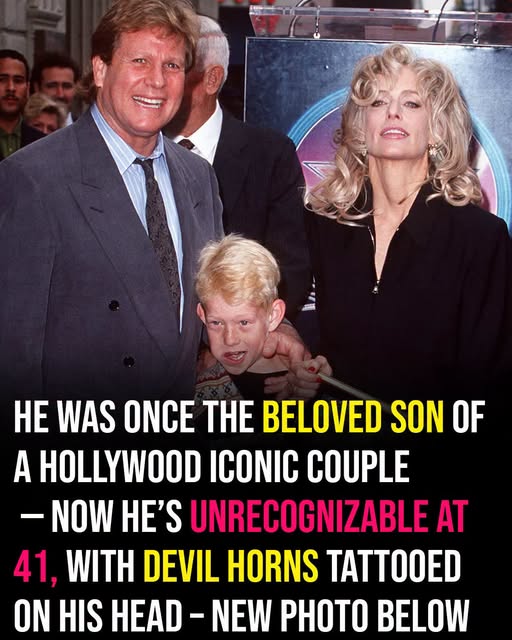
Farrah Fawcett died with one name on her lips: “Redmond.”
Her only child—the son she loved fiercely, worried about constantly, and spent years trying to protect—had become trapped in a life marked by addiction, legal troubles, and heartbreaking instability. Years later, when he appeared in court looking almost unrecognizable from the young boy his mother had once tried so desperately to shield, the images stunned the public. Some people saw a troubled man responsible for his own choices. Others saw the painful consequences of growing up inside a deeply damaged Hollywood family.
Farrah Fawcett’s life had looked almost perfect from the outside. She was one of the most recognizable faces of her generation, a television icon whose beauty and fame made her a global celebrity. Her image became inseparable from an era of Hollywood glamour, but behind the photographs and red carpets was a woman whose private life became increasingly complicated.
For Farrah, much of that emotional world eventually revolved around her son, Redmond O’Neal.
He was born into extraordinary privilege, surrounded by famous parents and the attention that came with them. His father was actor Ryan O’Neal, and his mother was already one of Hollywood’s biggest stars. But fame and wealth could not protect a family from addiction, conflict, and the consequences of destructive choices.
Redmond grew up in an environment where his parents’ relationship was increasingly strained. Ryan O’Neal struggled with his own demons, and the family experienced years of instability. Farrah repeatedly found herself caught between her love for her son and her fear about where his life was heading.
As Redmond grew older, his problems became increasingly public.
There were struggles with substance abuse, arrests, rehabilitation attempts, and periods of psychiatric treatment. Each new crisis brought another wave of attention, while Farrah continued trying to help her son away from the cameras.
For a mother, watching a child struggle with addiction can be devastating. Love does not automatically provide the ability to fix the problem. Farrah could offer support, resources, and protection, but she could not make every decision for her son.
That helplessness became one of the most painful parts of her final years.
In 2006, Farrah was diagnosed with anal cancer. She publicly documented her battle with the disease, allowing audiences to see a side of her life that was very different from the glamorous image that had made her famous.
As her health deteriorated, her focus remained deeply connected to the people she loved.
Farrah died on June 25, 2009, at the age of 62. Her death ended the life of one of Hollywood’s most recognizable stars, but the story surrounding her family did not end there.
Redmond continued struggling.
His legal troubles became increasingly serious, and his appearances in court generated renewed public attention. Photographs of him with distinctive tattoos on his face and a visibly troubled appearance shocked people who remembered him as Farrah’s son.
But photographs rarely tell the entire story.
Behind the headlines was a complicated history of addiction, mental-health struggles, family conflict, and years of attempts to find stability.
In court, Redmond became a symbol onto which people projected their own judgments. Some saw the consequences of repeated criminal behavior. Others saw someone whose life had been shaped by circumstances that began long before he was old enough to understand them.
Neither perspective could fully explain the person standing before the judge.
The public fascination was partly driven by the contrast between his parents’ Hollywood status and his own difficult trajectory. Farrah had been celebrated as an icon of beauty and success, while her only child was appearing in court under circumstances that seemed almost impossible to reconcile with the glamorous world into which he had been born.
But wealth and fame do not make a person immune to addiction.
They do not guarantee emotional stability.
And they cannot erase trauma.
Farrah’s attempts to protect her son became one of the most complicated parts of her legacy. She loved him deeply, but loving someone who is struggling does not mean being able to rescue them from every consequence.
Sometimes love means continuing to care even when the situation becomes painful.
Sometimes it means setting boundaries.
And sometimes it means accepting that another person’s choices cannot be controlled.
That reality appears to have haunted Farrah’s final years.
Her son was not simply another troubled celebrity. He was her child.
Every arrest, every relapse, and every public crisis carried a personal weight that strangers could never completely understand.
When Farrah died, she left behind a legacy that was far larger than her family troubles. She remained a television icon, an actress, an artist, and a woman who had publicly documented one of the hardest battles of her life.
But for people who knew how deeply she cared about Redmond, her relationship with her son became another part of the story.
Her final years demonstrated the painful contradiction of parental love: you can spend your entire life trying to protect someone and still be unable to prevent them from making destructive choices.
Redmond’s later life also illustrates how difficult recovery can be. Addiction is rarely a simple story of one bad decision. It can involve repeated attempts to get help, periods of improvement, setbacks, and consequences that accumulate over time.
That does not erase responsibility for harmful actions.
But it can provide context for understanding how someone arrives at a place that once seemed unimaginable.
When people saw Redmond in court, some recoiled at his appearance and behavior. Others felt sadness. Some remembered his mother and wondered what she might have thought if she could have seen him.
Those reactions revealed something important about the way society views celebrity families.
We often assume that children born to famous parents inherit the advantages without seeing the pressures that come with them.
Growing up under constant public attention can create its own complications. Every mistake can become a headline. Every family conflict can become entertainment. And when addiction or mental-health struggles enter the picture, privacy can become nearly impossible.
Redmond’s story unfolded under that microscope.
Farrah’s story did too.
The difference was that Farrah spent much of her life controlling the image the world saw, while her son’s struggles increasingly became visible in ways neither of them could control.
That contrast made their story especially heartbreaking.
The mother was remembered as an icon.
The son became known primarily through his struggles.
Yet behind both images were human beings dealing with fear, love, mistakes, illness, and loss.
Farrah could not save Redmond from every consequence.
But her love for him was never simply about whether he succeeded or failed.
He was her son.
And that bond existed independently of fame, money, headlines, or courtroom appearances.
Her death did not erase that connection.
If anything, it made the tragedy of his later struggles feel even more poignant to those who remembered how deeply she had cared for him.
Today, Farrah Fawcett is remembered for much more than the family tragedy that followed her final years. Her career, her influence on popular culture, and her decision to publicly document her cancer battle all became important parts of her legacy.
But her story also contains a quieter lesson.
Sometimes the people we love most are the people we are least able to save.
Parents can guide their children, support them, encourage treatment, and stand beside them through terrible moments. But ultimately, every adult has to make choices for themselves.
That truth can be devastating for a parent.
Farrah’s life ended before Redmond’s story was finished.
She never got to see where his life would ultimately lead.
She never got the certainty that every parent hopes for—that the child they love will eventually find peace.
What remains is the image of a mother who spent years worrying about her son while fighting her own battle with cancer.
Her public legacy may be defined by Hollywood.
Her private legacy may be defined by love.
And Redmond’s story remains a reminder that behind the glamorous photographs of celebrity families can exist struggles every bit as painful as those faced by ordinary people.
Farrah Fawcett could not control how her son’s story unfolded.
But she loved him through the uncertainty.
And sometimes, when everything else has disappeared—fame, wealth, photographs, and headlines—the most enduring thing left behind is simply the love a mother had for her child.