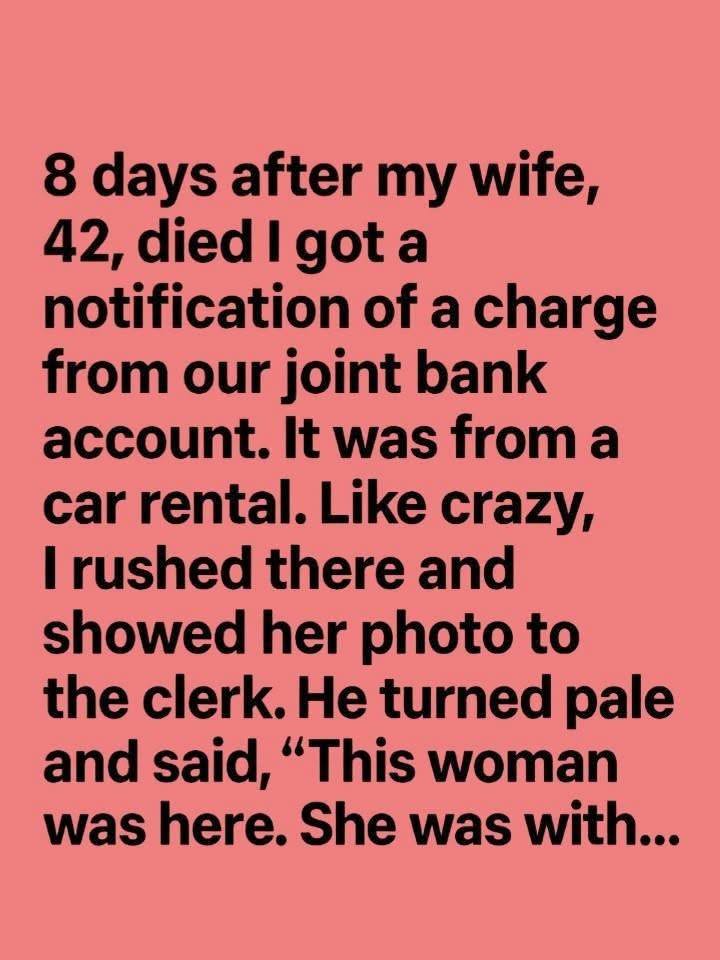
Eight Days After My Wife Died, I Found Her Renting a Car With My Brother — And the Truth Destroyed Everything
Eight days after my wife died, I was still moving through the house like a ghost, existing in a world that no longer felt familiar. Every morning, I woke up for a few seconds believing that everything was normal. Then reality returned, heavy and merciless, reminding me that the woman I had shared my life with was gone.
The house had become unbearably quiet.
I kept expecting to hear her humming in the kitchen while she prepared breakfast, or the familiar sound of her slippers dragging softly across the hallway floor. Sometimes, I caught myself turning toward the bedroom because I thought I heard her moving around. Other times, I would reach for my phone to tell her something insignificant about my day before remembering that there was no one on the other end who could answer.
Her coffee mug was still sitting in the cabinet where she had always kept it. Her favorite sweater remained draped over the back of a chair, and a half-finished book lay beside the bed with a small paper bookmark tucked between its pages.
I couldn’t bring myself to move any of it.
People kept telling me that grief took time, that I needed to eat, sleep, and allow myself to heal. They said I should surround myself with family and avoid spending too much time alone. I understood that they were trying to help, but none of their advice seemed capable of reaching the place where my pain lived.
I wasn’t simply missing my wife.
I was trying to understand how a future I had believed in so completely could disappear in a matter of days.
Eight days earlier, I had identified her body. I had stood at her funeral and listened as people spoke about her kindness, her laughter, and the life we had built together. I had watched the coffin being lowered, accepting a reality I never imagined I would have to face.
Now I was sitting at the dining table, staring at a cold cup of coffee, wondering how I was supposed to continue living in a house that still felt as though it belonged to both of us.
That was when my phone buzzed.
A simple notification appeared on the screen.
At first, I barely paid attention. I assumed it was another routine message from the bank, perhaps a reminder about an upcoming payment or a transaction I had forgotten about.
Then I read the details.
A charge from our joint account.
Car rental.
I stared at the screen, reading the words again and again, hoping I had misunderstood something. The amount was unfamiliar, and the transaction had been processed that morning.
My first thought was that it had to be a mistake.
Perhaps it was a delayed charge from before her death. Maybe the rental company had processed an old reservation late. My mind immediately began searching for an ordinary explanation because the alternative was too disturbing to consider.
My wife was dead.
I had identified her body. I had attended her funeral. I had watched people who loved her cry beside me while we said goodbye.
How could a car rental company possibly be charging our account for something she had done that morning?
I opened the banking application and checked the transaction details. The charge was real. The date was current, and there was nothing in the description suggesting that it had been processed late.
A cold sensation spread through my chest.
My hands began to shake as I searched for the rental company’s phone number. I nearly dropped the phone while dialing, and when someone finally answered, I struggled to explain what I needed.
I asked whether they could confirm the transaction.
The employee requested a few details, placed me on hold, and returned after what felt like an eternity.
Then he confirmed it.
The car had been picked up that morning.
For several seconds, I couldn’t speak.
I asked him to repeat what he had said, hoping that I had somehow heard him incorrectly. He repeated the information, explaining that the vehicle had been collected and the rental agreement was active.
I gripped the edge of the table until my fingers hurt.
Something was wrong. I didn’t know what it was, but I could no longer convince myself that the charge was an innocent mistake.
I asked for the rental location and ended the call.
Then I stood up, grabbed my keys, and walked out of the house.
I didn’t know where I was going emotionally, but I knew I had to see someone who could explain what was happening.
I needed an answer, even if I was terrified of hearing it.
The Employee Recognized Her Immediately
The drive to the rental office felt unreal.
I gripped the steering wheel so tightly that my knuckles began to ache. Traffic lights changed, cars passed, and people crossed streets as though the world were perfectly normal. I watched them through a kind of fog, unable to understand how everyone else could continue with their lives while mine seemed to be coming apart again.
Every possible explanation competed inside my head.
Could someone have stolen her identity? Could the bank have made a mistake? Had the rental company confused her with another customer?
I desperately wanted one of those explanations to be true.
When I finally arrived, I parked outside the building and sat in the car for several minutes. I could see people moving behind the glass doors, talking, laughing, and carrying on with ordinary business.
I wondered whether I was about to make a fool of myself by walking inside and accusing a company of something impossible.
Then I remembered the funeral.
I remembered the grief on the faces of our friends. I remembered standing beside her coffin, trying to accept that I would never see her smile again.
I could not simply ignore the transaction and return home.
I got out of the car and walked to the counter.
The employee greeted me politely. I explained that a rental had been charged to my joint bank account and that I needed to verify who had collected the vehicle.
He asked for the transaction details.
I showed him the notification on my phone.
Then I opened my photo gallery and found the picture of my wife that I loved most.
In it, sunlight fell across her hair. She was half-smiling at the camera, wearing the expression she often had when she knew something I didn’t. It was a small, ordinary photograph, taken during a happy moment when neither of us had any reason to imagine that our lives would eventually become unrecognizable.
I turned the screen toward the employee.
“Have you seen this woman?” I asked.
He looked at the photograph.
At first, his expression was neutral. Then his eyes moved closer to the screen. He looked at the picture again, and the color gradually drained from his face.
I noticed the change immediately.
My stomach tightened.
He looked from the photograph to me, then back at the photograph, as though he were trying to determine whether he should say what he was thinking.
Finally, he lowered his voice.
“This woman was here,” he said.
For a moment, I thought the room had tilted.
“What?”
“She was here,” he repeated.
I shook my head.
“No. That’s not possible. My wife died eight days ago.”
The employee swallowed. His expression had changed completely, and whatever uncertainty he had felt earlier seemed to have disappeared.
He glanced toward the office behind the counter before speaking again.
“She rented the car this morning.”
I felt my heart pounding against my ribs.
The words made no sense, yet the employee appeared absolutely serious.
I leaned closer to the counter.
“Are you telling me that someone who looks like my wife rented a car today?”
He hesitated.
Then he gave me the answer that changed everything.
“It wasn’t just her,” he said quietly. “She wasn’t alone.”
My mouth went dry.
“Who was she with?”
The employee turned toward his computer, checked the rental agreement, and moved the screen slightly so I could see it.
There was another name on the document.
A secondary driver.
I leaned forward, expecting to see the name of a friend, a colleague, or perhaps someone I had never heard of.
Instead, I saw a name I had known my entire life.
My brother.
For several seconds, I couldn’t move.
I read the name once, then again, hoping that my eyes were playing tricks on me. But the letters remained exactly where they were.
My brother had helped rent the car.
My brother, who had stood beside me at the funeral.
My brother, who had hugged me while I cried.
My brother, who had looked me in the eyes and told me that I would somehow survive the worst days of my life.
I suddenly remembered how carefully he had avoided certain conversations during the previous week. At the time, I had assumed he was simply uncomfortable with grief. Now every small detail seemed to acquire a new and frightening meaning.
I stepped back from the counter.
“Give me the address associated with the rental,” I said.
The employee immediately became cautious. He explained that there were privacy rules and that he could not casually hand over another customer’s personal information.
I understood his concern, but I was no longer capable of pretending this was an ordinary misunderstanding.
I explained that the woman in the photograph was my wife, that I had identified her body eight days earlier, and that I had reason to believe the rental agreement contained information connected to a serious situation.
The employee looked at me for a long moment.
Perhaps he saw the desperation in my expression. Perhaps he understood that I was not asking out of idle curiosity.
After another hesitation, he provided information that helped me identify the location.
The address was approximately two hours away.
I thanked him, though I barely remember saying the words, and walked back to my car.
I had arrived at the rental office hoping to discover a clerical error.
Instead, I had found evidence that my brother was connected to a rental involving a woman who looked exactly like the wife I had buried.
I started the engine.
And I drove.
The Two-Hour Journey Toward the Truth
I don’t remember most of that drive.
I remember the highway stretching ahead of me. I remember my hands tightening around the steering wheel whenever I thought about the name on the rental agreement. I remember passing familiar exits and realizing that I had no idea how long I had been driving.
My thoughts kept returning to the same impossible question.
What if it really was her?
I tried to imagine the practical explanations first. Perhaps my brother had rented the vehicle for someone else. Perhaps the woman at the office was a stranger who happened to resemble my wife. Perhaps the employee had misunderstood the documents.
But each explanation became harder to believe as I remembered his reaction.
He had recognized her.
He had seen her face and immediately understood that something was wrong.
And my brother’s name had appeared on the rental agreement.
I began to remember conversations from the days before her supposed death. Small moments I had barely noticed at the time now seemed suspicious. There had been phone calls she had taken in another room. There had been pauses in conversations when I entered unexpectedly. There had been occasions when my brother and my wife exchanged looks that I interpreted as ordinary familiarity.
Grief has a cruel way of making a person revisit the past, searching for clues that might explain an unbearable present.
I couldn’t tell whether I was remembering genuine warning signs or simply trying to construct a story around a discovery I did not understand.
I knew only that I needed to see the house.
As the miles passed, the fear in my chest changed into something harder to describe. I was frightened of finding nothing, because that would mean I had misunderstood the evidence. But I was equally frightened of finding exactly what I suspected.
If the woman was not my wife, I would have to explain why I had driven two hours based on a rental agreement.
If she was my wife, then the funeral, the grief, and the last eight days of my life would take on a meaning I could barely comprehend.
I thought about calling my brother.
I even picked up my phone once, but I couldn’t bring myself to press his name. What would I say? How could I ask him whether he knew anything about a woman I had buried when I was beginning to suspect that he had helped her disappear?
I put the phone down.
I needed to see the truth with my own eyes.
Eventually, I turned onto a quieter road. The houses became more spread out, and the traffic thinned until I was driving through a neighborhood I had never visited before.
I slowed as I approached the address.
Then I saw the car.
It was parked in the driveway.
The same model.
The same license plate.
For a moment, I simply stared through the windshield.
There was no longer any room for the idea that the rental transaction had been a random mistake. The vehicle was sitting directly in front of the house connected to the information I had received.
I parked nearby and switched off the engine.
My hands were trembling again.
I could hear my own breathing as I looked toward the front door. It was closed, but not locked. Somewhere inside, a sound drifted through the walls.
Laughter.
I froze.
I knew that laugh.
I had heard it at dinner tables, during road trips, in the kitchen on lazy mornings, and in the quiet moments when my wife and I shared jokes that no one else understood.
For eight days, I had believed I would never hear it again.
Now it was coming from inside a house two hours from my home.
I stepped out of the car.
My legs felt strangely weak, as though some part of my body already understood what my mind was still struggling to accept.
I walked up the driveway, approached the front door, and pushed it open.
It moved without resistance.
Inside, the laughter became clearer.
I stepped into the hallway.
And followed the sound.
The Woman Standing Beside My Brother
When I reached the living room, the world seemed to stop.
There she was.
My wife.
Alive.
She was standing beside my brother, close enough that their shoulders nearly touched. One of her hands rested protectively over her stomach, while the other held a glass she appeared to have forgotten about.
For a moment, none of us moved.
I couldn’t process what I was seeing. My eyes recognized her immediately, but the rest of my mind seemed incapable of accepting the information.
I knew the shape of her face. I knew the way she stood when she was uncomfortable. I knew the tiny movement she made with her mouth when she was trying to find the right words.
It was her.
The woman I had identified at the morgue.
The woman whose funeral I had attended.
The woman whose absence had filled every room of my house.
She was standing in front of me, breathing, looking at me with the same eyes I had spent the last eight days remembering.
My brother turned first.
His expression changed so quickly that I knew he understood the situation before he said a word.
Then my wife turned toward the doorway.
When she saw me, the color disappeared from her face.
Her hand remained pressed against her stomach, and her lips parted slightly. For several seconds, she looked as though she might faint.
I stared at her.
Neither of us spoke.
I wanted to run toward her. I wanted to hold her, touch her face, and make sure that what I was seeing was real. I wanted to hear her explain that there had been a terrible mistake and that everything could somehow return to normal.
At the same time, I wanted to step away from her as quickly as possible.
The two feelings collided inside me until I could barely breathe.
Finally, she whispered my name.
I couldn’t answer.
She took a small step forward.
“I was going to tell you,” she said. Her voice trembled. “I swear I was.”
I stared at her, trying to reconcile those words with the past eight days.
“You were going to tell me what?”
Her eyes filled with tears.
I felt something inside me give way.
“I buried you.”
The words came out quietly, but they seemed to fill the entire room.
“I stood at your funeral. I watched them lower your coffin. I went home and tried to figure out how I was supposed to keep living without you.”
She began to cry.
“Please,” she whispered.
“No.” I shook my head. “Don’t tell me to calm down. Don’t ask me to understand something you haven’t even explained.”
My brother moved slightly between us, and I turned toward him.
He looked uncomfortable, but he did not look surprised that I had arrived.
That frightened me more than anything else.
He had known I might discover the truth eventually. Perhaps he had spent the last eight days hoping I never would.
I looked back at my wife.
“Tell me what happened.”
She pressed both hands against her stomach.
Then she began to speak.
“That Wasn’t Me”
“I was scared,” she said.
Her voice was barely audible.
I stood perfectly still, afraid that if I interrupted her, I would never hear the explanation I had come so far to find.
She wiped her face with the back of her hand and looked at my brother before turning toward me again.
“That wasn’t me,” she said. “The person you identified wasn’t me. It was staged.”
For a moment, the words passed through my mind without making sense.
Staged.
I repeated the word silently, trying to understand what it meant in the context of the funeral I had attended.
“What do you mean, staged?”
She shook her head, crying harder.
“I was scared. I didn’t know what else to do. He told me it was the only way.”
I looked at my brother.
He finally spoke.
“She was pregnant.”
I turned toward him slowly.
“What?”
“She was pregnant,” he repeated. “She didn’t want you to know. She didn’t know how you would react.”
I felt a strange, hollow laugh rise from somewhere inside me.
My wife was alive.
She was pregnant.
My brother had helped her disappear.
And both of them had allowed me to believe that she was dead.
I looked at the woman I had loved and tried to understand how she could stand in front of me without seeming to comprehend the scale of what she had done.
“How long?” I asked.
She looked down.
“How long have you known?”
She hesitated before answering.
That hesitation hurt almost as much as the revelation itself.
“I found out before everything happened,” she said.
“Before what happened? Before you supposedly died?”
She nodded.
I closed my eyes for a moment.
The room seemed to shrink around me.
“Did you ever intend to come back?”
She began to speak, stopped, and tried again.
“I thought I would. I didn’t know how to explain it. Everything was happening so quickly, and I was frightened.”
“Frightened of me?”
She didn’t answer immediately.
My brother stepped in.
“She didn’t know how you would react. She needed time to think. We thought this was the safest way to handle it.”
I turned toward him.
“The safest way?”
He looked away.
I could no longer tell whether I was angrier at my wife for deceiving me or at my brother for helping her do it. Both had known exactly what I believed. Both had watched me mourn. And neither had stopped the lie from continuing.
Whatever fears or disagreements had existed before her disappearance, staging a death had transformed them into something far more destructive.
I had not been given the opportunity to ask questions, seek help, or make my own decisions.
I had been forced to accept the most devastating news imaginable, while the people responsible for that deception continued living somewhere else.
My wife took another step toward me.
“I’m alive,” she said through her tears. “That’s what matters.”
I looked at her for a long time.
I wanted those words to mean something comforting. I wanted to feel relief strong enough to overcome everything else.
But being alive did not erase what had happened.
It did not return the eight days I had spent grieving.
It did not undo the funeral, the shock, the sleepless nights, or the moments when I had struggled to imagine a future without her.
And it did not explain why my own brother had helped make me believe that my wife was gone forever.
The Brother Who Had Helped Me Mourn
I turned toward my brother.
For most of my life, I had believed that family meant having someone who would stand beside you when everything else fell apart. My brother had been that person through countless ordinary moments and difficult periods. We had shared childhood memories, family celebrations, private jokes, and years of experiences that no one else could fully understand.
When my wife supposedly died, he had been one of the people I relied on most.
He had listened when I struggled to speak. He had stayed with me when the silence at home became unbearable. He had told me that I needed to eat and sleep, and he had assured me that the pain would eventually become easier to carry.
I had believed him because he was my brother.
Now those memories had become almost impossible to look at.
Had he been comforting me while knowing she was alive? Had he watched me cry because he genuinely felt sorry for me, or had he simply convinced himself that the deception was necessary?
I wanted to ask a hundred questions, but one emerged above the others.
“Did you know I identified the body?”
His expression tightened.
“Yes.”
The answer struck me with unexpected force.
“You knew?”
He nodded reluctantly.
“And you still let me bury her?”
He opened his mouth, but no immediate answer came.
I waited.
Finally, he said, “I thought it was the only way to protect her.”
“Protect her from what?”
He rubbed his face.
“She was scared. She believed you wouldn’t understand. She was pregnant, and everything had become complicated. She wanted a chance to leave before things got worse.”
I stared at him.
“You could have helped her leave. You could have helped her find somewhere safe. You could have told me she wanted to end the marriage. You could have done a thousand things that didn’t involve convincing me she was dead.”
He said nothing.
“You let me believe I had lost the person I loved most in the world.”
My voice cracked on the final words, and I hated that he could still cause that reaction in me.
He looked at the floor.
For the first time since I had entered the house, he appeared unable to defend himself.
But his silence could not undo what he had done.
I realized then that I might never receive an explanation that made sense of the past eight days. Even if my brother believed he had been helping someone, his decision had inflicted a devastating injury on another person.
He had chosen what he thought was best for my wife without considering that I was also a human being who deserved honesty.
He had decided that my feelings, my grief, and my right to understand what was happening could be sacrificed for a plan I had never been allowed to question.
I looked at him and understood that our relationship would never be the same.
Whatever happened next, I could not simply return to being the brother who trusted him without hesitation.
“I Nearly Lost Myself”
I turned back toward my wife.
She was crying openly now, her shoulders shaking as she tried to speak.
“I never wanted to hurt you like this,” she said.
I wanted to believe that she had not understood the full consequences of her decision. I wanted to believe that fear had clouded her judgment and that she had convinced herself the deception would be temporary.
But intentions were not the same as consequences.
“You didn’t want to hurt me?” I asked.
She shook her head.
“I loved you.”
I looked around the living room, at the furniture, the windows, and the ordinary objects that seemed completely disconnected from the emotional disaster unfolding before me.
Then I looked at her again.
“I mourned you.”
My voice was quieter now.
“I woke up every morning expecting to hear your voice. I sat at our table and couldn’t make myself drink a cup of coffee because I kept thinking about how you used to make yours. I looked at your things and wondered whether I should put them away or leave them exactly where they were.”
She covered her mouth with one hand.
“I couldn’t sleep. I couldn’t think straight. There were moments when I didn’t know how I was supposed to get through another day.”
I swallowed hard.
“I nearly lost myself trying to accept that you were gone.”
The room fell silent.
I had not planned to tell her those things. I had arrived wanting answers, and I had imagined that anger would carry me through the confrontation.
But standing in front of her, I realized that the deepest wound was not simply the lie.
It was the suffering I had experienced while believing there was no possibility of another explanation.
I had made decisions about my life based on a false reality. I had accepted condolences, endured the funeral, and tried to understand a future that I believed had been permanently changed.
Meanwhile, the two people standing in front of me had known that the story was not true.
My wife began to approach me again.
“I am here now,” she whispered. “We can talk about everything. We can figure it out.”
I stepped back.
For the first time, I saw her understand that being alive did not automatically mean she could return to the life we had shared.
She could explain herself. She could tell me what she had feared and why she had made the choices she made. She could ask for forgiveness.
But she could not decide for me that everything should return to normal.
The person I had loved had made a choice that shattered my trust. I needed time to understand what that meant, and I had no obligation to provide an immediate answer simply because she was standing in front of me.
The Call That Changed the Room
For several seconds, nobody spoke.
My brother stood beside the sofa, watching me carefully. My wife remained a few steps away, crying and holding her stomach.
I looked at them both.
I had driven two hours hoping to find an explanation that would make the impossible make sense. Instead, I had discovered a deception involving the two people I had trusted most.
I took out my phone.
My wife noticed what I was doing.
“What are you doing?” she asked.
I didn’t answer.
I opened the dial pad and called emergency services.
My brother moved toward me.
“Don’t do that.”
I raised one hand, signaling that I wasn’t going to stop.
When the operator answered, I forced myself to speak clearly.
“My wife was declared dead,” I said. “I identified her body and attended her funeral eight days ago. I’ve now found her alive at an address where she is staying with my brother. I believe there may have been a staged death, and I need the authorities to establish what happened.”
I gave the operator the information requested and explained where I was.
My wife began crying harder.
My brother’s expression changed from disbelief to anger.
“You can’t do this,” he said.
I looked at him.
For the first time since entering the house, I felt something approaching steadiness.
“You already did.”
He took another step forward, but stopped when I told him I was not going to argue while I was on the phone.
I remained where I was, answering the operator’s questions as carefully as I could. I did not know exactly what the authorities would discover, what records existed, or whether any laws had been broken. Those questions would have to be investigated.
What I knew was that I had discovered a situation involving a supposed death, a rental agreement, and people whose actions required an explanation.
I could not resolve that situation through another private conversation alone.
I needed the facts established, and I needed the deception to stop.
When I ended the call, the room was painfully quiet.
My wife looked at me as though she had only just realized that the consequences of her choices were no longer under her control.
My brother stood rigidly beside the sofa.
Neither of them seemed to know what to say.
For the first time in eight days, I was no longer waiting for someone else to tell me what reality was supposed to look like.
I was asking for the truth to be examined.
Waiting for the Sirens
The minutes that followed seemed strangely slow.
My wife tried to speak several times, but each attempt ended in tears. She wanted me to listen to her explanation, and part of me still wanted to hear every word.
I wanted to understand what had led her to this decision. I wanted to know who had arranged the deception, what had happened before the funeral, and whether anyone else had been involved.
I also wanted to know what I had actually been told about the death and how the identification had been handled.
There were too many unanswered questions to count.
But I understood that this was not the moment to force answers from people who had already concealed so much from me.
I stepped toward a chair and sat down.
My legs were shaking, and I realized that I had been holding myself rigidly for what felt like hours.
My brother paced near the window. Every so often, he glanced toward the driveway as though he were calculating what would happen when the authorities arrived.
My wife remained near the sofa.
She looked exhausted, frightened, and desperate to explain herself. Her hand stayed close to her stomach, and I found myself thinking about the pregnancy she had concealed from me.
If the child was mine, that would introduce another reality I had to consider. But I did not know the full circumstances, and I refused to make assumptions in the middle of a crisis.
There would be time to establish the facts.
For now, I needed to remain calm enough to tell the authorities exactly what I had discovered.
When I finally heard the distant sound of sirens, my brother stopped pacing.
My wife closed her eyes.
I stood up.
The sound grew louder as the vehicles approached the house, and I felt a strange mixture of relief and sadness. I had wanted answers, but I had never imagined that finding them would mean confronting the woman I had buried and the brother who had helped me mourn her.
The sirens reached the driveway.
I looked at my wife one last time before turning toward the door.
There was a time when seeing her face would have made every problem in my life seem smaller.
Now I could barely recognize the relationship we had once shared.
The woman standing in front of me looked exactly like my wife. She had her voice, her expressions, and the familiar movements I had known for years.
But the trust that had made her my closest companion was gone.
And whatever happened after the authorities arrived, I knew that nothing could simply return to the way it had been before.
The Woman I Loved Was Gone in a Different Way
As the first officers approached the house, I found myself thinking about the funeral.
I remembered the people who had gathered to support me. I remembered the flowers, the quiet conversations, and the faces of friends who did not know what to say.
I remembered standing there, trying to make sense of the fact that someone who had been part of every ordinary detail of my life would no longer be there to share any of it.
At the time, I had believed that grief was the price of losing her.
Now I understood that the past eight days had contained another kind of loss.
The woman I had loved had remained alive somewhere in the world, but the relationship I believed we shared had been destroyed by a decision I had never been allowed to understand.
I could not know whether forgiveness would ever be possible. I could not know whether the truth would eventually provide an explanation that made some part of her decision understandable.
And I could not know what the future would hold for my brother, my wife, or the child she was carrying.
Those questions would have to wait.
I had spent eight days accepting a reality that turned out not to be what I had been led to believe. I had been forced to confront grief, and now I had to confront betrayal.
The two experiences were different, but both had changed me.
I looked at the woman standing across the room.
She was alive.
That fact was undeniable.
But the marriage I thought I had lost to death had been damaged by something I had never imagined: a deliberate deception carried out by people I trusted.
The sirens had stopped outside. Footsteps sounded in the hallway, and the officers entered the room.
My brother said nothing.
My wife looked at me through her tears.
I did not look away.
For eight days, I had believed my wife was gone forever. I had mourned her, buried her, and tried to learn how to exist without her.
Now I knew she had been alive all along.
And as the authorities began asking questions, one chilling thought settled into my mind:
The woman I loved had died eight days ago.
She just kept breathing.