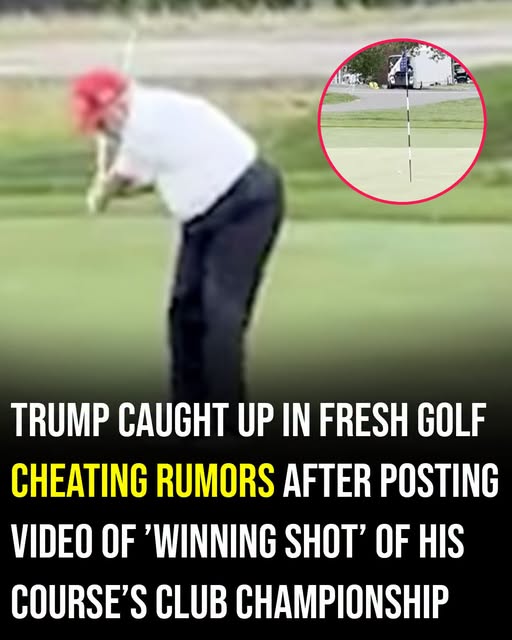
Trump’s boast exploded across social media like a bomb.
One triumphant swing, one carefully framed viral video, and suddenly Donald Trump’s golf legacy was back on trial. Supporters celebrated the shot as another example of a competitive man doing what he loves most: winning. Critics immediately pounced. Old stories resurfaced, familiar accusations returned, and years of arguments about Trump’s relationship with golf came roaring back into public conversation. Beneath all the cheering and mockery sat the same stubborn question that has followed him around golf courses for years: when Trump wins, is it simply skill—or is something else happening behind the scorecard?
What might have remained a relatively ordinary victory at one of his clubs instead became another referendum on Donald Trump’s character.
Trump proudly shared footage from Bedminster highlighting what he described as the “winning shot,” pairing the moment with a characteristically confident declaration: “It’s called TALENT.” To anyone familiar with Trump’s public persona, the message was unmistakable. He wasn’t merely announcing a golf result. He was celebrating another victory and dismissing anyone who questioned whether he’d earned it.
But almost immediately, the post collided with years of controversy.
Trump’s golf ability has never really been the central point of dispute. Even critics have acknowledged that he has spent decades playing the sport and possesses genuine ability. He plays frequently, owns golf properties, has competed in club championships, and has surrounded himself with professional golfers and celebrities who understand the game.
The argument has always been about something more complicated.
It’s about how the game is played when Donald Trump is involved.
Sportswriter Rick Reilly turned that question into an entire book, Commander in Cheat, which collected stories and allegations about Trump’s behavior on golf courses. Reilly portrayed Trump as an intensely competitive golfer whose desire to win allegedly sometimes pushed beyond the traditional honor system that defines the sport.
Golf is unusual because so much of its integrity depends on the player.
There isn’t an official standing beside every ball.
Players are often expected to report their own penalties, count their own strokes honestly, and respect rules even when nobody else is watching. That culture of self-policing is one reason accusations of cheating carry particular weight within golf.
And Trump has faced plenty of them.
Over the years, former playing partners, caddies, sportswriters, celebrities, and others have told stories alleging everything from questionable scorekeeping to suspiciously improved ball positions. Some anecdotes have become almost legendary among Trump’s critics, repeated so often that they now follow him onto virtually every course he plays.
There have been claims about balls supposedly moving from difficult lies to more favorable positions.
Stories about strokes allegedly disappearing from scorecards.
Accounts of competitions in which Trump’s final score seemed, to skeptics, almost too convenient.
Then came viral videos.
Clips recorded during Trump’s golf outings, including footage from Scotland, have repeatedly circulated online accompanied by accusations that something improper was happening. Supporters argue that short clips stripped of context prove very little. Critics watch the same footage and insist it confirms what they already suspected.
And therein lies the problem.
Trump’s golf game has become almost impossible to separate from people’s political opinions about Trump himself.
For supporters, the accusations are simply another version of a familiar pattern. Trump succeeds, critics become furious, and every achievement is immediately treated as suspicious. They see a man in his late seventies still playing competitive rounds, hitting impressive shots, and collecting club victories while opponents search desperately for reasons to diminish them.
To them, the controversy says more about Trump’s critics than it does about his golf.
His detractors see exactly the opposite.
They argue that the stories are too numerous and too consistent to dismiss. To them, every unusually favorable score, every disputed anecdote, and every viral clip becomes another piece of a larger pattern.
The golf course, in their telling, becomes a miniature version of the public Trump.
Win first.
Argue later.
Never concede.
Trump himself has never appeared particularly troubled by the criticism.
If anything, he seems energized by it.
He has denied cheating allegations and repeatedly emphasized his golfing ability. When questioned about victories, he doesn’t retreat into modest explanations about luck or favorable conditions. He doubles down.
He is talented.
He wins.
End of discussion.
That confidence is especially visible in the championships he has claimed at clubs he owns. Those victories have become another source of fascination and skepticism because winning tournaments at your own properties naturally invites questions from people already inclined to doubt the results.
Trump treats the victories as completely legitimate accomplishments.
His critics treat them almost as punchlines.
And neither side appears remotely interested in changing its mind.
That is what made the Bedminster post so perfectly suited to the larger Trump phenomenon.
The image was simple: Trump, golf club in hand, celebrating a successful shot.
But around that image immediately formed two completely different realities.
In one, an experienced golfer had just demonstrated exactly why he continues winning competitions despite his age. The swing was evidence. The result was evidence. The confidence was earned.
In the other, a famously competitive man was once again celebrating a victory surrounded by questions that have followed his golf career for decades.
Same video.
Same shot.
Completely different conclusions.
Even the phrase “it’s called TALENT” seemed designed to intensify the divide.
Trump rarely presents his achievements quietly. His public identity has always been built around winning—bigger crowds, better ratings, stronger businesses, better deals, better polls, better golf scores.
Victory isn’t merely something he enjoys.
It is part of the character he presents to the world.
That makes golf particularly fascinating because the sport places enormous emphasis on personal integrity. A great golfer isn’t simply expected to hit excellent shots. Traditionally, the player is also expected to police himself when nobody else can.
For critics, that makes the cheating allegations especially revealing.
For supporters, it makes them especially insulting.
And so a golf shot becomes something larger than golf.
Rick Reilly’s book returns to the conversation. Old caddie stories circulate again. Celebrity anecdotes are reposted. Social-media detectives replay grainy footage frame by frame, searching for the moment that proves whatever conclusion they already hold.
Meanwhile, Trump keeps playing.
He keeps posting.
And he keeps winning tournaments at his properties.
There is something almost perfectly Trumpian about the cycle.
The louder the accusations become, the more confidently he celebrates. The more confidently he celebrates, the more determined critics become to examine every scorecard and every swing.
Neither side ever truly reaches the eighteenth hole.
The argument simply starts another round.
Perhaps that is why Trump’s golf controversies endure in a way that stories about other politicians’ hobbies rarely do. Golf provides a strangely intimate stage for the qualities people already associate with him: competitiveness, confidence, confrontation, showmanship, and an almost absolute refusal to admit defeat.
His supporters see those characteristics and call them strength.
His critics see the same characteristics and call them warning signs.
Trump sees them and calls them winning.
The truth about any individual round may ultimately be far less dramatic than the online arguments surrounding it. Without independent observation of every shot and every score, outsiders often cannot conclusively determine what happened during a particular game.
But certainty has never been required for the controversy to survive.
The stories themselves have become part of Trump’s mythology.
Every championship adds another chapter.
Every accusation adds another footnote.
Every viral clip sends thousands of people back into the same argument.
Was that really his score?
Did the ball move?
Did everyone play under the same rules?
Or are critics simply incapable of admitting that Donald Trump might actually be very good at golf?
Those questions will probably continue as long as Trump keeps stepping onto a course.
And judging by his enthusiasm for the game, that won’t end anytime soon.
Somewhere between the immaculate scorecards, the triumphant social-media posts, the allegations collected by writers and playing partners, and Trump’s unwavering insistence on his own ability lies the real story of his golf game.
Maybe it is simply the story of an intensely competitive man who loves winning.
Maybe critics believe it reveals something deeper about his relationship with rules and recognition.
Maybe supporters are right that political hostility has made every ordinary golf achievement unnecessarily controversial.
But one thing is undeniable: when Donald Trump walks onto a golf course, the final score is rarely the end of the story.
Because with Trump, even a single winning swing can become an argument about talent, truth, character, and the meaning of victory itself.