She didn’t start as a legend.
She started as one of twelve hungry children in a tiny shack in East Tennessee, where there was rarely enough money, space, or certainty—but somehow there was always a song. Before the wigs, rhinestones, sold-out arenas, movie screens, and worldwide fame, there were hand-me-down clothes, crowded rooms, hard winters, funerals, and music sung loudly enough to drown out the worry for a little while.
That was the world that shaped Dolly Parton.
Long before the world claimed her as a country icon, she belonged to a crowded cabin in the Smoky Mountains, one voice among twelve children fighting to be heard. Her family didn’t have the kind of wealth that could guarantee opportunity. What they had was work, faith, determination, and music. Those things became the foundation beneath Dolly’s extraordinary life.
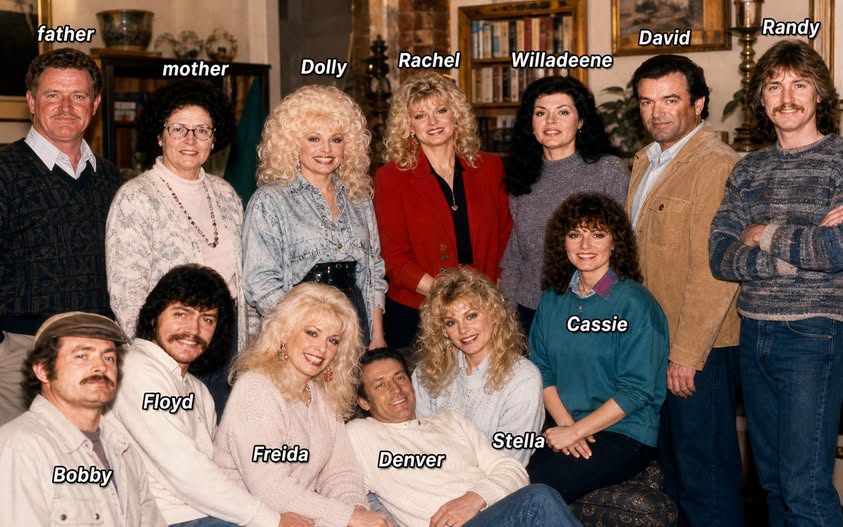
Her parents, Robert Lee and Avie Lee Parton, raised six sons and six daughters in a household where privacy was scarce and resources were even scarcer. Every child had a place in the family’s story, and every personality was different. Some were drawn toward music and performance. Others preferred quieter lives away from the spotlight. Some carried pieces of the family’s story into entirely different careers.
But all of them came from the same place.
And that matters.
Because when people talk about Dolly Parton, it can be easy to imagine that her story began when the world discovered her voice. In reality, it began much earlier, with the people who taught her how to survive before she ever had an audience.
Her sisters each found their own paths.
Willadeene preserved memories and family history through writing, helping document the world they came from. Stella and Cassie carried the family’s musical tradition onto stages of their own, proving that the talent running through the Parton household did not belong to Dolly alone. Freida eventually moved away from the music business and into ministry, following a different calling. Rachel stepped into television and became known to audiences through *9 to 5*, bringing another branch of the family into the entertainment world.
Their lives were different, but the connection remained.
They had grown up hearing the same voices in the same small home. They knew the same struggles, the same jokes, the same family stories, and the same songs. Fame might separate people physically, but shared childhood memories create a bond that is difficult to erase.
Her brothers walked quieter roads.
Bobby, David, and Denver largely chose lives away from the glare of celebrity, reminding the world that not every Parton wanted a microphone or a camera pointed at them. Randy, however, became part of Dolly’s professional world, bringing his own musical talent to Dollywood’s stages. Floyd also shared the creative side of the family, writing songs alongside his famous sister and contributing to the musical legacy that had started long before Dolly became a household name.
In that family, music wasn’t simply entertainment.
It was part of survival.
It was something they could create even when they had very little else. A melody cost nothing. A song could fill a room that felt too small. It could make difficult days feel lighter and give children a way to imagine something beyond the hills surrounding them.
And Dolly never seemed to forget that.
The family also knew devastating loss early. Baby Larry died as an infant, leaving a wound in the household that no amount of later success could completely erase. Years later, the family would experience more grief as Floyd, Randy, David, and Denver passed away.
Those losses changed the shape of the family over time.
The twelve children who once crowded together under one roof slowly became adults with separate lives, careers, families, dreams, and struggles. Some became recognizable names themselves. Others remained almost entirely outside the public eye. Some stood beside Dolly in music and entertainment, while others watched from a distance as their sister became one of the most recognizable women in the world.
But fame never changed where the story began.
It began in East Tennessee.
It began with parents who had very little but gave their children what they could. It began with siblings sharing space, food, responsibilities, laughter, arguments, and songs. It began with a little girl learning that a voice could become a way out of poverty—and eventually learning that the same voice could be used to bring other people with her.
That may be one of the most remarkable parts of Dolly’s story.
The world sees the finished legend.
Her family remembers the girl before the legend existed.
They remember the childhood, the struggles, the relatives who never became famous, the ones who left home, the ones who stayed close, and the empty spaces created by loss. They know that behind every photograph of Dolly in rhinestones is a much simpler image: a child from the mountains who came from a family too large to fit neatly into a single frame.
By the time Dolly died in 2026, six siblings remained, carrying memories that no biography, documentary, or award could ever fully capture. They were living links to the beginning of her story—a time when she wasn’t an international superstar, but simply one of twelve children growing up in a family where everyone had a role.
And perhaps that is why her success feels different.
Dolly Parton’s story was never truly hers alone.
It was shaped by the people who sang with her, struggled beside her, encouraged her, challenged her, loved her, and sometimes simply shared the same small room with her. Every stage she eventually stood on carried a little piece of those Tennessee hills with it.
The wigs came later.
The rhinestones came later.
The fame came later.
The songs that millions would eventually sing came later.
First, there was a family.
First, there was a cabin.
First, there were twelve children and two parents trying to make something out of very little.
And somewhere inside that crowded home, surrounded by poverty, faith, laughter, grief, and music, a future legend began to find her voice.
Dolly may have become the name the world remembered.
But the chorus that created her was much bigger than one person.