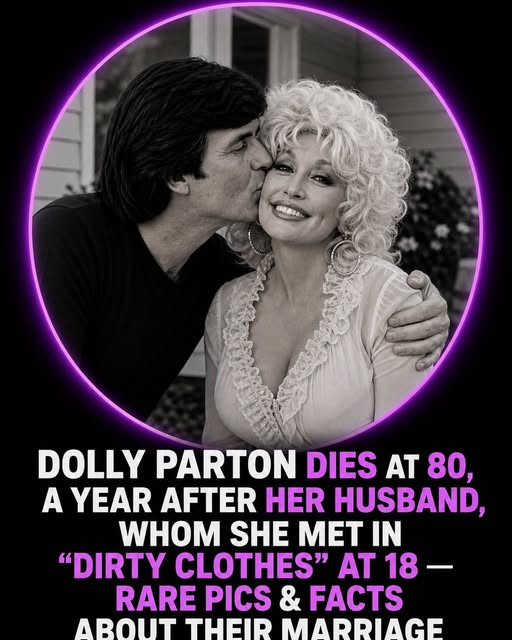
The country star once said she would “never marry again” if her husband died before her because her love for him ran that deep. Their marriage lasted for nearly six decades, despite the striking differences between them. Dolly Parton embraced fame, music, and the spotlight, while Carl Dean preferred privacy, quiet, and a life far removed from Hollywood and Nashville attention.
Dolly Parton spent nearly 60 years with her husband, Carl Dean, carefully protecting their relationship from public scrutiny. While the singer became one of the most recognizable entertainers in the world, Dean remained almost entirely out of the spotlight. Only occasional photographs, interviews, and stories offered fans a glimpse into the private relationship that stood behind Parton’s extraordinary career.
Their love story began in an unexpected place, at a time when Parton was still a young woman chasing her dreams. Shortly after moving to Nashville in 1964, she met Dean at a Wishy-Washy laundromat while staying with her Uncle Bill.
“I’d come to Nashville with dirty clothes. I was in such a hurry to get here — and after I’d put my clothes in the machine, I started walkin’ down the street, just lookin’ at my new home, and this guy hollered at me, and I waved… And he came over and, well, it was Carl, my husband,” Parton recalled in a 1976 interview.
Dean was immediately interested, but Parton was cautious. She initially refused to go out with him because she had been taught from a young age to be careful around strangers. Instead of agreeing to a date, she invited him to visit while she babysat her nephew.
Dean did not give up. He reportedly showed up every day that week, sitting with Parton on the porch and spending time with her until she finally agreed to go somewhere with him.
Parton later recalled that Dean drove her directly to his parents’ house and introduced her to his mother and father. According to Parton, Dean told her that he knew almost immediately that she was the woman he wanted to marry.
She was just 18 when their relationship began. Two years later, in May 1966, Parton and Dean married. She was 20, while Dean was 23.
Their wedding came at an important moment in Parton’s young career. Around the same period, she had begun working with country music star Porter Wagoner. For the next several years, she toured, recorded, and wrote songs with him, gradually becoming one of country music’s most promising young stars.
As Parton’s career grew, Dean deliberately stayed in the background. A Nashville native who operated an asphalt paving business, he had little interest in becoming part of the entertainment industry. He was so uncomfortable with the spotlight that he often avoided attending Parton’s performances.
Parton once described him as shy and quiet, explaining that the private world they shared was something she wanted to protect. Their relationship worked partly because Dean did not try to compete with her fame or become part of her professional life. When she felt lonely while traveling, she could call him, and he would sometimes come visit her for a few days.
Despite their preference for privacy, the couple eventually built a comfortable home life outside Nashville. They lived at Tara, a sprawling 23-room house situated on roughly 200 acres, which also included a mobile home for visiting relatives.
Motherhood was another subject Parton had considered during her younger years. However, as her career became increasingly demanding, she recognized the difficulties of raising children while constantly traveling and working. She later explained that she did not believe she could bear children and leave them for someone else to raise while she pursued her career. She also believed adoption could remain an option if she eventually reached an age when having children naturally was no longer possible.
Through all of the changes in Parton’s career, her marriage remained remarkably steady. Her glamorous image during the 1980s did not appear to threaten the relationship. In a 1981 interview, Parton expressed just how deeply she loved Dean, saying that she wanted to grow old with him and that if he died first, she might never marry again.
While Parton spent much of her time traveling, recording, performing, and building her career, Dean remained at home. He enjoyed buying and reselling trucks and tractors and was comfortable pursuing his own interests away from the entertainment business.
Their independence became one of the unusual strengths of their marriage. Dean did not need to be beside Parton every moment, and Parton did not expect him to follow her everywhere. They could have separate lives while still remaining deeply connected.
Decades into their marriage, Parton continued to describe their differences as one of the reasons their relationship worked so well. In 2015, nearly half a century after their wedding, she explained that opposites really do attract. They were very different people, she said, and that difference kept their relationship interesting because she never quite knew what Dean might say or do.
She described him as a good man with a quirky personality, someone who could make her laugh and who was completely comfortable being himself. He never needed the attention that came with her fame, and that independence gave their relationship a sense of stability.
Their favorite moments together were often surprisingly ordinary. They enjoyed taking trips in their RV, where Parton could read, cook, and relax in comfortable clothes she jokingly referred to as her “baby clothes.” Away from stages, cameras, and crowds, she could simply be herself.
Their travel preferences were not always identical, either. Parton loved being on the road, while Dean preferred staying close to home. He enjoyed short trips but did not like being away for extended periods. Rather than allowing those differences to divide them, they found a rhythm that gave each person the space they needed.
Parton believed their relationship worked because they shared enough important values to balance their very different personalities. Both appreciated simplicity, privacy, humor, and the ability to enjoy one another without constantly needing excitement or attention.
Above all, laughter became one of the quiet foundations of their marriage. Parton often spoke about how important it was that Dean could make her laugh. He enjoyed music, but he was never part of the music business, giving the two of them completely different worlds to return to and stories to share with each other.
For a woman whose professional life was lived almost entirely in front of millions of people, Carl Dean represented something entirely different: home. He did not need the spotlight, did not chase celebrity, and did not try to become part of Dolly Parton’s public identity.
Perhaps that was precisely why their marriage endured. Their love did not depend on having identical personalities or living identical lives. Instead, they gave each other room to remain themselves while maintaining the private bond that had begun with a chance meeting at a laundromat in Nashville.
After nearly six decades together, their relationship became one of the most enduring love stories in country music—not because the public saw everything, but because they deliberately kept much of it for themselves.