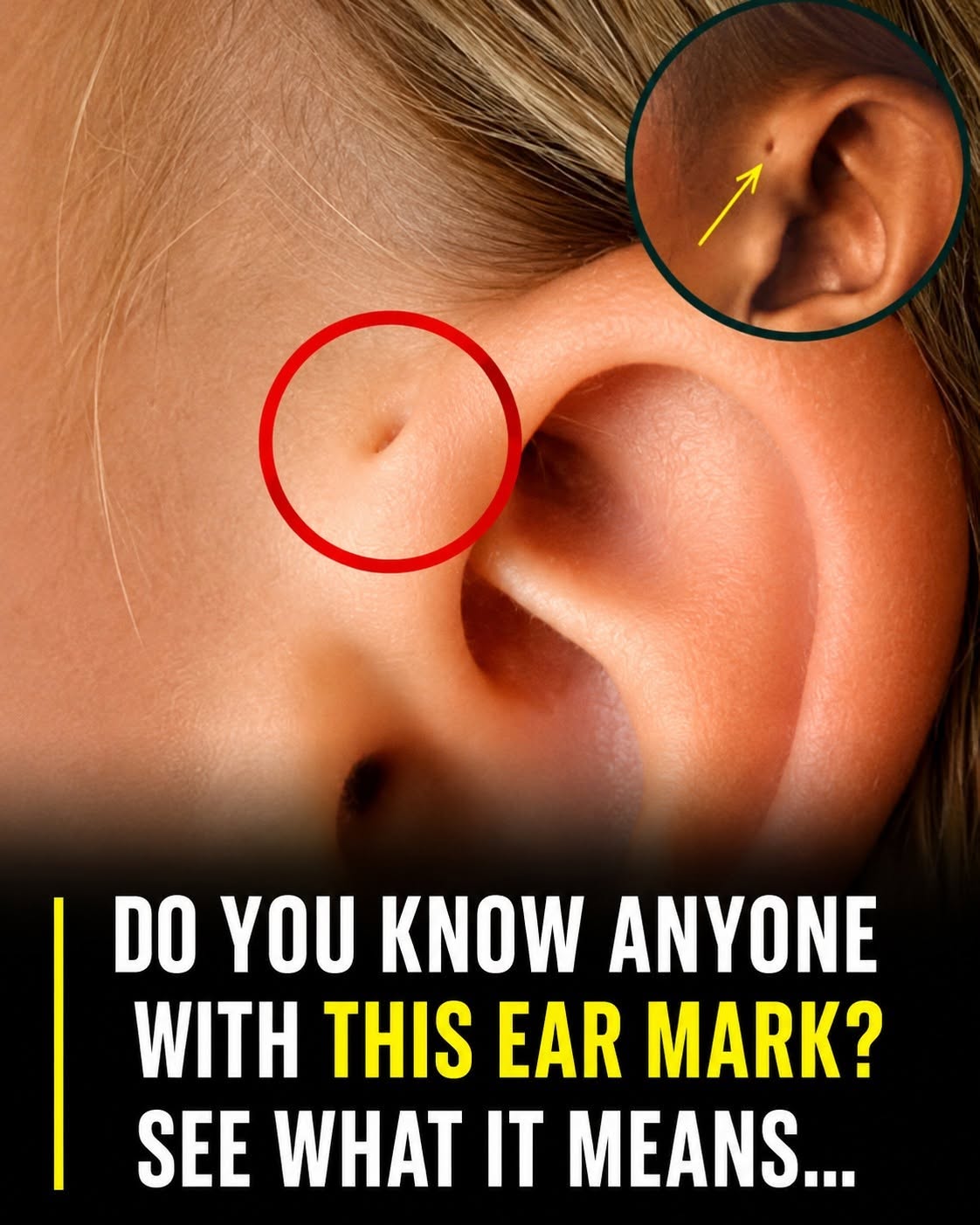
Discover the Meaning of This Tiny Mark Near the Ear: It’s More Common Than You Think
Have you ever noticed a tiny hole, dimple, or unusual mark near the front of someone’s ear and wondered what it means? At first glance, it may look like a small scar, a piercing mark, or a minor imperfection in the skin. However, this tiny feature can actually be a naturally occurring variation in human anatomy. Known as a preauricular pit, it is a small opening in the skin located near where the outer ear meets the face. Although many people have never heard of it, this feature is more common than they might imagine, and in most cases, it does not cause any serious problems.
For some individuals, the opening is so small that it can easily go unnoticed for years. Others may discover it during childhood when a parent notices a tiny indentation beside the ear. Because it is often present from birth, people may grow up with it without ever questioning its existence. In certain cases, someone might only become aware of it after noticing the same feature in another family member or seeing information about it online. Its unusual appearance can create curiosity, especially because it is not a feature that everyone has.
A preauricular pit develops during early fetal development, when the structures that form the outer ear are taking shape. The outer ear develops from several small tissue structures that gradually come together to form its familiar shape. Occasionally, this process leaves behind a tiny opening near the ear. The exact developmental mechanism can be complex, but the important point is that a preauricular pit is generally a congenital feature, meaning that it is present at birth rather than something that develops because of poor hygiene, an injury, or a person’s lifestyle.
One of the most interesting aspects of this tiny mark is that it can appear on either side of the head. Some people have a pit near only one ear, while others have one on both sides. Its size and appearance can vary, ranging from a barely visible dot to a more noticeable opening in the skin. In many cases, it remains unchanged throughout life and causes no discomfort whatsoever. People with this feature can lead completely normal lives without needing treatment or even thinking about it.
Although preauricular pits are not equally common in every population, they are a recognized variation in human anatomy found around the world. Their frequency varies according to the population being studied, and estimates differ between studies. This variation helps explain why some people encounter the feature frequently while others may go years without noticing it. In families where the trait occurs, it may be passed from one generation to another, suggesting a genetic component. However, inheritance patterns can vary, and not every child of a person with a preauricular pit will necessarily have one.
For many people, the most important question is whether the mark is dangerous. The reassuring answer is that an uncomplicated preauricular pit is usually harmless. It does not automatically indicate a disease, a hearing problem, or an abnormality affecting other parts of the body. Most people with an isolated pit do not experience any symptoms and require no medical intervention. A healthcare professional may identify it during a routine examination, but if it is healthy and causes no problems, treatment is generally unnecessary.
Nevertheless, because the opening connects with a small tract beneath the skin, it can occasionally become infected. Bacteria may enter the area, potentially leading to redness, swelling, tenderness, or the formation of a small pocket of pus. Some people may notice fluid draining from the opening, particularly if an infection or inflammation develops. In these situations, the feature can become uncomfortable and may require medical attention. Repeated infections can be especially troublesome because the underlying tract may remain even after the immediate symptoms disappear.
If a preauricular pit becomes red, painful, swollen, or begins producing unusual discharge, it is important not to squeeze it or attempt to clean it with sharp objects. Such actions can irritate the surrounding tissue and potentially worsen an infection. Instead, a healthcare professional can examine the area and determine whether treatment is needed. Depending on the severity of the problem, treatment may involve medication, drainage of an abscess, or other appropriate care. If infections occur repeatedly, a specialist may recommend surgery to remove the tract responsible for the recurring symptoms.
Surgical treatment is not necessary for everyone who has a preauricular pit. In fact, most people never need surgery at all. When an operation is recommended, it is generally because of repeated infections, persistent drainage, or other ongoing complications. The procedure aims to remove the tract completely to reduce the likelihood of future problems. Because the tract can have small branches or extend beneath the skin, removal requires careful assessment by an appropriately trained clinician. For someone who has never experienced symptoms, however, preventive surgery is not routinely required simply because the opening exists.
Another common concern is whether a tiny mark near the ear could be associated with hearing loss or other medical conditions. An isolated preauricular pit usually does not affect hearing. However, in uncommon circumstances, pits can occur alongside other congenital differences or as part of a genetic syndrome. If a child has additional physical findings, a family history of certain congenital conditions, or concerns about hearing, a healthcare professional may recommend further evaluation. This does not mean that everyone with a preauricular pit should be worried. Rather, it highlights the importance of considering the person’s overall health instead of judging the significance of a single physical feature in isolation.
Parents who notice a preauricular pit in a newborn may understandably wonder whether additional tests are necessary. In an otherwise healthy infant with an isolated pit and no other concerning findings, extensive testing is not automatically required in every case. Medical decisions depend on the child’s examination, family history, hearing-screening results, and any additional symptoms or risk factors. A pediatrician can determine whether routine observation is sufficient or whether further assessment would be appropriate.
The feature can also raise questions about personal identity and family resemblance. Some people discover that a parent, grandparent, sibling, or other relative has the same tiny opening. This can be an interesting reminder of the many small anatomical traits that may run through families. Just as people inherit variations in facial shape, hair texture, and other physical characteristics, they may also inherit a tendency to develop a preauricular pit. Still, its presence or absence should not be used on its own to draw conclusions about someone’s ancestry, overall health, or genetic background.
It is also worth distinguishing a preauricular pit from other marks near the ear. A small opening in front of the ear is different from a skin tag, a scar, a cyst, or a hole caused by a piercing. Some congenital ear differences may look similar at first glance, but their structure and medical significance can differ. If a mark has appeared recently, changes in size, bleeds, becomes painful, or looks different from an ordinary tiny opening, a medical examination can help clarify what it is. Not every spot or indentation near the ear is a preauricular pit, and visual appearance alone may not always provide a definitive answer.
Ultimately, this tiny mark is a good example of how the human body can vary in ways that are both ordinary and fascinating. What may initially look unusual is often simply a harmless result of early development. For most people, a preauricular pit remains a small, permanent feature that requires no special attention. Understanding what it is can replace unnecessary worry with a clearer picture of normal human anatomy.
The key is to recognize the difference between an uncomplicated opening and one that develops symptoms. If the area remains clean, comfortable, and unchanged, there is usually little reason for concern. If it becomes painful, swollen, red, or begins draining fluid, professional medical advice is sensible. And if the mark is accompanied by other unusual findings or hearing concerns, a clinician can determine whether further evaluation is appropriate.
Sometimes, the smallest details of our bodies raise the biggest questions. A tiny mark near the ear may seem mysterious, but it often has a straightforward explanation rooted in the earliest stages of human development. For the majority of people who have one, it is simply another natural variation that makes every person’s anatomy a little different.