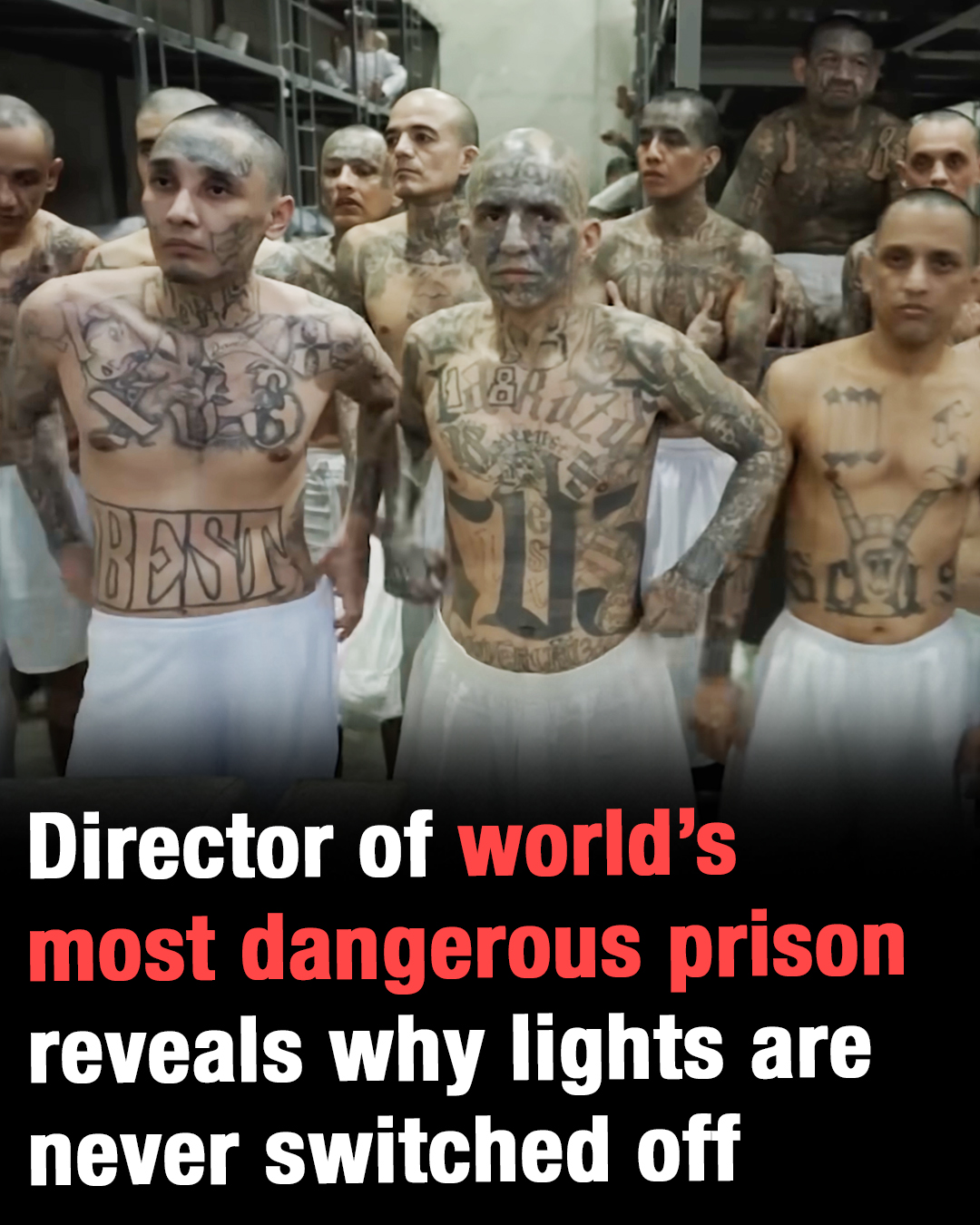
Inside one of the world’s most controversial prisons, darkness is something inmates rarely experience.
The lights remain on around the clock, casting a constant fluorescent glow across rows of cells and concrete corridors. There are no shadows to disappear into, no quiet corners hidden from view, and no moment when surveillance truly ends. For the thousands of prisoners held there, the absence of night is not accidental—it is part of the system itself.
At the center of El Salvador’s aggressive campaign against gang violence stands CECOT, the country’s massive high-security prison built to house tens of thousands of inmates. Designed to contain individuals accused of belonging to some of the nation’s most feared criminal organizations, the facility has become both a symbol of government power and a subject of intense international debate.
Life inside the prison is deliberately stripped down to the essentials.
Inmates sleep on metal bunks with minimal comfort. Daily meals are basic and repetitive. Entertainment is virtually nonexistent. Access to books, electronic devices, television, and communication with the outside world is extremely limited or entirely prohibited. Every aspect of the environment is designed to reduce opportunities for gang coordination and maintain strict control.
Even the architecture reflects that goal.
Advanced security systems monitor movement throughout the complex, while electronic measures prevent communication signals from entering or leaving the facility. Massive walls, reinforced barriers, and constant surveillance ensure that escape is nearly impossible.
Yet it is the permanent lighting that often captures the most attention.
According to prison officials, maintaining illumination twenty-four hours a day serves multiple purposes. It enhances security, improves visibility for guards, and reduces opportunities for violence, planning, or concealment. Under constant light, every movement remains observable.
For inmates, however, the experience can be psychologically exhausting.
Without the natural rhythm of day and night, time itself can begin to feel distorted. The simple comfort of darkness—a condition most people experience every evening without a second thought—becomes unavailable. Sleep must occur under the same bright lights that remain overhead at all hours.
The daily routine inside the facility follows a rigid structure. Prisoners are counted regularly, subjected to strict regulations, and spend most of their time confined to controlled areas. Any violation of prison rules can result in additional restrictions or disciplinary measures.
Supporters of the system argue that such measures are necessary. For years, El Salvador struggled with some of the highest levels of gang-related violence in the world. Communities lived under constant threat, businesses faced extortion, and many citizens feared leaving their homes. To those who support the government’s approach, facilities like CECOT represent a decisive response to a crisis that had devastated the country for decades.
Critics, however, raise concerns about the long-term human consequences of such extreme incarceration conditions. Human rights organizations have questioned whether certain practices prioritize punishment over rehabilitation and whether prolonged exposure to highly restrictive environments can cause lasting psychological harm.
This debate continues both within El Salvador and internationally.
For some, CECOT stands as evidence that strong measures can restore public safety and weaken powerful criminal organizations. For others, it serves as a warning about the risks of sacrificing individual rights in pursuit of security.
Regardless of where one stands in that discussion, the reality inside the prison remains striking. Under the unending glare of fluorescent lights, thousands of inmates live in a world where privacy barely exists, routine governs every hour, and the distinction between day and night has largely disappeared.
For the government, that environment represents control.
For the prisoners, it represents a life lived under constant observation.
And for the rest of the world, it raises a difficult question: how far should a society go in its pursuit of safety, and what price is acceptable in exchange for peace?