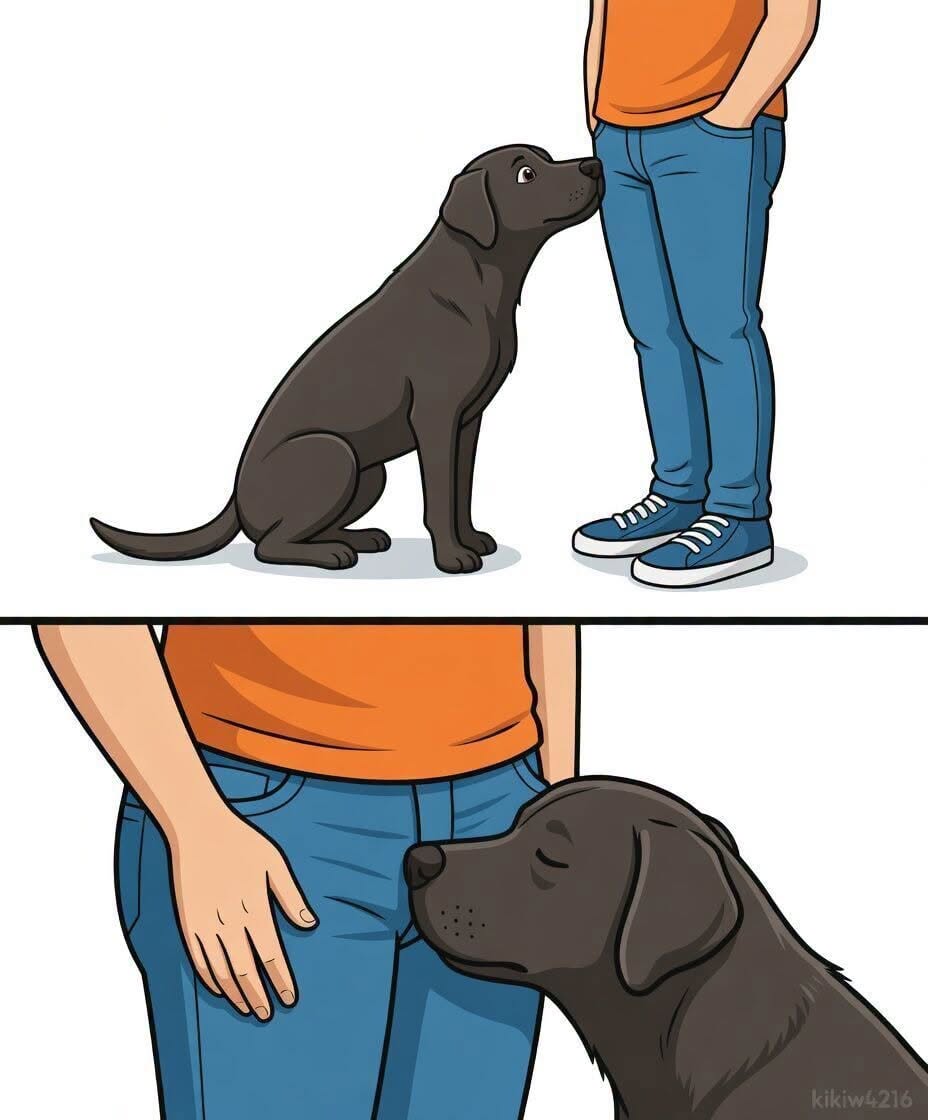
At first, it feels embarrassing.
A dog trots over, ignores your outstretched hand, and immediately buries its nose in the most awkward place imaginable. People laugh. Owners apologize. Someone inevitably says, “Sorry, he does that to everyone.”
But your dog isn’t being rude.
In fact, from a dog’s perspective, it’s one of the most natural greetings in the world.
Dogs experience life through scent in a way humans can barely comprehend. While we rely primarily on sight, dogs rely on smell to gather information about the world around them. Their noses contain hundreds of millions of scent receptors, allowing them to detect chemical signals far beyond human capability.
To a dog, every person carries a unique scent signature.
And one of the strongest sources of that information comes from the human body’s apocrine glands.
These glands are concentrated in areas such as the armpits and groin, producing chemical compounds known as pheromones. While humans are largely unaware of these signals, dogs can detect them instantly.
When a dog sniffs someone’s groin, it isn’t acting out of disrespect, aggression, or poor manners.
It’s gathering information.
A tremendous amount of information.
That single sniff may reveal a person’s sex, approximate age, emotional state, reproductive status, recent activity, diet, and even subtle changes occurring within the body.
To the dog, it’s the equivalent of reading an incredibly detailed biography.
Veterinarians and animal behaviorists explain that dogs often use scent to determine whether someone is familiar or unfamiliar, relaxed or anxious, healthy or potentially ill.
Research has even shown that specially trained dogs can detect certain medical conditions through scent alone, including low blood sugar episodes, seizures, and some forms of cancer.
While an ordinary family pet isn’t performing a medical examination, the same extraordinary sense of smell is still at work.
Your dog may notice changes you haven’t noticed yourself.
Stress.
Fear.
Hormonal fluctuations.
Pregnancy.
Illness.
All can alter the scent signals your body produces.
This is one reason dogs sometimes show unusual interest in pregnant women or people experiencing significant emotional distress.
They’re responding to information that remains invisible to everyone else.
For many owners, understanding this behavior changes how they view it.
What feels awkward from a human perspective is simply communication from a canine perspective.
Dogs don’t understand social etiquette the way humans do.
They don’t recognize certain body areas as private or embarrassing.
They only recognize information.
And they’re naturally curious.
Of course, understanding the behavior doesn’t mean you must allow it.
Training and boundaries remain important.
If a dog repeatedly greets guests by sniffing inappropriately, owners can calmly redirect the behavior.
Offering a hand to sniff first often satisfies a dog’s curiosity.
Commands such as “sit,” “leave it,” or “come” can also help create more comfortable interactions.
Experts emphasize that punishment is rarely necessary.
The behavior isn’t malicious.
It’s instinctive.
Redirecting the dog toward a more acceptable greeting method is usually far more effective.
Ultimately, that awkward nose-to-crotch encounter reveals something fascinating about the canine world.
Dogs are constantly collecting information through scent.
They are reading chemical messages that humans cannot perceive.
They are paying attention to changes in our bodies, emotions, and health every single day.
What seems embarrassing to us is simply another conversation to them.
A conversation conducted through scent instead of words.
And while it may not always feel comfortable, it’s a reminder of just how remarkable a dog’s senses truly are.
The next time your dog seems unusually interested in greeting someone, remember: it isn’t trying to embarrass anyone.
It’s simply reading a story written in a language only dogs can understand.