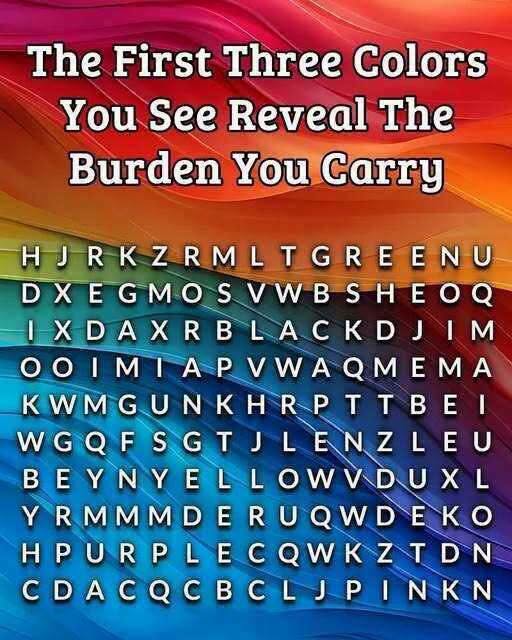
Some burdens become so familiar that you eventually stop noticing their weight. You carry them through ordinary days, keep up with responsibilities, and continue moving forward, sometimes without realizing how much emotional energy they require. That is part of the appeal behind a viral color exercise that promises to reveal what you are carrying inside. It asks you to notice the first three colors that catch your attention and explore what they might represent. But its real value may be much quieter than the dramatic interpretations circulating online: it gives an unnamed feeling somewhere to land.
The trend begins with a simple instruction. Look at a selection of colors and identify the first three that stand out to you. Do not spend too much time analyzing your choices. Once you have selected them, consider what each shade might symbolize in your life and what emotions or memories it brings to mind.
Some versions of the exercise attach familiar meanings to particular colors. Black might be associated with protection, emotional distance, or the desire to keep certain feelings hidden. Green may suggest growth, healing, or the need for a fresh beginning. White is sometimes connected with perfectionism, expectations, or the pressure to keep everything under control.
These interpretations can sound surprisingly personal, especially when someone is already dealing with emotions they have struggled to explain. A color that seems ordinary to one person may remind another of a difficult period, a meaningful relationship, or a responsibility that has become exhausting.
However, it is important to understand what this exercise can and cannot do. It cannot identify hidden emotional burdens, reveal a person’s deepest secrets, or diagnose a mental health condition. There is no established psychological test behind the viral trend that can accurately determine someone’s emotional state simply by asking them to choose three colors.
Color associations are highly personal and influenced by culture, memories, surroundings, and individual experiences. Red, for example, might remind one person of anger or conflict, while another may associate it with love, warmth, celebration, or excitement. Blue could represent peace and relaxation for someone, while another person might connect it with responsibility, sadness, or a difficult memory.
This is why your own associations matter much more than any interpretation provided by a viral post. A color does not carry one universal emotional meaning, and choosing a particular shade does not prove that you are experiencing a specific feeling.
Instead of treating the exercise as a psychological verdict, use it as an opportunity to pause and reflect.
Start by writing one honest sentence about each of the three colors you selected. Ask yourself what comes to mind when you look at that shade. Does it remind you of a particular place, a person, or a moment in your life? Does it bring back a feeling you have not acknowledged recently? Perhaps it reminds you of something you miss, a responsibility you are struggling with, or a change you know you need to make.
You do not have to force an answer. Sometimes, a color may simply look appealing, and that is perfectly fine. The exercise does not need to reveal a hidden meaning to be worthwhile.
It can also be helpful to consider the difference between what you feel and what you believe you are supposed to feel. Many people become so accustomed to meeting expectations that they rarely stop to ask whether their daily routines are leaving them emotionally exhausted. Others continue carrying responsibilities because they do not want to disappoint the people around them.
A small reflective exercise cannot solve those problems, but it may help bring them into focus.
If your chosen colors lead you to think about protection, growth, or perfectionism, consider those ideas as possibilities rather than conclusions. Perhaps you have been protecting yourself from disappointment. Perhaps you are ready for a new chapter. Or perhaps you have been placing unrealistic expectations on yourself and need permission to make mistakes.
There is no correct answer, no secret score, and no personality category waiting to be uncovered. You are not required to match your choices to an online explanation.
The most meaningful question is not what the colors supposedly say about you, but what they encourage you to recognize about your own experiences.
Sometimes, acknowledging an emotion is the first step toward understanding what you need. You may realize that you need more rest, a healthier boundary, a difficult conversation, or support from someone you trust. If the feelings you uncover are persistent or overwhelming, speaking with a qualified mental health professional can offer more meaningful guidance than any online color exercise.
Colors cannot lift every burden, and three shades cannot explain everything happening inside a person. But a moment of honest reflection can help you recognize feelings that have been pushed aside for too long. And sometimes, simply admitting that something is heavy is the beginning of finding a way to carry it differently.