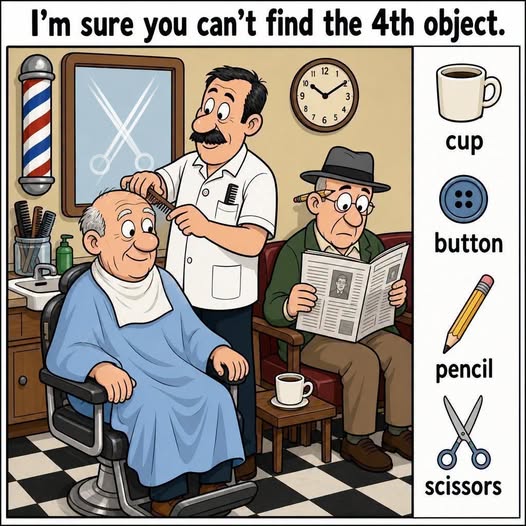
A simple barbershop puzzle managed to confuse countless viewers with a trick that was hiding in plain sight. People carefully searched the entire picture, looking behind objects and examining every corner for a button that they believed had to be there. The cup, pencil, and scissors were easy enough to identify, but the fourth object seemed impossible to find. What many people did not realize was that the missing button was never in the picture at all.
The puzzle appeared straightforward at first. Viewers were asked to locate four everyday objects in a barbershop scene. Three were clearly visible, giving people confidence that the challenge would be easy. But when they reached the fourth item, the search became much more complicated. They looked around the barber’s workspace, examined the furniture, and tried to identify tiny details that might resemble a button.
Some viewers spent far longer than expected trying to solve it. Others became convinced that the object was cleverly hidden somewhere in the illustration. The longer they searched, the more determined they became to find it. Yet the answer was not hidden in a difficult corner or disguised among the other objects. There was simply no button to discover.
What made the puzzle so effective was the way it influenced people’s expectations before they even began looking. When someone is told to find four objects, the brain naturally assumes that all four must exist. That instruction creates a strong expectation, making it difficult to consider the possibility that the challenge itself might be misleading.
This is closely connected to the way human attention works. People do not always observe an image as a collection of completely neutral details. Instead, the brain uses instructions, previous experiences, and expectations to decide what deserves attention. Once a person believes something is present, they may continue searching for evidence to support that belief, even when the evidence is missing.
In this case, the cup, pencil, and scissors provided enough confirmation to make the instructions seem trustworthy. Since the first three objects were real, viewers naturally assumed the fourth one had to be somewhere nearby. The puzzle used that assumption to keep them looking.
The missing button became the center of attention precisely because it could not be found. Instead of questioning whether the object existed, many people questioned their own ability to see it. They wondered whether they had overlooked a small detail, misunderstood the illustration, or failed to notice something obvious.
That reaction is part of what makes visual puzzles so entertaining. They challenge more than eyesight. They test patience, concentration, and the willingness to question an assumption. Sometimes the hardest part of a puzzle is not identifying what is visible, but recognizing that the instructions may have led us toward the wrong conclusion.
The experience also reveals how easily confidence can influence perception. When people are certain that an answer must exist, they may interpret ordinary shapes and details as possible clues. A shadow might suddenly look like an object, a small mark might seem important, and an insignificant part of the picture may receive far more attention than it deserves.
Eventually, the trick becomes clear: the puzzle was never asking viewers to find an unusually well-hidden button. It was testing whether they would challenge the assumption that there had to be one. The moment someone realizes that only three of the four requested objects are actually present, the confusion disappears.
That is what gives this simple barbershop illustration its surprising effect. It does not require complicated artwork, hidden symbols, or extraordinary visual details. It relies on a basic psychological tendency: people often trust the information they are given before questioning whether it is correct.
In the end, the puzzle offers a small but memorable lesson about perception. Not everything we expect to see is necessarily there, and sometimes searching harder is not the solution. The better answer may be to step back, reconsider the instructions, and question the assumption that started the search in the first place.
The cup, pencil, and scissors were there all along. The button was never missing. It never existed.