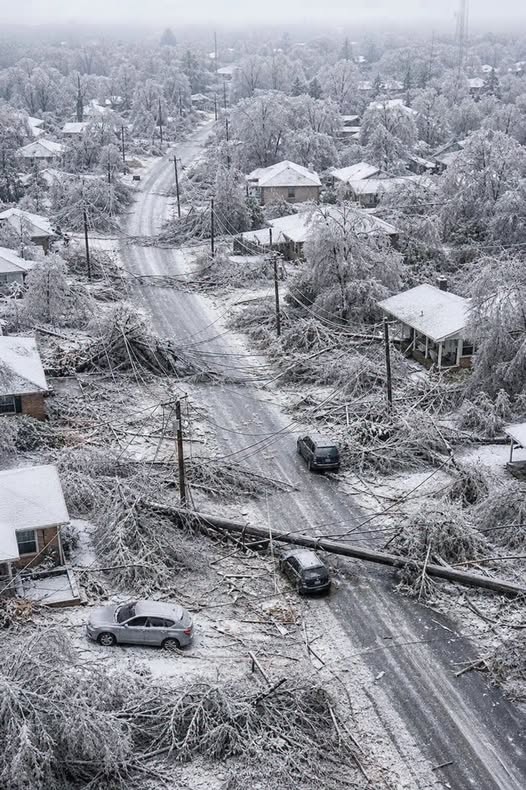
Families are freezing in the dark. Sirens echo through streets coated in glassy ice as Tennessee’s worst nightmare unfolds in real time. Power grids are collapsing, trees are detonating under the weight of ice, and entire neighborhoods are disappearing into a silent, frozen blackout. Officials warn of dangerous and potentially life-threatening conditions, but for families trapped without electricity or heat, those words barely capture the reality unfolding outside their doors.
More than a quarter million homes sit in darkness as the storm tightens its grip, turning familiar streets into frozen hazard zones. In neighborhoods around Nashville, the normal sounds of traffic and everyday life have been replaced by silence, distant emergency sirens, and the occasional thunderous crack of a tree breaking beneath the weight of accumulated ice.
The streets that residents know so well have become nearly unrecognizable.
Road signs disappear behind layers of ice. Driveways become slippery traps. Sidewalks are transformed into sheets of glass. Cars sit buried beneath frozen branches, while power lines sag dangerously toward the ground.
Inside homes, families huddle together beneath layers of blankets.
Candles and phone screens provide the only light in some rooms, casting faint shadows against windows coated with ice. Parents check the temperature repeatedly. Children are kept close. People conserve phone batteries because nobody knows how long the outage will last.
The silence can be more frightening than the storm itself.
Every few minutes, another crack echoes through the neighborhood.
Sometimes it is a branch.
Sometimes it is an enormous tree.
Sometimes it is a power line snapping under the weight.
And every sound raises the same question:
Was that our house?
For many residents, the greatest danger isn’t simply losing electricity.
It is losing heat.
Without working furnaces, heat pumps, or electric heaters, indoor temperatures can begin dropping rapidly. Homes that normally feel warm and secure can become dangerously cold, especially for older adults, infants, and people with medical vulnerabilities.
Cellphone batteries become another concern.
A phone may be the only connection between a family and emergency services, relatives, or local authorities. But without electricity, every call, message, and search consumes precious battery power.
People begin switching their phones to low-power modes.
Screens stay dark.
Calls become shorter.
Charging becomes something families plan carefully.
Across the region, emergency crews face conditions that make even simple rescues extremely difficult.
Roads are covered in ice.
Trees block entire routes.
Vehicles slide unexpectedly.
Power lines create additional hazards.
First responders must move slowly because rushing into dangerous conditions can create even more emergencies.
Yet they continue.
Utility crews work to locate damaged lines and restore service.
Firefighters respond to emergencies involving fallen trees and dangerous electrical equipment.
Police officers help stranded motorists and close roads that have become too dangerous to travel.
Medical personnel continue reaching people who cannot safely leave their homes.
For some residents, however, help may take longer than anyone wants.
A fallen tree can block a driveway.
A damaged road can prevent an ambulance from reaching a neighborhood.
A power line can make an otherwise accessible street too dangerous to enter.
And while crews work outside, families wait inside.
The landscape looks shattered.
Massive trees lie splintered across roads, lawns, and vehicles. Some have fallen directly onto houses, damaging roofs and walls. Others have collapsed across driveways, trapping residents inside their properties.
The weight of the ice is the enemy.
Every branch carries more.
Every wire carries more.
Every tree becomes heavier.
The longer the freezing conditions continue, the greater the pressure becomes.
That is why the sound of another branch breaking can be so terrifying.
People know that the next one could fall on a car.
A roof.
A power line.
A bedroom.
A road used by emergency crews.
In some neighborhoods, residents are afraid to leave their homes because they don’t know what they will encounter outside.
In others, they can’t safely remain inside because their homes are becoming too cold.
The storm creates a terrible choice.
Stay inside and wait.
Or step outside into dangerous conditions.
For families with nowhere else to go, there may be no easy answer.
Neighbors begin checking on one another.
Someone knocks on an elderly neighbor’s door.
Someone offers a warm room to a family whose heat has failed.
Someone brings blankets.
Someone shares a portable charger.
Someone with a working generator becomes a lifeline for several households.
These small acts become critical when normal infrastructure stops functioning.
A severe storm can make an entire community realize how dependent everyday life is on systems most people rarely think about.
Electricity.
Heating.
Road maintenance.
Cell towers.
Emergency services.
Transportation.
All of them work quietly in the background until one event begins taking them away.
Then every missing piece becomes visible.
The ice continues building.
Power lines remain under pressure.
Trees continue falling.
And families continue waiting for the lights to return.
For those sitting in the darkness, the storm isn’t something they are watching on television.
It is outside their window.
It is on their roof.
It is wrapped around their power lines.
It is blocking their road.
It is the sound of a transformer failing somewhere down the street.
It is the cold air entering a house that was never designed to function without heat.
And it is the uncertainty of not knowing when normal life will return.
But outside the darkness, crews continue working.
Truck after truck moves carefully through dangerous conditions.
Utility workers inspect damaged infrastructure.
Emergency responders search for people who need help.
Neighbors continue checking on neighbors.
The storm may have frozen the roads and silenced entire neighborhoods, but it has not stopped people from helping one another.
Eventually, the ice will begin to melt.
Trees will be cleared.
Power lines will be repaired.
Roads will reopen.
The lights will return.
But for the families who spent those nights listening to trees crack in the darkness, the memory will remain.
They will remember the cold.
The silence.
The candles.
The dying phone batteries.
The sound of transformers failing.
And the terrifying realization that the warm, familiar home they had always considered a place of safety could suddenly become vulnerable to the forces outside.
For now, they wait beneath blankets, listening to the storm.
Hoping the next crack isn’t their roof.
Hoping the next flash isn’t a transformer exploding.
Hoping the next sound they hear is something much simpler:
The power coming back on.