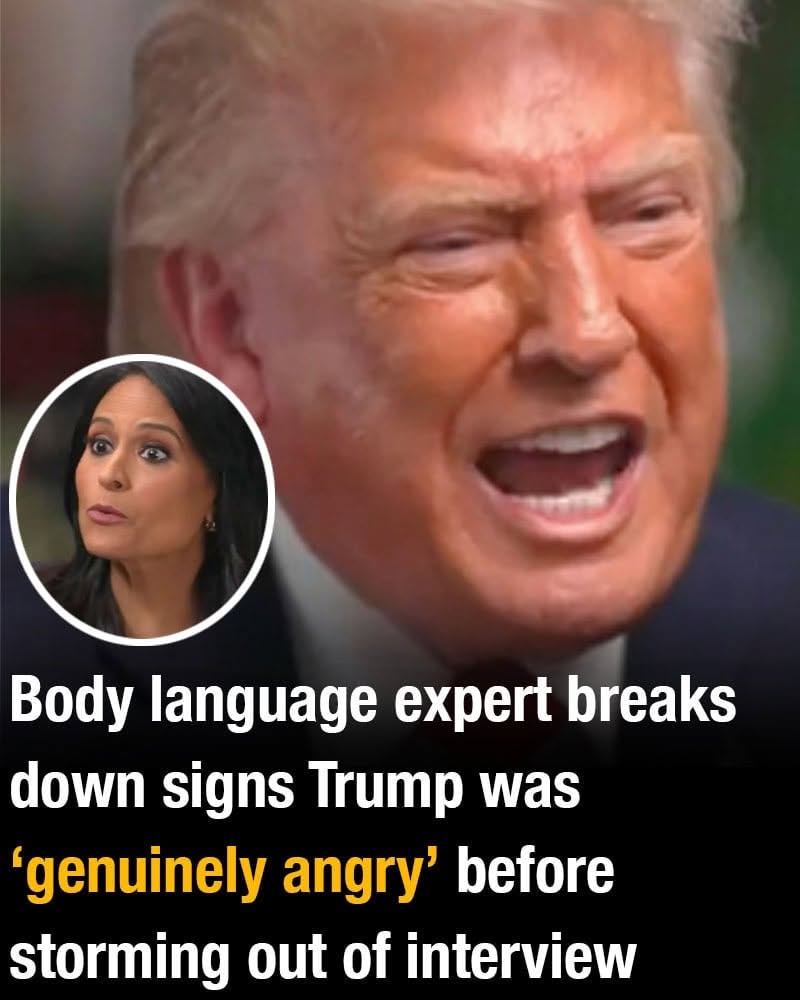
The moment he stood up, the atmosphere changed.
What had begun as a tense political interview suddenly became something far more revealing. Viewers watching at home saw Donald Trump rise from his chair, exchange sharp words with NBC moderator Kristen Welker, and abruptly end the conversation.
But according to body language experts, the most important part of the encounter may have happened before he ever walked away.
It was written in his face.
His posture.
His gestures.
And the subtle physical reactions that often reveal what words attempt to conceal.
A Battle Beyond Words
The exchange centered on one of the most controversial subjects in American politics: Trump’s continued claims that major elections were “rigged.”
Welker repeatedly pressed him for evidence.
Trump repeatedly defended his position.
At first, the confrontation followed a familiar pattern.
The former president answered forcefully.
Welker challenged his assertions.
Neither appeared willing to yield ground.
But as the questioning intensified, observers say the interaction became less about policy and more about control.
Body language specialist Darren Stanton argues that several physical signals suggested Trump’s frustration was growing in real time.
According to Stanton, Trump’s narrowed eyes, tightened facial muscles, and lowered brows indicated genuine irritation rather than calculated performance.
His body leaned forward.
His gestures became sharper.
His movements grew more emphatic.
These behaviors are often associated with individuals attempting to dominate a conversation or regain authority within a challenging interaction.
The Fight for Control
Throughout his political career, Trump has frequently relied on confidence, assertiveness, and forceful communication to shape public exchanges.
In many situations, that approach has allowed him to seize control of a discussion and place opponents on the defensive.
This interview proved more complicated.
Welker continued returning to the same question.
Evidence.
Proof.
Documentation.
Rather than engaging with personal attacks or emotional exchanges, she repeatedly redirected the conversation back to the factual basis of his claims.
That persistence appears to have altered the dynamic.
According to Stanton, one particularly revealing moment came when Trump’s body language shifted from expansion to withdrawal.
Earlier in the interview, he leaned into the discussion.
His hands moved aggressively.
His posture projected certainty.
But as the exchange continued, subtle signs of retreat emerged.
His gestures became more restrained.
His body pulled back.
His movements appeared less expansive.
In body language analysis, these changes can sometimes indicate discomfort, uncertainty, or frustration when an individual feels a conversation is no longer unfolding on favorable terms.
A Rare Shift
Political interviews are often carefully managed environments.
Experienced politicians typically arrive prepared for difficult questions and hostile exchanges.
What made this moment unusual, according to observers, was the apparent shift in emotional momentum.
Trump entered the interview expecting confrontation.
What he may not have expected was resistance that remained calm, measured, and persistent.
Welker did not match his intensity.
She did not engage in personal attacks.
And she did not abandon her line of questioning.
That composure may have proven more challenging than open conflict.
Many communication experts note that highly emotional exchanges often benefit the more aggressive participant because they shift attention away from evidence and toward personalities.
Welker’s approach denied that opportunity.
By remaining focused on documentation and proof, she continually redirected attention back to the substance of the claims themselves.
The Walk-Off
Eventually, the interview reached its breaking point.
Trump stood up.
He dismissed the conversation.
And he walked away.
To supporters, the move may have appeared decisive—a refusal to continue engaging with what they viewed as a hostile media environment.
To critics, it looked very different.
They saw a leader abandoning a conversation when pressed too hard on questions he could not adequately answer.
Body language experts caution that no gesture can definitively reveal someone’s inner thoughts.
Human behavior is complex.
Motivations are rarely obvious.
And interpretations can vary significantly.
Yet many analysts agree on one point:
The final moments of the interview felt different from the beginning.
What started as a confident and confrontational exchange ended with visible frustration and an abrupt departure.
Strength or Vulnerability?
That question ultimately sits at the center of the debate.
Did Trump’s decision to walk away demonstrate strength?
Or did it reveal vulnerability?
Supporters argue that refusing to continue an unfair discussion is a sign of confidence.
Critics argue that confidence requires staying in difficult conversations and defending claims under scrutiny.
The answer depends largely on perspective.
What is undeniable is that the interview generated exactly the kind of reaction that modern political moments often produce.
Supporters and opponents watched the same footage and saw entirely different stories.
One side saw a fighter refusing to be cornered.
The other saw a man struggling to maintain control of a conversation that was slipping away.
The Lasting Image
Long after specific questions and answers fade from memory, people often remember images.
A glance.
A gesture.
A pause.
A walk toward the exit.
For many viewers, the lasting image from this interview was not a policy discussion or a campaign message.
It was the moment the power dynamic appeared to shift.
The moment a journalist refused to retreat.
The moment a former president visibly reacted.
And the moment an interview became a contest not only of words, but of composure.
Whether that moment represented confidence, frustration, or something in between will continue to be debated.
But one thing is certain:
The most revealing part of the confrontation may not have been what was said.
It may have been what the cameras captured between the words.