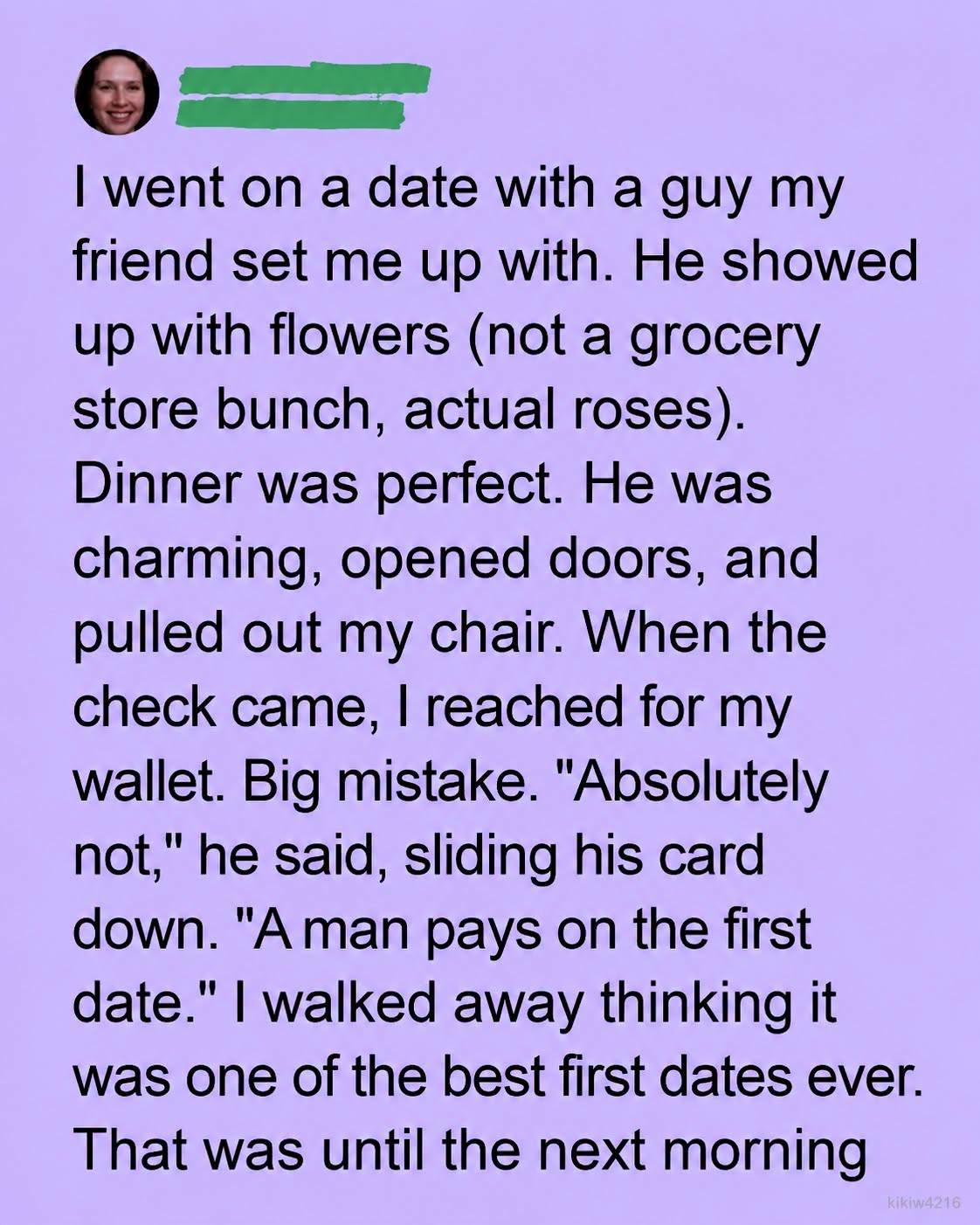
By the following morning, the roses that had once made me smile were sitting on the counter, and the excitement I had felt the night before had turned into something I could barely describe. I had gone to dinner believing I might finally be giving love another chance. Instead, I woke up to a message that made me question everything about the evening.
For weeks, my closest friend, Mia, had been encouraging me to meet Eric. She kept telling me that he was a good man, that we might have more in common than I realized, and that I shouldn’t let past disappointments prevent me from meeting someone new.
I had resisted at first. Dating wasn’t something I particularly wanted to rush into, and I had grown comfortable protecting my peace. But Mia wouldn’t give up. Eventually, I agreed to meet him, telling myself that one dinner couldn’t hurt.
To my surprise, the evening was genuinely lovely. Eric arrived with roses, greeted me warmly, and seemed thoughtful throughout the night. He chose a beautiful restaurant, asked questions about my life, and made me feel as though he was genuinely interested in getting to know me.
When the bill arrived, he insisted on paying. I offered to contribute, but he dismissed the suggestion and told me that everything was his treat. He even gave me a small engraved keychain, a gesture that seemed personal and unexpectedly sweet.
I went home feeling lighter than I had in a long time. For the first time in months, I caught myself wondering whether Mia had been right. Perhaps I had been too guarded. Perhaps Eric really was different.
Then his message arrived.
Instead of a simple good morning or a message saying he had enjoyed our evening, Eric sent me an itemized invoice.
I stared at the screen, trying to understand what I was looking at. He had listed the cost of dinner, the roses, and even the engraved keychain. Every gesture I had interpreted as kindness had been assigned a price.
At the bottom was a total, followed by a message explaining that he expected me to reimburse him unless I intended to pursue something serious with him.
I read it again, hoping I had misunderstood. But there was no confusion. He was asking me to pay for the evening because I had not yet agreed to become his girlfriend.
The humiliation was difficult to describe. I thought about how warmly he had insisted on paying, how he had presented the flowers, and how carefully he had made the evening feel special. At no point had he suggested that these things came with conditions.
I wasn’t upset because he had spent money. I was upset because he had turned what I believed was a genuine date into a financial transaction without telling me.
I immediately called Mia.
At first, she seemed surprised by my reaction. But when I explained what Eric had sent, her silence told me that there was something she wasn’t saying.
After a few uncomfortable moments, she admitted that Eric had done this before.
According to Mia, he had a peculiar rule about dating. He believed that if he paid for a date and the woman did not want to continue the relationship, she should reimburse him for the expenses. He apparently considered it unfair to spend money on someone who wasn’t interested in something serious.
I couldn’t believe what I was hearing.
Mia explained that she had hoped Eric and I would genuinely connect. If we liked each other, she reasoned, his strange rule would never become an issue. She admitted that she hadn’t thought I needed to know about it beforehand.
But that was exactly the problem.
She had encouraged me to meet someone while withholding information that could have completely changed my decision. I had trusted her judgment because she was one of the people closest to me. I expected honesty, not a carefully avoided warning.
I told her that she had taken away my opportunity to make an informed choice. If she knew about Eric’s behavior, she should have told me before arranging the introduction. Whether she believed we would get along or not, that decision belonged to me.
Then I turned my attention back to Eric.
I sent him a clear message explaining that accepting dinner did not create an obligation to enter a relationship. I had never promised him anything, and his decision to pay had been presented as a gift, not a loan.
I wasn’t going to reimburse him for an evening he had freely offered to pay for. And I certainly wasn’t going to pursue a relationship simply because he had spent money on flowers and dinner.
After sending the message, I blocked his number.
The conversation with Mia was much harder. Unlike Eric, she had been part of my life for years. I didn’t want to throw away a friendship over one mistake, but I also couldn’t pretend that her decision hadn’t hurt me.
I explained that I needed distance. Trust is not just about being present during the good moments; it is also about telling someone the truth when that truth might be uncomfortable. She had known something important and decided that my feelings would be easier to manage if I never found out.
For a while, the roses remained on the kitchen counter. They were still beautiful, but every time I looked at them, I remembered the invoice and the uncomfortable realization that the evening hadn’t meant what I thought it meant.
Eventually, they wilted, and I threw them away.
Strangely, that small act hurt less than I expected. By then, I had begun to understand something important: a beautiful dinner, expensive flowers, and thoughtful-looking gifts do not necessarily reveal someone’s character.
Real kindness does not arrive with an unexpected bill the following morning. And a relationship should never begin with the pressure to repay someone for their generosity.
I had agreed to one dinner, not a lifetime commitment. I had accepted flowers, not signed a contract.
Perhaps the most valuable thing I took from that experience wasn’t a lesson about dating, but a lesson about boundaries. I could remain open to love without ignoring my instincts, and I could forgive people without immediately restoring the trust they had broken.
The roses were gone. Eric was blocked. And my friendship with Mia would need time and honesty before it could become what it once was.
But I hadn’t lost my belief in love. I had simply learned that the right person would never make me feel that affection was something I owed in return for a dinner.