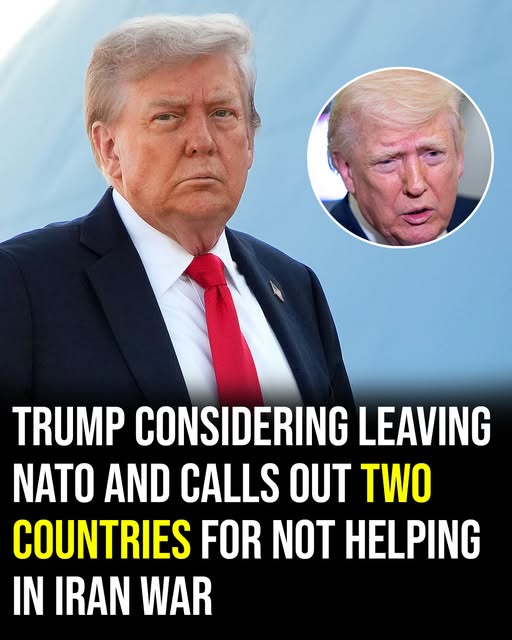
Donald Trump has once again brought up the prospect of leaving NATO, this time in more blunt and unyielding words than before, which has caused tensions between the US and its longstanding allies to sharply worsen.
Trump stated in a recent interview that his mistrust of NATO has not only remained but also grown. What was previously presented as criticism or reform pressure now seems to be developing into something much more significant: a real contemplation of leaving.
He said, “Oh yes, I would say it’s beyond reconsideration,” indicating that the possibility of abandoning the partnership is no longer speculative.
These comments are not coincidentally timed.
They coincide with rising geopolitical tensions, especially in light of the ongoing war with Iran, which has revealed differences between the US and a number of its long-standing allies. Trump claims that his belief that NATO is not operating as it should has been strengthened by the absence of assistance from important European allies throughout this war.
Trump has used harsh language to characterize NATO for years, frequently casting doubt on its usefulness and worth to the US. He went beyond in his most recent remarks, referring to the partnership as a “paper tiger,” a term that implies weakness, lack of credibility, and little practical influence.
This description poses a direct threat to NATO’s basic principles.
NATO was established in 1949 as a collective defense alliance with 12 members at first, including the United States, the United Kingdom, France, and Canada. It has grown to 32 nations now, making it one of the most important military alliances in contemporary history.
The idea of mutual defense, which states that an attack on one member is regarded as an attack on all, is at its foundation.
Trump’s remarks cast doubt on that idea.
He is questioning the legitimacy of the system as a whole rather than only criticizing policy by implying that the alliance lacks cohesion or strength. In doing so, he poses more general queries regarding the prospects for transatlantic collaboration.
The United Kingdom and France are specifically at the center of his most recent comments.
With strong military, political, and historical ties, both countries have long been regarded as America’s closest friends. However, Trump believes that their actions—or lack thereof—during the battle with Iran have been inadequate.
He expressed particular disapproval of the UK’s alleged reluctance to take decisive action against Iran. He expressed dissatisfaction not only with policy choices but also with what he perceives to be a lack of dedication.
Simultaneously, he harshly criticized France, charging it with impeding military operations’ logistical support. He claimed that France’s measures were not just ineffective but were deliberately impeding initiatives that were in line with American objectives.
Whether or not these charges are entirely true, they point to a larger trend in Trump’s foreign policy strategy.
He has continuously highlighted the importance of contributions, assistance, and tangible advantages in his transactional perspective on partnerships. In such paradigm, partnerships are assessed not on long-standing diplomatic relations but on quantifiable involvement.
His viewpoint has frequently put him at odds with conventional diplomatic methods, which prioritize collaboration, shared values, and long-term strategic alignment.
He went much farther in his comments regarding the UK.
He made critical remarks regarding the condition of Britain’s defense infrastructure and questioned the country’s military prowess, particularly its naval might. Despite being contentious, his remarks are consistent with his larger criticism that many NATO countries depend too much on the US while making fewer contributions of their own.
This is not a novel argument.
Trump has frequently urged NATO countries to boost their defense spending during his political career, claiming that the burden has been apportioned unfairly. Tensions around this matter have never really subsided, despite the fact that some nations have responded by increasing their military spending.
These conflicts seem to have been rekindled by the current circumstances.
However, there are further sources of contention in Trump’s past with NATO. His prior interest in obtaining Greenland, a region that is a part of the Kingdom of Denmark, is one such example. Strong opposition to such initiative complicated relations between the United States and Europe.
When combined, these instances create a pattern.
They demonstrate a persistent readiness to examine long-standing agreements, challenge established alliances, and advocate for reforms that support his conception of the national interest.
The degree of escalation is what distinguishes the current situation.
Talking about leaving NATO is a significant change in global strategy, not a small tweak. Since the alliance’s founding, the United States has been one of its main pillars. Its exit would have a significant impact on both NATO and the dynamics of international security in general.
The balance of power in several areas, coordination, and deterrence would all be called into question.
It would also compel other member states to reevaluate their own strategic plans, roles, and obligations.
For the time being, the potential is just that—a possibility.
However, it appears to be taken seriously based on the terminology used.
And that is sufficient to have an impact on discussions at the highest governmental and military levels.
Thus far, responses from allies have been muted, with officials stressing the significance of ongoing stability and collaboration. Even though there are still underlying conflicts, there is a public emphasis on preserving unity.
The problem is probably being evaluated more urgently in private.
due of the big stakes.
NATO is more than just an organization; it is a framework that has influenced global security for many years. Any change to its membership or structure has ramifications that go well beyond specific nations.
According to Trump, the main concern is whether the alliance effectively serves American interests in its current form.
Others have a more general question: what happens if it doesn’t?
One thing is evident as the conversations go on.
NATO’s future is still up in the air.
Furthermore, the result of that discussion may change international alliances in ways that are currently being worked out.