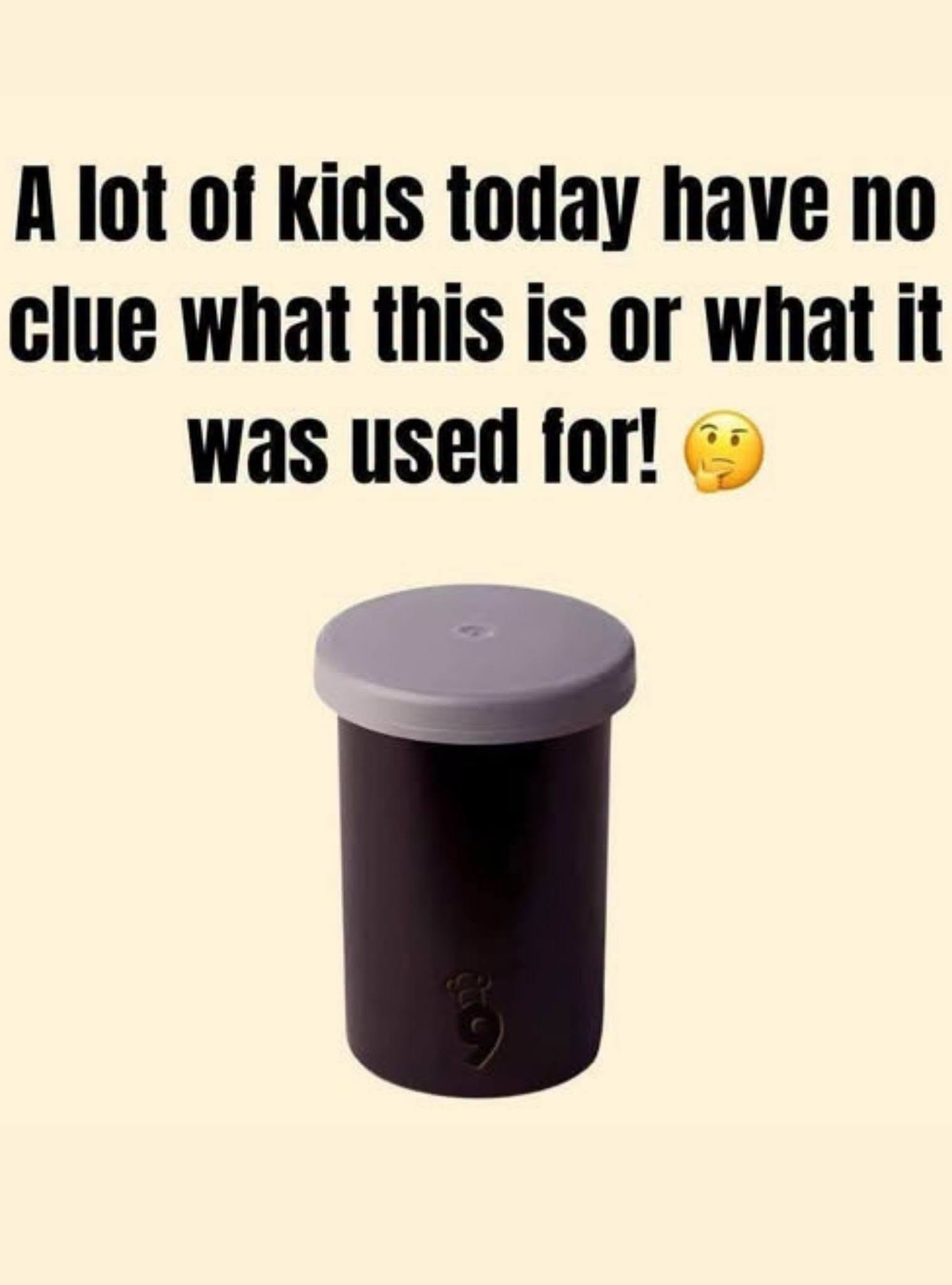
As photography evolved into the digital age, these little canisters quietly slipped out of everyday life, but they never truly disappeared. Millions of households still have a handful tucked away somewhere, not because they serve an essential purpose, but because letting go of them somehow feels like letting go of the memories they once protected. They became tiny time capsules—not valuable for what they contained today, but for what they represented yesterday.
Their usefulness hardly ended when the last roll of film was developed. Gardeners discovered they were perfect for storing seeds through the winter. Hobbyists filled them with beads, fishing hooks, nails, and tiny hardware that would otherwise disappear into the depths of a toolbox. Parents turned them into homemade rattles for toddlers, while teachers used them for science experiments, craft projects, and classroom games. Their simple design made them surprisingly durable, proving that the most ordinary objects often find extraordinary second lives.
Yet for many people, opening one still triggers something far deeper than practicality. It recalls family vacations where every photograph mattered because there were only twenty-four or thirty-six chances to capture the perfect moment. It reminds us of birthdays where everyone squeezed together because no one wanted to waste a frame. Every click of the shutter carried intention, and every undeveloped roll held weeks—or even months—of anticipation. You couldn’t delete mistakes or immediately check the results. You simply trusted the moment and hoped it would come back exactly as you remembered it.
Then there was the excitement of visiting the photo lab. Picking up that familiar envelope was an event in itself. Friends and families gathered around kitchen tables, passing glossy prints from hand to hand, laughing at closed eyes, unexpected photobombs, and crooked smiles that somehow became everyone’s favorites. Those photographs didn’t disappear into cloud storage or endless camera rolls. They found homes inside albums, frames, scrapbooks, and shoeboxes that would be rediscovered years later.
Perhaps that is why so many people still hesitate before throwing away an empty film canister. It isn’t the plastic that’s difficult to part with. It’s everything the object has quietly absorbed through the years—the adventures, the celebrations, the ordinary afternoons that somehow became precious with time. Like ticket stubs, handwritten letters, or cassette tapes, the canister has become a symbol of an era when memories demanded patience, and that patience made them feel even more valuable.
Today, nearly everyone carries a camera in their pocket capable of taking thousands of photos without a second thought. Yet despite all that convenience, many people still find themselves missing the slower rhythm of film photography. There was something deeply satisfying about knowing that every frame counted, that every photograph represented a conscious choice rather than an endless stream of forgotten images.
So if you happen to stumble across one of those tiny plastic canisters hidden in a drawer or tucked inside an old camera bag, don’t be surprised if you pause before tossing it away. It may no longer hold a roll of film, but it still carries something impossible to replace—a reminder of a time when memories weren’t measured by the number of photos we took, but by the moments we chose to preserve. Sometimes the smallest containers hold the biggest pieces of our past, quietly waiting for someone to remember why they mattered in the first place.