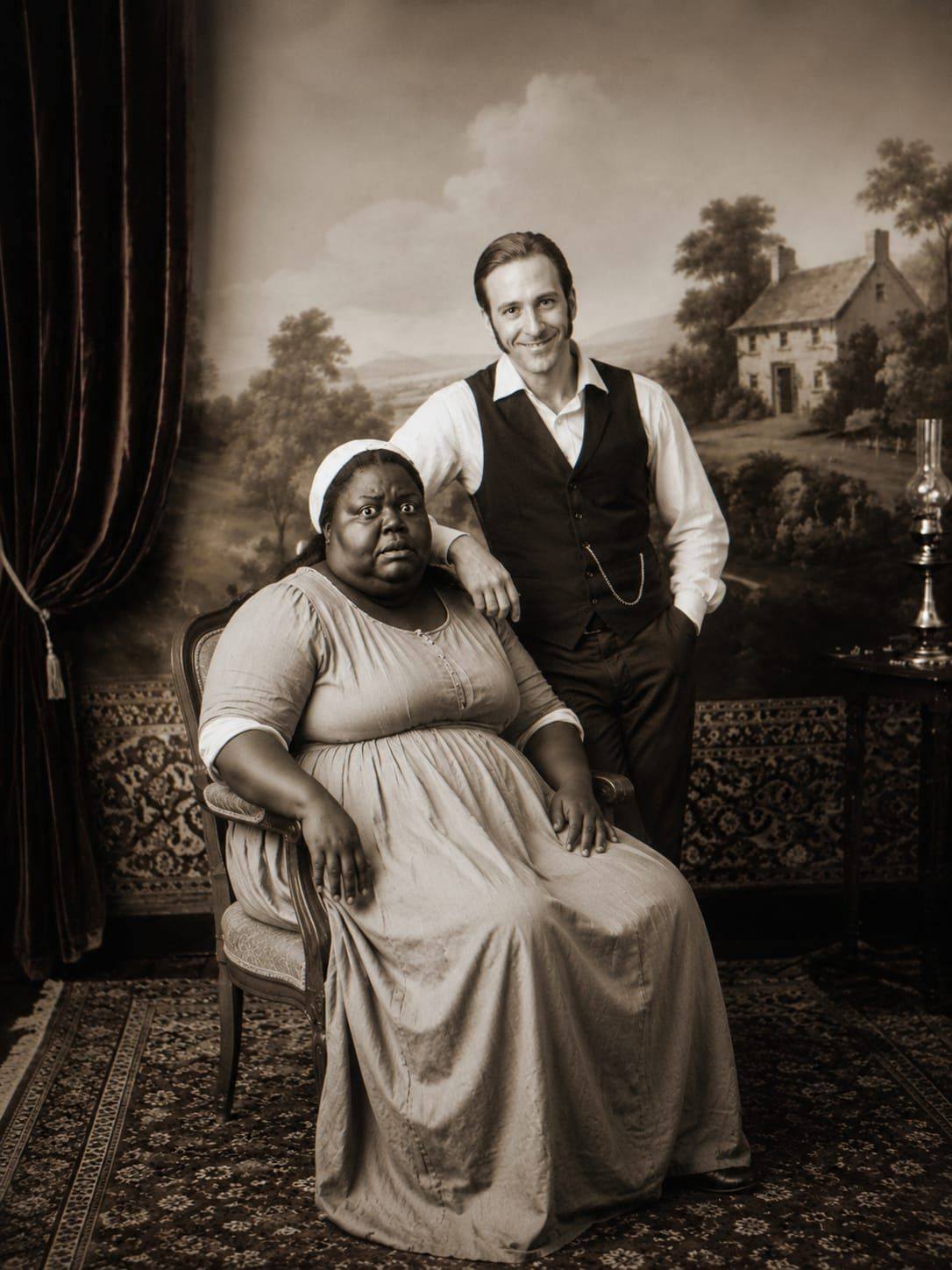
They marched her through the crowd as though she were nothing more than a burden no one wanted to claim. Under the burning sun of 1857 Vassouras, surrounded by traders, plantation owners, and curious onlookers, Benedita stood alone while strangers measured her worth with cold eyes. Every glance felt like a judgment. Every whisper felt like a sentence already decided. In a world where human beings were bought and sold like livestock, she was considered even less desirable than most. Her unusual height, powerful build, and commanding presence made people uneasy. Instead of seeing strength, they saw danger. Instead of seeing resilience, they saw a problem.
The crowd did not hide its opinions.
Some laughed.
Others pointed.
Many shook their heads before even hearing the asking price.
To them, Benedita seemed too strong, too intimidating, too different. Rumors spread quickly through the marketplace. Buyers whispered that she was difficult to control, stubborn, perhaps even dangerous. Whether any of it was true hardly mattered. Once those ideas took hold, they followed her from one potential buyer to the next.
For Benedita, every rejection cut deeper than the last.
She had already endured a life shaped by cruelty and chains. She knew what it meant to have her freedom stolen and her future decided by others. Yet standing there while strangers openly dismissed her brought a different kind of humiliation. Even within a system built on exploitation, she was being treated as unwanted.
As bidding began, the situation only grew worse.
Potential buyers hesitated.
A few offers were made, but they were low.
Far lower than expected.
Each failed bid seemed to confirm what the crowd already believed. Laughter echoed through the square as people watched her value fall lower and lower. What should have been a competitive sale slowly became an uncomfortable spectacle.
Then came the silence.
The kind of silence that says more than words ever could.
No new offers.
No interested buyers.
No one stepping forward.
It felt like the final verdict on her life.
Even as property, she was unwanted.
For a moment, it seemed her fate had already been decided.
Then a voice broke through the silence.
A single bid.
Quiet.
Calm.
Unexpected.
The crowd turned toward the source.
It was Joaquim Lacerda.
Unlike the others, he wasn’t laughing. He wasn’t whispering with the crowd or joining in the mockery. While others saw a burden, he appeared to see something entirely different.
He saw strength.
He saw potential.
He saw a woman whose spirit had survived circumstances that would have broken many others.
The bid itself was simple, but its impact was enormous.
Suddenly, the silence disappeared.
People exchanged surprised glances.
Some questioned his judgment.
Others laughed at the decision.
But Joaquim remained unmoved.
He was not interested in the crowd’s approval.
Something about Benedita had caught his attention.
Perhaps it was her determination.
Perhaps it was the way she continued standing tall despite the humiliation surrounding her.
Or perhaps he simply recognized that the qualities others feared were the very qualities that made her remarkable.
His decision did not erase the brutality of slavery.
It did not transform oppression into kindness.
Nor did it undo the years of suffering Benedita had already endured.
The system remained cruel.
The injustice remained real.
Yet within that harsh reality, one decision altered the direction of her life.
For the first time that day, someone had looked beyond the labels others placed upon her.
The crowd saw a problem.
Joaquim saw possibility.
The crowd saw danger.
Joaquim saw strength.
The crowd saw someone to reject.
Joaquim saw someone worth recognizing.
As Benedita left the auction that day, the chains of slavery had not disappeared. Her struggles were far from over. Yet something important had changed. The story everyone thought they understood was no longer moving toward the ending they expected.
History is often shaped by powerful men, governments, and major events. But sometimes a life changes because of something much smaller: a choice, a moment, a single person willing to see what everyone else ignores.
Benedita’s story is not a tale of a cruel system becoming just. It is a reminder that even in the darkest chapters of history, human dignity can survive attempts to destroy it. Despite humiliation, rejection, and years of suffering, she remained more than the value others assigned to her.
The people gathered in that marketplace believed they were witnessing the decline of a woman nobody wanted.
In reality, they were witnessing the beginning of a new chapter.
And although none of them could see it yet, the woman they dismissed as worthless possessed a strength far greater than anything they feared.
Sometimes all it takes to change a life is one person willing to look beyond what everyone else sees. And sometimes that single act of recognition becomes the first step toward rewriting an entire destiny.