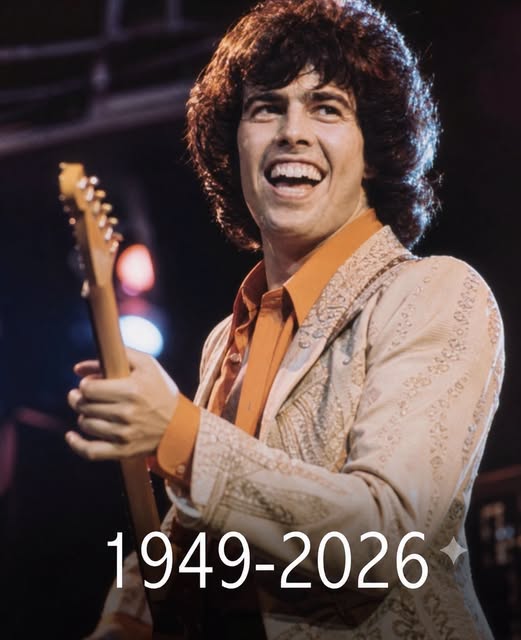
The news hit like a chord cut mid-song.
Alan Osmond is gone, and with him goes one of the quieter pillars of an American musical dynasty. For decades, his name was connected to the sound, discipline, and unity of the Osmond family, but his importance was never limited to what audiences could see from a stage.
He was one of the people who helped hold the entire structure together.
For fans, the Osmonds represented music, family, television, and the kind of entertainment that could bring generations together in the same living room. But behind the bright costumes, rehearsals, tours, recordings, and applause was an enormous amount of work that most viewers never witnessed.
Alan was part of that hidden machinery.
He helped shape the direction.
He helped maintain the discipline.
He helped keep the family moving forward.
And for years, even as multiple sclerosis quietly rewired his body, he continued finding ways to contribute.
What his fans saw was only half the story.
Alan’s life was never just about standing beneath the spotlight.
It was about holding the light steady so other people could stand in it.
From childhood stages to global tours, he helped shape the Osmonds’ sound, organization, discipline, and direction. He understood that a successful performance wasn’t created during the few minutes an audience saw.
It was created backstage.
In rehearsals.
In planning sessions.
In disagreements that had to be resolved.
In decisions that nobody in the audience would ever know had been made.
Family entertainment can look effortless from the outside.
It rarely is.
When several brothers and relatives are performing together, the personal and professional worlds become impossible to separate. A disagreement at home can affect a rehearsal. A mistake onstage can become a family conversation later that night.
Alan learned how to navigate that complicated territory.
He wasn’t simply helping create music.
He was helping maintain a family system.
Then multiple sclerosis changed the rules.
The disease gradually imposed limitations on his body, forcing him to confront something few performers are prepared to accept: the physical abilities that once seemed permanent can suddenly become uncertain.
Movement becomes harder.
Energy becomes more precious.
Plans require adjustment.
The things that once happened automatically may require assistance.
For someone whose early life had been defined by movement, performance, and constant activity, that could have been devastating.
But Alan learned to lead differently.
When his body could no longer do everything it once had, his mind, experience, and commitment remained.
He turned rehearsal rooms into classrooms.
He helped younger family members understand not only how to perform, but why preparation mattered.
He transformed family decisions into shared missions rather than individual battles.
And he carried his private faith with a steadiness that became part of the way people understood him.
His illness did not erase his usefulness.
It forced him to redefine it.
That may be one of the most important parts of his story.
There is a painful assumption in modern culture that someone’s value is tied to what their body can physically accomplish. Alan’s later life challenged that idea.
He couldn’t always contribute in the same way.
So he found another way.
He couldn’t necessarily stand where he once stood.
So he helped others stand there.
He couldn’t move through life at the same pace.
So he became more deliberate about where his energy went.
And in doing so, he demonstrated that leadership doesn’t always become smaller when circumstances change.
Sometimes it becomes quieter.
In later years, his role became less visible but no less central.
He became a mentor to sons and brothers.
A partner to Suzanne.
A reassuring presence for fans who had grown older alongside him.
People who had watched the Osmonds as children eventually became parents and grandparents themselves, carrying memories of television appearances, family gatherings, songs, and performances into entirely different generations.
For those fans, Alan wasn’t simply a member of a famous group.
He was part of the background music of their lives.
He existed in memories of living rooms filled with relatives.
In evenings when everyone gathered around the television.
In songs that instantly transported people back to a particular year, a particular home, or a particular person.
That’s the strange power of music.
It doesn’t simply occupy our ears.
It attaches itself to memory.
A melody can bring back an entire period of your life before you even realize what is happening.
And Alan helped create some of those melodies.
But his legacy extends beyond hit records.
It lives in the invisible work of arranging and organizing.
It lives in musicians who understand that successful performances depend on preparation long before an audience arrives.
It lives in family members who learned from his example that collaboration can matter more than individual recognition.
And it lives in anyone who has ever had to reinvent their usefulness after illness or circumstance redraws the map of their life.
That last lesson may be especially powerful.
Alan’s story was not simply about what multiple sclerosis took away.
It was also about what he refused to surrender.
Purpose.
Family.
Faith.
Connection.
The desire to contribute.
There is a difference between accepting a limitation and accepting defeat.
Alan appeared to understand that difference.
He could acknowledge what his body could no longer do without allowing that fact to become the definition of who he was.
That takes a particular kind of strength.
Not the dramatic strength of a person lifting something heavy or performing beneath bright lights.
A quieter strength.
The strength required to wake up and adapt.
To accept help when necessary.
To find another path.
To continue being present when your role has changed.
That is often the hardest kind of resilience because there is no applause for it.
Nobody sees every difficult morning.
Nobody witnesses every private adjustment.
Nobody knows how many times a person has had to tell themselves, “I’ll find another way.”
But those moments matter.
Alan’s later years were filled with them.
And through them, he remained connected to the people who mattered most.
His family.
His faith.
His music.
His fans.
His role as a mentor.
The Osmonds were always more than a musical act. They were a family enterprise, and that made Alan’s contribution especially significant.
He understood that preserving a family’s history isn’t simply about remembering the biggest performances.
It is about preserving the relationships that made those performances possible.
The arguments.
The laughter.
The rehearsals.
The sacrifices.
The private encouragement.
The people who stayed behind the scenes so someone else could walk into the spotlight.
Alan was one of those people.
And now, with his death, the family and the fans are left to carry those memories forward.
The stage eventually empties.
The microphones go quiet.
The lights turn off.
But the influence of someone who spent decades helping others doesn’t disappear when the performance ends.
It moves into the people they taught.
The children they raised.
The siblings they supported.
The musicians they influenced.
The fans who still remember the sound of those songs.
Perhaps that’s why his passing feels like more than the loss of another performer.
It feels like the closing of a chapter.
A chapter that began with childhood performances and expanded into an extraordinary family story, but ultimately became something much more personal: a story about adapting when life changes the rules.
Alan didn’t get to choose every challenge placed in front of him.
He didn’t choose the limitations imposed by multiple sclerosis.
But he could choose how he responded.
And he kept choosing participation.
He kept choosing family.
He kept choosing purpose.
He kept finding ways to be useful.
That is the part of his story that may remain longest.
Not simply that he was once onstage.
Not simply that he helped create successful music.
But that when the physical world around him changed, he refused to believe his life had become meaningless.
He found another role.
Then another.
And another.
Until the spotlight mattered less than the people standing inside it.
The news may have arrived like a chord cut mid-song.
But the music Alan helped create doesn’t end with him.
It continues in recordings.
In memories.
In family stories.
In the lessons passed from one generation to the next.
And in every person who learns from his life that when illness redraws the map, you don’t necessarily have to stop moving forward.
Sometimes you simply learn to walk a different road.