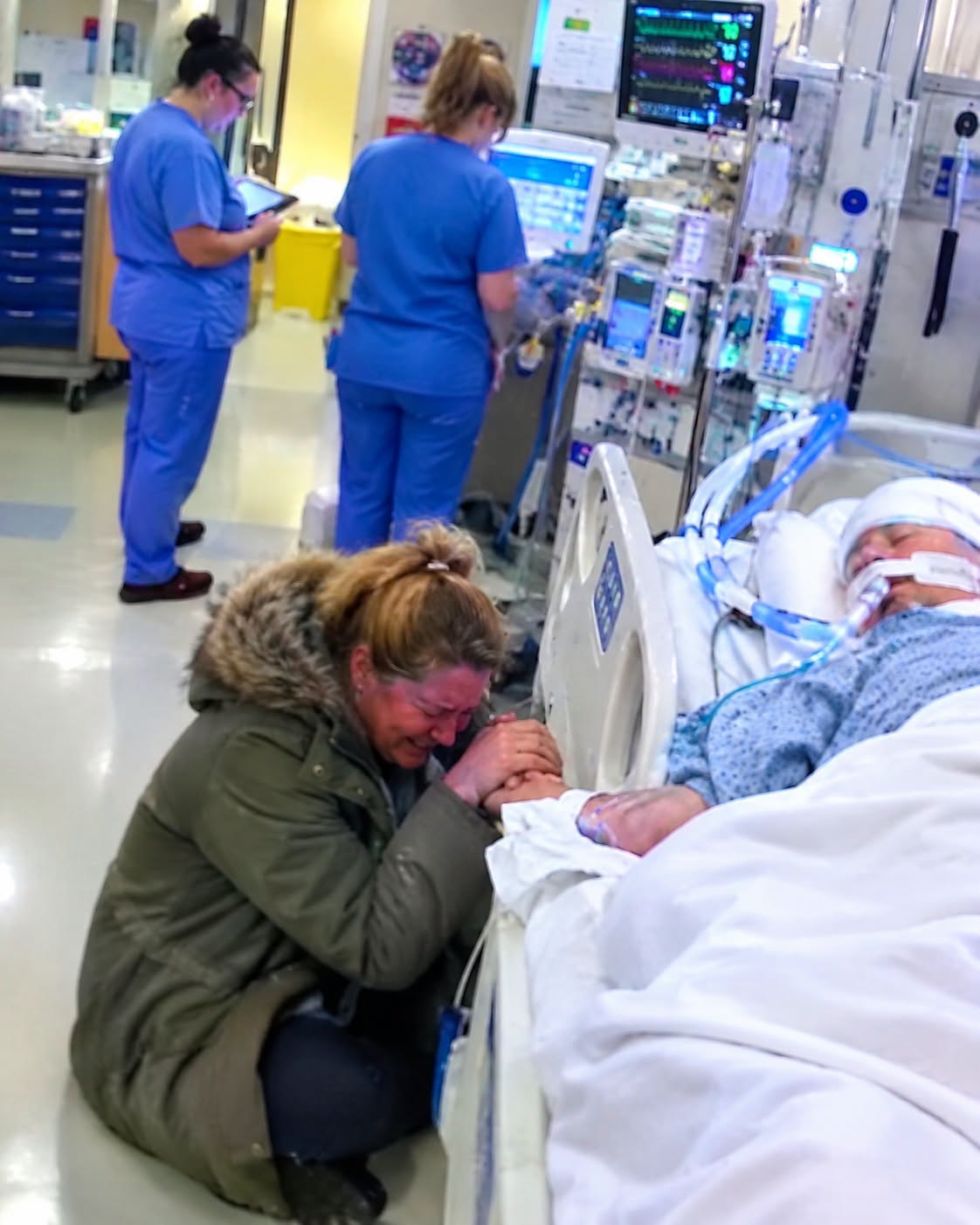
At 5 A.M., My Son-in-Law Called and Said, “Come Pick Up Your Daughter at the Bus Stop. We Don’t Want Her Anymore.” When I Found Her Covered in Bruises, She Whispered, “My Husband and His Mother Beat Me.” I Rushed Her to the Hospital, But She Didn’t Survive. That Morning, I Made a Promise: The People Who Took My Daughter From Me Would Finally Face the Truth.
At 5:03 a.m., my phone rang.
I remember the time because I had barely slept that night. I was sitting in the kitchen, holding a cup of tea that had gone cold, when my son-in-law’s name appeared on the screen.
For a moment, I wondered why he was calling so early.
Then I answered.
“Hello? Daniel? Is everything all right?”
His voice was flat, almost bored.
“Come pick up your daughter at the bus stop. We don’t want her anymore.”
I froze.
“What are you talking about? Where is Emily?”
“At the bus stop. She’s your problem now.”
Before I could ask another question, he hung up.
I stared at my phone, waiting for it to ring again. I called him back twice, but he rejected both calls.
Something about his voice frightened me. There was no concern, no explanation, and not even the slightest hint of embarrassment. It sounded as though he were asking me to collect an unwanted package.
My daughter, Emily, was thirty-four years old.
She was a mother, a wife, and the little girl I had raised after her father died when she was twelve. She had always been stubborn in the best possible way, the kind of person who would give away her last dollar if someone else needed it more.
For the past two years, however, I had watched her slowly disappear.
She called less often. She stopped visiting without a reason. When I asked about the bruises she sometimes concealed beneath long sleeves, she laughed nervously and blamed accidents.
Whenever I questioned her husband, Daniel, he assured me that their marriage was fine.
His mother, Margaret, was even more convincing.
“Emily is emotional,” she once told me. “You know how sensitive she can be. She exaggerates everything.”
I wanted to believe them.
That was my first mistake.
I grabbed my coat, my keys, and my purse. I didn’t even change out of my slippers before rushing to the car.
The roads were nearly empty. Streetlights cast pale circles across the wet pavement, and a thin fog hovered above the sidewalks.
I kept calling Emily’s phone.
No answer.
I called Daniel again.
Nothing.
With every passing minute, a terrible feeling grew inside my chest.
When I finally reached the bus stop, I saw someone lying beside the shelter.
For one second, I didn’t recognize her.
Then I saw the familiar blue coat.
“Emily?”
I threw open the car door and ran toward her.
She was lying on her side, her hair tangled across her face. Her coat was torn, one sleeve was stained with blood, and her hands trembled uncontrollably.
There were bruises across her cheeks and forehead. One of her eyes was swollen almost shut. Her breathing came in shallow, irregular gasps.
I fell to my knees beside her.
“Oh, sweetheart. Oh, my baby. What happened to you?”
Her eyes opened slightly.
“Mom?”
“I’m here. I’m right here. Don’t try to move.”
I reached for my phone with shaking hands and called emergency services.
While I waited for help, I held her hand and tried to keep her awake.
She was freezing.
I wrapped my coat around her and begged her to keep looking at me.
“Stay with me, Emily. Please. You’re going to be okay. Just stay with me.”
She began to cry.
Not loudly. Not dramatically.
Just a few weak tears slipping down her cheeks.
Then she whispered something that changed my life forever.
“My husband…”
I leaned closer.
“What about him, sweetheart?”
“And his mother…”
Her breathing caught.
“They beat me, Mom.”
For a moment, the world went silent.
I heard the distant sound of traffic, the wind moving through the trees, and the faint crackle of my phone as the emergency dispatcher spoke.
But all I could hear was my daughter’s voice.
They beat me.
I wanted to ask a thousand questions. I wanted to know how long it had been happening, why she hadn’t told me, and what those people had done to her.
Instead, I pressed her hand against my cheek.
“You don’t have to explain anything right now. Just breathe, sweetheart. Help is coming.”
She began to sob.
“I tried to leave.”
My heart shattered.
“I know. I know, baby.”
“They wouldn’t let me…”
Her voice faded.
I bent over her, calling her name, terrified that if I stopped speaking, she would disappear.
When the ambulance arrived, the paramedics worked quickly. They checked her breathing, stabilized her, and lifted her onto a stretcher.
One of them asked me to move back.
I couldn’t.
“Please,” I begged. “She’s my daughter.”
The paramedic looked into my eyes.
“We’re going to do everything we can.”
I climbed into the ambulance beside her.
All the way to the hospital, I held her hand and prayed.
I prayed to a God I had barely spoken to in years. I promised I would do anything if He would let my daughter live.
I would sell my house.
I would give away every possession I owned.
I would spend the rest of my life making things right.
Just let her come home.
Just let me hear her laugh again.
Just let me tell her that I was sorry I hadn’t understood how much danger she was in.
But sometimes, no matter how desperately a mother prays, the answer she receives is the one she cannot bear.
And that morning, I lost my daughter.
Chapter One: The Doctor Who Wouldn’t Look Me in the Eye
The hospital doors opened at 5:41 a.m.
Doctors and nurses rushed Emily into the emergency department. Someone asked me for her medical history. Someone else asked whether she had any allergies.
I answered every question automatically.
Then a nurse guided me into a small waiting room.
“Please sit down, ma’am. The doctors need space to work.”
I sat in a plastic chair beneath fluorescent lights that made everything look pale and unreal.
My hands were covered in Emily’s blood.
I kept rubbing my fingers together, trying to clean them, but the stains had already dried.
After twenty minutes, a doctor came out.
He introduced himself as Dr. Harris and asked me to follow him into a consultation room.
I knew before he spoke.
A mother knows when a room has become the place where her life will divide into before and after.
“Your daughter has sustained multiple serious injuries,” he said carefully. “We’re doing everything we can to stabilize her.”
“Will she survive?”
He paused.
“We’re very concerned about internal injuries and the extent of the trauma.”
I gripped the edge of the chair.
“Please don’t speak to me like I’m a stranger. Tell me whether my daughter is going to live.”
He looked down at his notes.
“We’re fighting for her.”
That was all he could give me.
I returned to the waiting room and called Emily’s best friend, Sarah.
When she answered, her voice was thick with sleep.
“Hello?”
“Sarah, it’s me. Emily’s in the hospital.”
There was a sudden silence.
“What happened?”
“I don’t know everything yet. Please come.”
She arrived forty minutes later, still wearing the clothes she had slept in. When she saw me, she rushed forward and wrapped her arms around me.
I began to cry.
Sarah held me while I told her what Emily had whispered at the bus stop.
Her face changed.
“What do you mean, Daniel and Margaret beat her?”
“I don’t know. I don’t know anything except that my daughter was lying in the cold, barely breathing.”
Sarah covered her mouth.
Then she said something I will never forget.
“She tried to tell me.”
I pulled away.
“What?”
“Three weeks ago, she called me late at night. She was crying, but she wouldn’t tell me exactly what happened. She said she was afraid Daniel would find out she’d spoken to me.”
My stomach turned.
“Why didn’t you tell me?”
Tears filled Sarah’s eyes.
“She begged me not to. She said you would confront him, and she was afraid he’d hurt her worse.”
I stared at her.
Emily had been frightened enough to hide her suffering from her own mother.
And I had mistaken her silence for distance.
I had thought she was busy.
I had thought she needed space.
I had thought the marriage was simply going through a difficult period.
How many times had she sat beside me at the kitchen table, smiling through pain I couldn’t see?
How many times had I accepted her excuses because the truth was too frightening to imagine?
At 7:18 a.m., the doctor returned.
This time, he brought another physician with him.
I stood before either of them could speak.
“No,” I whispered. “Please. Don’t tell me that.”
Dr. Harris took a breath.
“I’m so sorry.”
I shook my head.
“No.”
“Despite our efforts, we were unable to save your daughter.”
I don’t remember screaming.
I don’t remember falling to my knees.
I remember the doctor reaching for me, and I remember pushing his hands away because I couldn’t understand why anyone was touching me when my daughter was gone.
Emily was gone.
My little girl, who had once fallen asleep with her head on my shoulder.
My daughter, who used to leave handwritten notes in my lunch bag when I worked long shifts.
The woman who called me every Sunday just to ask what I was cooking.
Gone.
I had spent thirty-four years protecting her as best I could.
And in the end, I hadn’t been there when she needed me most.
I pressed my hands against my face and sobbed until I couldn’t breathe.
But beneath the grief, something else was beginning to take shape.
A terrible, burning certainty.
Daniel and Margaret knew what had happened.
They had left my daughter at a bus stop like discarded property.
And they believed they could return to their comfortable home, close their front door, and continue their lives.
They were wrong.
Chapter Two: The Last Message Emily Sent Me
The police arrived at the hospital shortly after eight.
A detective named Laura Mitchell introduced herself and asked whether I could answer a few questions.
I was barely functioning, but I agreed.
She asked about the phone call, the bus stop, and Emily’s final words.
I repeated everything as accurately as I could.
When I told her that Emily had accused her husband and mother-in-law of beating her, Detective Mitchell became very still.
“Did she say anything else?”
“She said she had tried to leave.”
The detective wrote something down.
“Has your daughter ever reported domestic violence before?”
“No.”
“Has she ever told you that her husband was physically abusive?”
I closed my eyes.
“Not directly.”
“Has she ever had unexplained injuries?”
I hesitated.
Then I remembered the bruises.
The long sleeves.
The way Emily sometimes flinched when someone moved too quickly behind her.
The excuses.
“Yes,” I whispered. “But she always said they were accidents.”
Detective Mitchell didn’t blame me.
She didn’t tell me I should have known.
She simply asked me to describe what I remembered.
And as I spoke, the pieces began falling into place.
Six months earlier, Emily had arrived at my house with a small cut above her eyebrow.
She told me she had slipped on the stairs.
I offered to take her to a doctor.
She refused.
A few weeks later, she had stopped wearing her wedding ring.
When I asked why, she said it needed repairing.
Then there was the night she called me at nearly midnight and asked whether she could come home.
I had been half asleep.
“Of course, sweetheart,” I told her. “What’s wrong?”
She had been quiet for several seconds.
Then she said, “Nothing. I just wanted to hear your voice.”
I asked whether she wanted me to drive over.
“No, Mom. Everything is fine.”
The next morning, she texted me a heart emoji.
I never questioned it again.
Now I would give anything to return to that night.
I would tell her to pack a bag.
I would drive through the darkness to bring her home.
I would sit beside her until she felt safe enough to tell me everything.
But the past does not open its doors for grieving mothers.
It only leaves them standing outside, staring at what they can no longer change.
Before Detective Mitchell left, she asked whether I could provide Emily’s phone.
I explained that the police had taken it from her belongings.
She nodded.
“We’ll need to examine her recent communications. If there’s evidence of threats or previous assaults, it may help us establish what happened.”
I looked at her.
“Will you find out the truth?”
“We’ll investigate every lead we have.”
I held onto that promise.
Because my daughter deserved more than a tragic story whispered at a funeral.
She deserved the truth.
And if someone had hurt her, she deserved justice.
Chapter Three: The House Where My Daughter Suffered
Two days after Emily died, I packed a small suitcase.
I wasn’t planning to do anything reckless.
I wasn’t going to hurt anyone.
But I could no longer sit in my quiet house surrounded by photographs while the people responsible for my daughter’s suffering remained behind their locked doors.
I needed to look them in the eye.
I needed to hear what they had to say.
And I needed them to understand that Emily was not someone they could erase.
Before leaving, I called Detective Mitchell.
I told her where I was going.
She warned me not to confront Daniel if I believed he might become violent.
“I don’t want you putting yourself in danger,” she said.
“I won’t do anything to interfere with your investigation,” I promised. “I just need to speak to them.”
She advised me to remain calm and call the police if there was any threat.
Then I drove to the house where Emily had lived for six years.
It was a beautiful home with white shutters, a neatly trimmed lawn, and flower beds Margaret had always taken great pride in.
From the street, nothing looked wrong.
That was the most frightening part.
A family could appear ordinary to the neighbors while someone inside was living in terror.
I parked across the road and sat behind the steering wheel for several minutes.
I remembered Emily standing on those front steps on her wedding day, laughing as the wind blew her veil across her face.
She had looked so happy.
She had squeezed my hand and whispered, “Mom, I think this is the beginning of everything wonderful.”
I had kissed her cheek.
“I hope it is, sweetheart.”
I had believed her.
I had believed them all.
Then I got out of the car and walked to the front door.
Daniel answered.
For a moment, neither of us spoke.
He looked tired, but not devastated. There were dark circles beneath his eyes, and his shirt was wrinkled.
When he recognized me, his expression hardened.
“What are you doing here?”
I stared at him.
“My daughter is dead.”
He glanced toward the street.
“I know.”
“You left her at a bus stop.”
“She wanted to leave.”
“She was barely breathing.”
He rubbed his forehead.
“Look, this is not a good time.”
I felt something inside me go cold.
“Not a good time?”
He started to close the door.
I placed my hand against it.
“Did you hurt my daughter?”
His jaw tightened.
“I don’t know what she told you.”
“She told me you and your mother beat her.”
He looked away.
That tiny movement told me more than any denial could have.
“Get off my property,” he said.
I stepped back.
For a moment, I wanted to scream.
I wanted to ask how he could stand there in a clean shirt while my daughter lay in a funeral home.
But I remembered Detective Mitchell’s warning.
I wouldn’t give him an excuse to portray me as unstable.
Instead, I looked him directly in the eyes.
“You can refuse to speak to me. You can close your door. You can pretend you don’t know what happened.”
I paused.
“But you will not make my daughter disappear. I will remember her. I will speak her name. And I will make sure the truth is heard.”
Then I turned and walked away.
I had expected anger to consume me.
Instead, I felt something more focused.
A determination to keep going, even when grief made every step feel impossible.
Chapter Four: The Woman Who Called My Daughter a Liar
Margaret was waiting in the doorway when I returned to the house the following afternoon.
She wore a dark cardigan and held a cup of tea.
Her expression was composed.
Too composed.
“I suppose you’ve come to accuse us of something,” she said.
I looked at her.
“My daughter is dead.”
She sighed.
“It’s a terrible tragedy.”
“Then tell me what happened.”
Margaret took a sip of tea.
“Emily was unstable. She had been talking about leaving for months. She was upset, and things got out of hand.”
“What does that mean?”
“It means there was an argument.”
“An argument that left her with broken bones?”
Her face tightened.
“You weren’t there.”
“No. I wasn’t. Because I trusted you.”
For the first time, her composure faltered.
I stepped closer, keeping my voice low.
“She called me her mother. She trusted me enough to whisper what happened before she died. And she said you beat her.”
Margaret’s eyes narrowed.
“Emily said many things when she was upset.”
I stared at her in disbelief.
Even now, she was trying to turn my daughter’s final words into another symptom of a supposed flaw.
“Did you touch her?”
“I will not discuss this with you.”
“Did you touch my daughter?”
She set the cup down.
“You should leave before I call the police.”
I nodded slowly.
“That’s fine. I’ve already spoken to them.”
For the first time, Margaret looked frightened.
It lasted only a second, but I saw it.
Then she recovered.
“You have no idea what you’re doing,” she said.
“Maybe not. But I know what a mother’s grief feels like.”
I looked at the house behind her.
“I also know that my daughter spent years trying to keep the peace here. She made excuses for you. She hid her injuries. She was afraid to tell me the truth.”
Margaret said nothing.
I continued.
“You may never admit what happened. But I will not let you convince the world that Emily deserved it.”
Then I left.
I didn’t threaten her.
I didn’t touch her.
I didn’t need to.
The investigation would determine what had happened, and I intended to cooperate with every legitimate step.
My job was no longer to make them understand my pain.
My job was to protect my daughter’s memory and ensure that the evidence was not buried beneath their excuses.
Chapter Five: The Envelope in Emily’s Closet
A week later, Sarah came to my house carrying a small cardboard box.
She looked exhausted.
“I found something,” she said.
I invited her inside.
We sat at the kitchen table where Emily used to do her homework.
Sarah placed the box between us.
“She gave me this a few months ago. She told me to keep it safe, but she made me promise not to open it unless something happened to her.”
I felt the blood drain from my face.
“Why didn’t you tell the police?”
“I did. Detective Mitchell said I should bring it to you only if you were comfortable, and that we should let her know immediately.”
Sarah explained that the box contained copies of documents Emily had collected over several months.
There were photographs of bruises.
Screenshots of threatening messages.
Notes recording dates when arguments had turned violent.
And a folded letter addressed to me.
My hands trembled as I opened it.
Mom,
If you’re reading this, it means something happened, and I’m sorry I didn’t tell you everything sooner.
I was afraid.
At first, Daniel only shouted. Then he began breaking things. Margaret always said I was provoking him. She told me that if I were a better wife, he wouldn’t lose control.
When I tried to tell Daniel that I wanted to leave, he said he’d make sure I never saw anyone again. He said you would suffer if I embarrassed him.
I kept thinking I could fix things. I thought if I became quieter, if I stopped arguing, if I did everything they wanted, the person I married would come back.
But I’m scared, Mom.
I’m scared of what happens when I leave.
I know you’ll be angry that I didn’t tell you. Please understand that I wasn’t trying to keep you away. I was trying to protect you from them.
I want to come home.
I want to sit at our kitchen table and tell you everything.
I want to feel safe again.
I love you.
Emily.
I couldn’t finish reading the final line aloud.
The letter slipped from my fingers.
Sarah reached across the table and held my hand.
I cried until my chest hurt.
My daughter had wanted to come home.
She had been planning to leave.
And all those months when I thought she was growing distant, she had been trying to survive.
I pressed the letter against my heart.
“I should have known,” I whispered.
Sarah shook her head.
“She was afraid. People who hurt someone often make leaving feel dangerous. She was trying to survive.”
I wanted to believe her.
I needed to believe that Emily’s silence had not been a failure of love.
That night, I called Detective Mitchell and told her about the box.
The detective arranged for the materials to be collected and documented properly.
She warned me not to contact Daniel or Margaret about the evidence.
I agreed.
The next morning, I handed over the documents.
For the first time since Emily died, I felt that something useful might come from the unbearable pain.
Not revenge.
Not another confrontation.
Evidence.
A record of what my daughter had experienced.
A chance for the truth to be examined.
Chapter Six: The Investigation
The investigation moved slowly.
Detective Mitchell explained that every piece of evidence had to be verified, documented, and examined carefully.
The photographs needed to be authenticated.
The messages needed to be traced to their sources.
Witnesses had to be interviewed.
Medical records had to be reviewed.
Nothing could be based solely on my grief or my suspicions, no matter how certain I felt about what Emily had told me.
At first, the waiting was unbearable.
I wanted answers immediately.
I wanted someone to explain how my daughter had ended up alone at a bus stop with injuries so severe that doctors could not save her.
But I knew that anger could not replace evidence.
So I did the only thing I could.
I cooperated.
I provided every message I had received from Emily.
I wrote down every conversation I could remember.
I gave the police the names of people who had seen her injuries or heard her express fear.
Sarah also provided her records and agreed to answer questions.
As the weeks passed, Detective Mitchell informed me that investigators had identified messages and other materials requiring further examination.
She did not share details that could compromise the case.
She simply told me that the evidence was being reviewed and that Daniel and Margaret had been interviewed.
I asked whether they had admitted anything.
“I’m not able to discuss every aspect of the investigation,” she said. “But we’re following the evidence.”
I understood.
I didn’t like it, but I understood.
Then, one afternoon, she called with an update.
“Mrs. Carter, we have enough information to take the next step. I can’t promise you what the final outcome will be, but the case is moving forward.”
I sat down at the kitchen table.
For the first time in weeks, I could breathe without feeling that I was about to collapse.
My daughter would never come home.
No arrest, trial, or verdict could change that.
But the truth was no longer trapped inside the house where she had suffered.
It was being examined by people who had a responsibility to take it seriously.
And that mattered.
Chapter Seven: The Day Their Front Door Opened
Several weeks later, Detective Mitchell informed me that Daniel and Margaret had been formally charged in connection with Emily’s death.
The precise allegations and the evidence supporting them would be addressed through the legal process.
I listened quietly as she explained the next steps.
When the call ended, I sat alone in my living room.
I had imagined this moment many times.
I thought I would feel triumph.
I thought I would feel the rage inside me finally settle.
Instead, I felt exhausted.
The charges did not bring Emily back.
They did not erase the photographs in the box.
They did not undo the fear in her final words.
But they meant that the allegations would no longer be treated as a private family dispute.
They would be examined in court.
There would be witnesses, evidence, and an opportunity for the facts to be established.
For the first time, I did not feel the need to go to Daniel’s house.
I had already looked him in the eye.
I had already told him that my daughter would not be forgotten.
Now it was time to let the legal process do what it was designed to do.
On the morning of the first court appearance, I wore Emily’s favorite blue scarf.
Sarah sat beside me.
We didn’t speak much.
When Daniel entered the courtroom, he looked toward me for a moment.
I held his gaze.
I did not shout.
I did not insult him.
I did not need him to acknowledge my pain.
I was there because Emily deserved to have her story heard.
Margaret sat a few seats away.
She stared straight ahead.
For years, they had controlled the story inside their home.
They had told Emily that she was exaggerating.
They had made her afraid to speak.
They had convinced her that leaving would make everything worse.
But now, the case was no longer theirs to control.
The proceedings would take time.
The outcome would depend on the evidence and the law.
I understood that.
And I would wait.
Because justice is not a single dramatic moment.
Sometimes it is the slow, painful process of refusing to let the truth disappear.
Chapter Eight: What I Wish I Had Understood Earlier
After the first court appearance, I returned home and opened Emily’s old bedroom.
I hadn’t changed much since she moved out.
Her books were still on the shelves.
A framed photograph from her university graduation stood on the dresser.
Inside the closet, I found a sweater she had left behind years earlier.
I held it against my face and cried.
Then I sat on the edge of her bed and thought about all the things I wished I had understood.
I wish I had known that controlling behavior can begin quietly.
I wish I had recognized that isolation is not always obvious.
I wish I had understood that someone can love their partner and still be terrified of them.
I wish I had asked more questions when Emily’s explanations stopped making sense.
And I wish I had known that the words “I’m fine” sometimes mean, “I’m frightened, and I don’t know how to ask for help.”
But I also know that the responsibility for violence belongs to the person who chooses to commit it.
Emily did not cause what happened to her by staying.
She did not cause it by remaining silent.
She did not cause it by hoping the man she loved would change.
And I did not cause it by failing to recognize every warning sign.
The people responsible for abuse are responsible for their own actions.
That truth matters, because survivors and families already carry enough pain without being told they should have predicted the future.
I cannot go back and change the past.
But I can speak about what happened.
I can help other families recognize warning signs.
I can encourage people to listen without judgment when someone says they are afraid.
And I can remind anyone experiencing abuse that they deserve safety, support, and a chance to leave without being threatened.
If Emily’s story helps even one person recognize that they are not alone, then speaking her name will have meaning beyond my own grief.
Chapter Nine: The Promise I Made to My Daughter
Months passed.
The legal case continued, and I learned to live with the uncertainty of waiting for answers.
Some days, I could manage ordinary tasks.
I could shop for groceries, pay bills, and speak to neighbors.
Other days, the sound of a phone ringing before sunrise sent me into a panic.
I stopped drinking tea in the kitchen because it reminded me of that morning.
For a while, I avoided the road leading to the bus stop.
But eventually, Sarah persuaded me to visit a support group for families affected by domestic violence.
I didn’t want to go.
I didn’t want to sit in a room full of strangers and tell them that my daughter had died.
But when I arrived, nobody asked me to explain myself.
A woman sitting beside me simply offered a tissue.
Another person told me that grief could arrive in waves, sometimes when I least expected it.
For the first time, I understood that I didn’t have to carry everything alone.
I also began volunteering with a local organization that helps people experiencing domestic abuse connect with support services.
I wasn’t a counselor, and I didn’t pretend to have all the answers.
I helped with practical tasks, listened when people needed someone to hear them, and supported efforts to make safety information more accessible.
Sometimes I thought of Emily when I spoke to someone who was afraid to leave.
I wanted to tell them to run immediately.
I wanted to promise that everything would be better once they escaped.
But I had learned that leaving an abusive relationship can be dangerous, especially when a person has been threatened or controlled.
So I listened.
I encouraged them to speak with trained domestic violence advocates, make safety plans, and seek emergency help if they were in immediate danger.
I learned that supporting someone does not mean forcing them to act before they are ready.
It means helping them find safer options and reminding them that they deserve to live without fear.
One evening, I returned home and took Emily’s letter from its protective folder.
I read it slowly.
I want to come home.
I closed my eyes.
“I wish you had made it home, sweetheart,” I whispered.
Then I placed the letter back in its folder.
I could not give Emily the future she had wanted.
But I could honor the truth she had trusted me with.
And I could refuse to let her death become another story that people whispered about and then forgot.
Chapter Ten: A Mother’s Grief Is Not Revenge
People sometimes ask whether I hate Daniel and Margaret.
The honest answer is complicated.
There are moments when I feel such anger that I struggle to find words for it.
I think about Emily’s bruises.
I think about her letter.
I think about her lying alone at the bus stop, waiting for someone to find her.
And I wonder how anyone could treat another human being that way.
But I have also learned that hatred can become another prison.
I do not want the rest of my life to be controlled by the people accused of taking my daughter from me.
I want to remember Emily’s laughter.
I want to remember the way she sang badly on purpose to make me laugh while we cooked dinner.
I want to remember how she once drove forty minutes through a storm because I had a fever and she thought I shouldn’t be alone.
I want to remember the woman she was before fear began taking pieces of her life.
She was more than what happened to her.
She was kind.
She was funny.
She was stubborn.
She loved animals, terrible romantic comedies, and pancakes covered in far too much maple syrup.
She was my daughter.
And she deserved a life filled with safety and joy.
When I said I wanted Daniel and Margaret to understand what it felt like when a mother lost her child, I did not mean that I wanted to hurt them physically.
I meant that I wanted them to face the consequences of their actions if the evidence proved them responsible.
I wanted the truth acknowledged.
I wanted the law to do its work.
I wanted the world to know that Emily’s suffering was not something that should be dismissed as a private argument between a husband and wife.
I wanted her name to matter.
That is the promise I made.
Not revenge.
Accountability.
Not violence.
Truth.
And not silence.
Never silence again.
Epilogue: The Call at 5:03 A.M.
It has been more than a year since that morning.
I still remember the phone ringing at 5:03 a.m.
Sometimes I wake before sunrise and reach for my phone before I realize where I am.
For a few seconds, I am back in that kitchen.
The tea is cold.
The house is silent.
And I am waiting for someone to tell me that Emily needs me.
Then the memory returns.
I have learned that grief does not disappear just because time passes.
It changes shape.
Some days, it feels like a stone in my chest.
Other days, it is a photograph, a familiar song, or a recipe I can no longer make without crying.
But I am still here.
I keep Emily’s photograph beside my bed.
I visit her grave with fresh flowers.
And every year, on her birthday, Sarah and I prepare the pancakes Emily loved so much.
We talk about her.
We laugh about her terrible singing.
We remember her as a whole person, not merely as a victim.
Because that is what I want the world to understand.
Emily was not defined by the man she married.
She was not defined by the violence she experienced.
And she was not defined by the way her life ended.
She was a daughter who loved her mother.
A woman who wanted to feel safe.
A human being who deserved so much more time.
If there is one thing I have learned, it is this:
Never assume that silence means someone is safe. Never dismiss unexplained injuries or sudden isolation. And never make a person prove that their suffering is serious before you offer them help.
Sometimes the bravest thing a person can do is ask for help.
Sometimes the most important thing a family member can do is listen without judgment.
And sometimes the difference between isolation and safety begins with a simple sentence:
You can come home. I believe you. I will help you find a safe way forward.
I wish I had known how desperately Emily needed to hear those words.
I cannot tell her now.
But I can say them to someone else.
And I can keep the promise I made when I left that hospital.
My daughter will not be forgotten.
Her story will not be buried.
And the truth will not be silenced.
Because a mother’s love does not end when her child dies. It becomes a promise to remember, to speak, and to make sure that the suffering of someone she loves was not endured in vain.
Editorial note: This is a fictional dramatic story based on the supplied premise. The characters, dialogue, and events are invented and should not be presented as a verified news report.