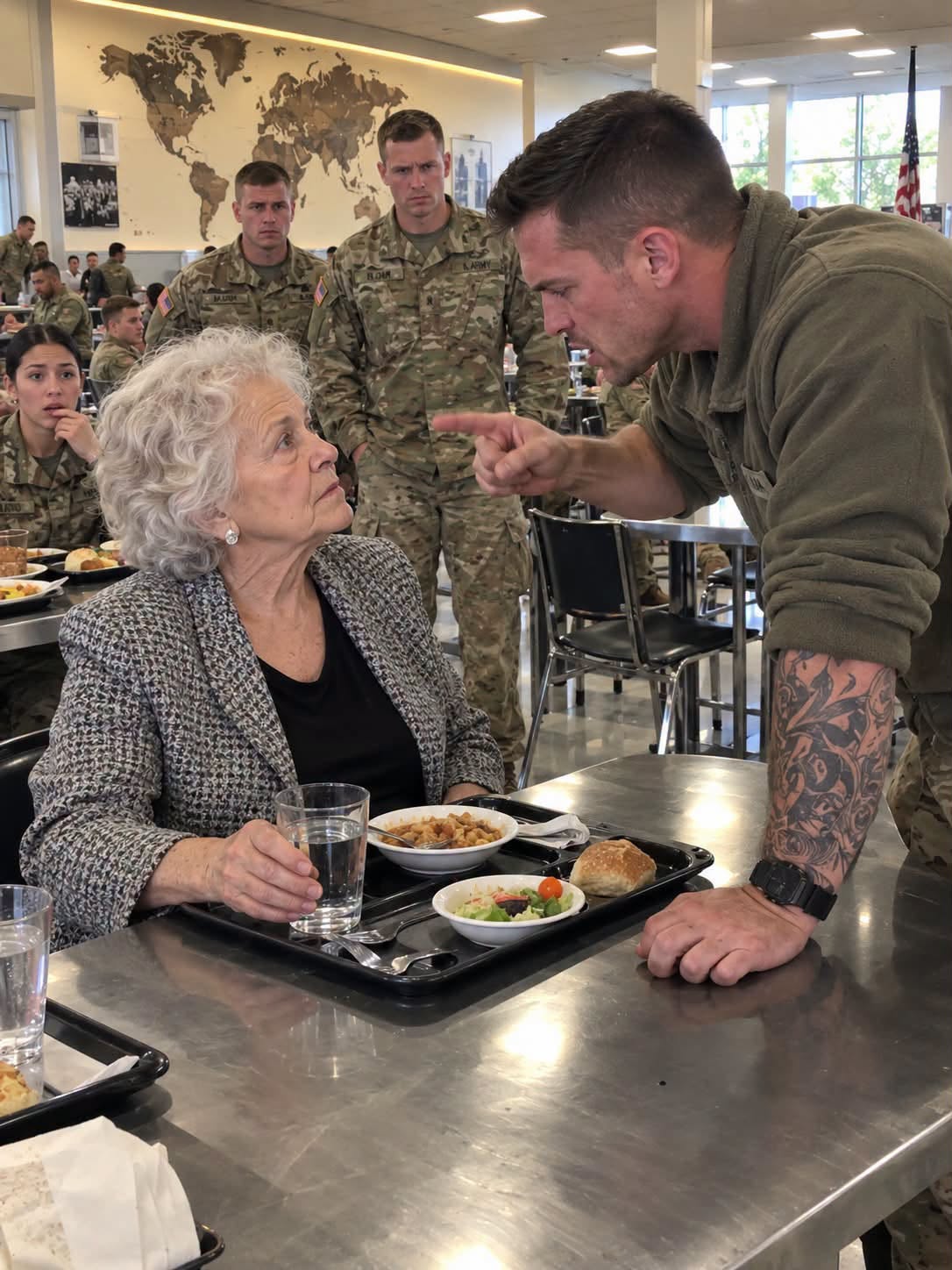
“Hey, Grandma. What was your rank back in the Stone Age?”
I didn’t look up. I’d driven forty minutes for that chili.
“I’m talking to you, ma’am.”
There were three of them standing over my table. The one doing the talking was maybe twenty-seven. He had a neck like a fence post and arms to match, and a voice that was used to being listened to.
The name tape on his chest said REESE. Three chevrons and a rocker. A staff sergeant.
My name is Quinn Braddock. I’m eighty-one years old. I live by myself in Clarksville, Tennessee, in a yellow house with too many stairs. I was a school nurse at Burt Elementary for thirty-one years.
Before that, a long time before that, I was something else.
That Thursday in October, I was sitting in the big dining facility at Fort Campbell, Kentucky. I had on my good gray wool coat and my church shoes. Every other person in that room was wearing camouflage and was young enough to be my grandchild.
“This is a military installation,” Sergeant Reese said. “You need a pass to be in here. Or did you just wander over from the old folks’ home for a free lunch?”
His two friends laughed.
The room started to change. You know how it goes. The talking thins out. You start to hear forks scraping on trays. People are listening, and trying to look like they aren’t.
I set my spoon down beside the bowl.
That seemed to make him angrier. He set his tray on the next table and put both of his hands flat on mine. He had a tattoo of an eagle on his right forearm.
“Look at me when I’m talking to you. We’ve got standards here. We don’t let just anybody stroll in and take up a table in my dining facility. So I’ll ask you again. Who are you, and what are you doing on my post?”
A young private at the next table looked up. She couldn’t have been twenty. She opened her mouth to say something. Then she looked at his stripes and closed it again.
I finally turned my head and looked at him.
He had a good face under all that meanness. He looked like a boy who’d been told his whole life he was the strongest one in the room, and never once had a reason to doubt it.
I looked at his name tape. I looked at the patch on his left shoulder.
Then I looked at the little enameled crest pinned above his right breast pocket. The one that tells you which battalion a soldier belongs to.
A blue shield with a white heron on it, wings spread wide.
I didn’t say a word. I picked up my water glass.
“What, you deaf?” one of the others said.
“I asked you for ID,” Sergeant Reese said. He snapped his fingers twice, right in front of my face. “Now. Let’s see it.”
He had no right to ask. A sergeant can’t demand identification from a visitor in the chow line. That’s what the military police are for. Everybody in that room knew it.
I had a visitor’s pass. It was in my purse, on a blue lanyard, with my picture on it, issued that morning at the Gate 4 visitor center.
I didn’t take it out.
I have a stubborn streak that my late husband, Walt, used to call the eighth wonder of the world. I hadn’t come all that way to show my papers to a boy.
I took a sip of water. My hand was steady. It’s the one part of me that still is.
His face had gone red. He’d started this in front of two hundred soldiers, and it wasn’t going the way he’d planned.
“That’s it,” he said. “You and me are taking a walk to the gate. Get up.”
I didn’t get up.
He straightened up. He looked me over, from my white hair down to my church shoes, hunting for something else to use against me.
And he found it.
On the collar of my gray coat, there’s a pin. It’s small. The brass has gone dark with age. The blue enamel is chipped on one corner.
It’s a blue shield with a white heron, wings spread wide.
It’s the same as the one on his chest. Mine’s just fifty-six years older.
He stared at it.
Then he jabbed his finger at it, an inch from my throat.
“Where did you get that?”
I set down my glass.
“That’s my battalion’s crest,” he said. His voice was shaking now. With anger. “Men bled for that. Men died for that. You don’t buy it at some flea market in Hopkinsville and pin it on your coat to get a free lunch. Take it off.”
“No,” I said.
It was the first word I’d spoken to him.
“Take it off. Or I’ll take it off for you.”
The young private at the next table stood up. I shook my head at her, just a little, and she stopped.
I looked up at that young man. Then I looked past his shoulder. At the wall over the serving line.
There are words painted on that wall. Blue letters, a foot high, across thirty feet of cinder block. He’d eaten his lunch underneath them every day for three years.
“Sergeant,” I said. “Before you put your hands on me, I’d like you to turn around and read me what it says on that wall.”
He didn’t move for a second.
“I know what it says,” he said.
“Then it won’t take you long. Read it to me. Out loud.”
The room was so quiet now you could hear the steam table hissing.
Something in my voice must have reached him. Because slowly, Staff Sergeant Reese turned around.
And he read it.
“We Carry Our Own.”
That’s the battalion motto. Every soldier in that unit learns it on his first day.
“Keep going,” I said.
Underneath the motto, in smaller blue letters, there was a second line. Most soldiers never bother to read it. It’s just part of the wall. Like a fire extinguisher. Like the clock.
He read it slowly. I watched his lips move.
“This dining facility is dedicated to First Lieutenant Quinn Hollis, Army Nurse Corps, who carried forty-one of ours home. May 1969.”
He stopped.
He stood there with his back to me for a long time.
Then, very slowly, Staff Sergeant Reese turned around and looked down at the woman in the gray coat.
“Ma’am,” he said. His voice had gone small. “What did you say your name was?”
“I didn’t,” I said. “You never asked. You asked my rank.”
I folded my hands on the table.
“It was first lieutenant,” I said. “And my maiden name was Hollis.”
You could have heard a pin drop in that dining hall.
Sergeant Reese’s face went from red to white so fast I thought he might faint.
His two friends had backed up about three steps. One of them was staring at the wall like he’d never seen it before in his life.
And from the back of the room, near the double doors, I heard a deep voice.
“Staff Sergeant Reese.”
The whole room turned.
A tall man in his fifties was walking down the center aisle between the tables. Gray at the temples. Four stripes, three rockers and a star in the middle on the front of his uniform. The command sergeant major of the battalion. The senior enlisted man in the whole unit.
Beside him walked a lieutenant colonel. The battalion commander. A wiry man named Gerald Ortiz, with a clipboard under his arm.
They’d come to meet me. We had a one o’clock appointment. I’d gotten there early for the chili.
Command Sergeant Major Darnell Hayes stopped beside my table. He looked at Reese. Then he looked at me.
Then he did something I’ll never forget.
He came to attention. Right there between the tables. Heels together. Shoulders back.
And he saluted me.
“Ma’am,” he said. “Welcome home to the Herons.”
Every soldier in that room, two hundred of them, stood up at once. Chairs scraping on the linoleum. Trays rattling.
The young private at the next table was crying.
Sergeant Reese stood frozen beside my chair. He didn’t know what to do with his hands.
I stood up. It took me a minute. My knees aren’t what they were in 1969.
I returned the salute. Not as crisp as it used to be. But I still remembered how.
“At ease, Sergeant Major,” I said. “Please. Everybody sit down. Your chili’s getting cold.”
Nobody sat down.
Lieutenant Colonel Ortiz stepped forward and shook my hand with both of his.
“Mrs. Braddock,” he said. “I’m so sorry. We were coming to get you at the visitor center. You beat us here.”
“It’s Chili Thursday,” I said. “I wasn’t going to miss it.”
Then he turned to Sergeant Reese.
He didn’t raise his voice. He didn’t have to.
“Staff Sergeant,” he said. “My office. Thirteen-thirty. Bring your first sergeant.”
“Roger, sir,” Reese said. His voice cracked on it.
He looked at me. His eyes were wet.
“Ma’am,” he said. “I’m…”
“Not now, son,” I said quietly. “You go on. We’ll talk later.”
He walked out of that dining hall with two hundred soldiers watching him go, and the double doors swung shut behind him.
I need to tell you how I got that pin. And how my name got on that wall.
In the summer of 1968, I was twenty-four years old, fresh out of nursing school at Vanderbilt, working the night shift in the emergency room at Nashville General.
My little brother, Danny, was nineteen. He’d been drafted in January. He was a rifleman. In a battalion whose crest was a blue shield with a white heron.
In June of 1968, I got a letter from Danny. Two pages, in pencil. He said it was hot. He said the food was terrible. He said there was a medic in his platoon named Ray who could make anybody laugh, even in the rain.
At the bottom, he wrote, “Don’t worry about me, Quinnie. I’m careful.”
Three weeks later, two officers came to my parents’ farmhouse outside Ashland City.
Danny stepped on a mine during a patrol in the A Shau Valley. He died on a medevac helicopter on the way to the hospital. Twenty minutes from help.
Twenty minutes.
I couldn’t stop thinking about that. If somebody had been on that helicopter who knew what to do. If somebody had been there to hold pressure. Twenty minutes.
Two weeks after Danny’s funeral, I walked into the Army recruiting office on Broadway in Nashville and asked to join the Army Nurse Corps.
“You know where they’ll send you,” the recruiter said.
“I know exactly where they’ll send me,” I said. “That’s why I’m here.”
In January of 1969, I landed in Vietnam. They assigned me to the 85th Evacuation Hospital at Phu Bai.
Most of our wounded came in from the A Shau Valley.
Most of them were Herons.
I asked to work the receiving ward. That’s where the helicopters came in. That’s where the soldiers came off the stretchers, still in their muddy fatigues, still bleeding, still scared.
I worked twelve-hour shifts. Sometimes eighteen. Sometimes thirty-six, when the casualties came in so fast we couldn’t stop.
And every time a helicopter landed, before I looked at a single wound, I looked at the crest on their collar.
When I saw that white heron, I worked harder.
I never told anybody why. I don’t think I even knew, at first. I just knew that every one of those boys was somebody’s Danny.
Pages: