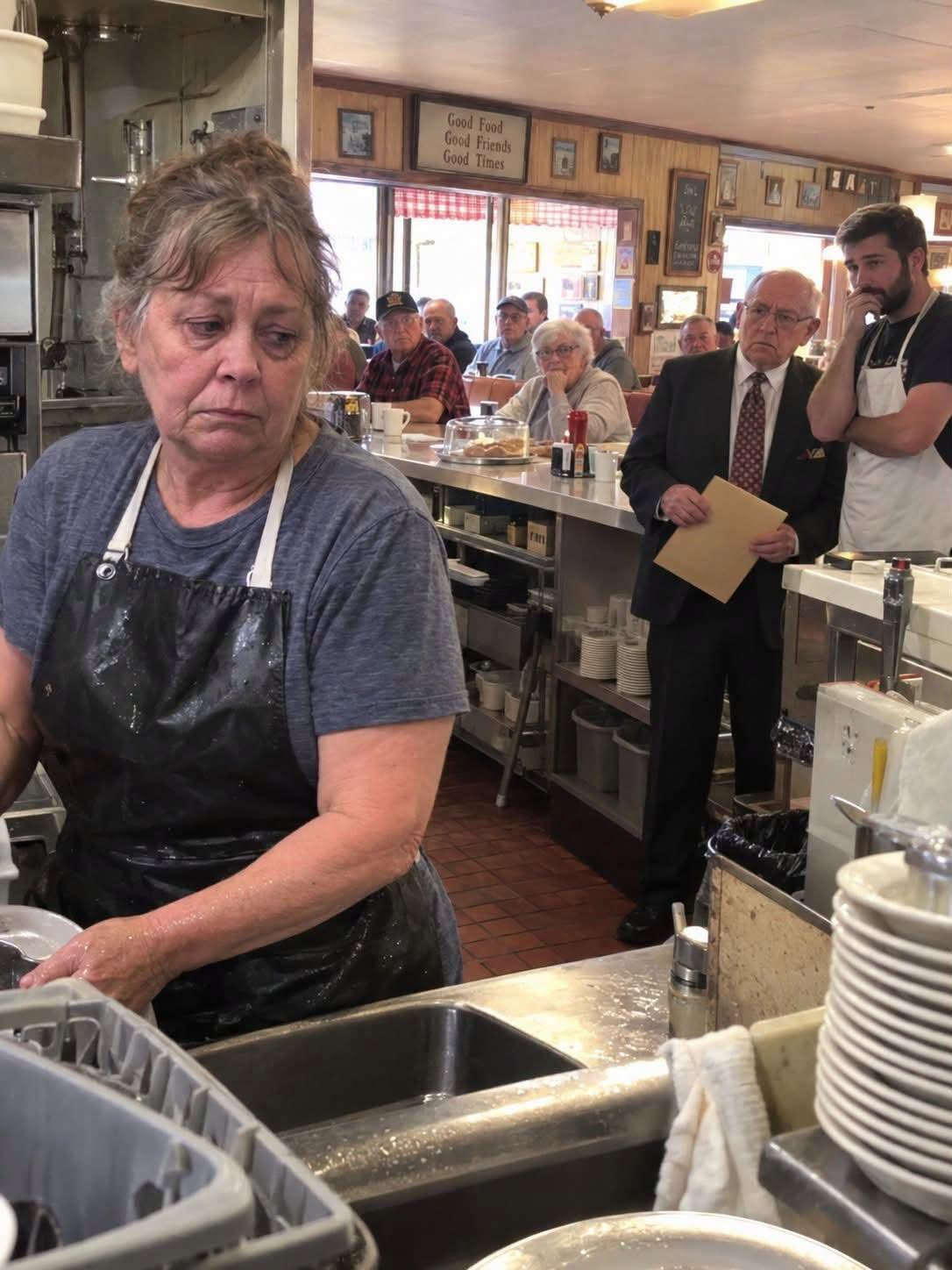
Whatever Bev’s Making
“Bev, I’m going to be honest with you.”
Chad didn’t sit down. He stood in the doorway of the little back office at Gus’s Diner with his arms crossed over his sleeveless puffy vest, leaning on the frame like a man in a cologne ad.
I was standing too. I’d been on my feet since five-fifteen. My coffee pot was still in my hand. I’d been on my way to top off the Miller boys when he called me back.
People only say I’m going to be honest with you when they’re about to say something they’ve already decided.
“We’re rebranding,” Chad said. “Younger crowd. Fresh energy. Customers want to see young faces out front.”
I just looked at him.
He had very nice teeth. Very white. The kind you pay for.
“I’ve got Madison on the floor now,” he said. “I need you on dishes.”
The coffee pot was getting heavy in my hand. I set it down on the filing cabinet.
“Dishes,” I said.
“Same pay. Fewer hours on your feet.” He smiled. All those teeth. “Honestly, Bev, it’s a favor.”
I’m sixty-two years old.
My knees are bad. My hands are worse. Arthritis in every knuckle. In the winter, I can’t close my fists all the way until I run them under hot water for five minutes.
The dish pit at Gus’s is a steel sink and a sprayer hose in a room with no window. It’s hot back there. Steam and grease and bleach. The floor is always wet. There’s a drain in the middle of it that backs up every time it rains.
I could have walked out.
I could have untied my apron right there and set it on Chad’s desk and walked out the back door into the alley and never come back. Thirty-eight years. I’d earned that much.
I could have told him what Gus told me. Standing by that same grill. Fifteen years ago. With his big hand out and grease on his wrist.
But Gus was gone.
And a handshake doesn’t mean much to a man who’s never shaken yours.
“Whatever you need, Chad,” I said.
He looked surprised. Then relieved. Then a little smug, like he’d expected a fight and was proud of himself for avoiding one.
“Great,” he said. “Great. I knew you’d be cool about it. Madison can take the rest of your tables. You can start in the back right now.”
I picked up my coffee pot.
I walked out of the office, past the grill, through the swinging door into the dish pit.
I set the pot down on the drainboard.
And I tied on the rubber apron.
I started at Gus’s Diner when I was twenty-four.
It was 1988. Coffee was forty cents. A short stack was a dollar ten. You could get the Farmer’s Breakfast, two eggs, hash browns, bacon, sausage, toast, and a biscuit with gravy, for two ninety-five.
I’d just left my first husband. I had a four-year-old daughter, a duffel bag, and forty-one dollars in my wallet. I’d driven up from Sioux City in a Pontiac with no reverse gear. I could only park in places where I could pull straight through.
I saw the sign in the window. HELP WANTED. ASK FOR GUS.
So I asked for Gus.
He came out from behind the grill. Big man. Bald head. Forearms like hams. A white T-shirt with a cigarette pack rolled up in the sleeve, even though he’d quit in 1979. He wiped his hands on his apron and looked me up and down.
“You ever waitress?”
“No, sir.”
“You good with people?”
“I don’t know. I guess.”
“You got a kid?”
I didn’t know how he knew. Maybe he could see it on my face. The tiredness.
“Yes, sir. A girl. Four.”
“Who’s watching her?”
“She’s in the car.”
Gus looked out the front window at my Pontiac in the lot. At my daughter, Carrie, in the back seat, holding her stuffed rabbit, her face pressed to the glass.
He didn’t say anything for a long moment.
Then he went out to the lot and opened the back door of my car and squatted down in front of my daughter.
“Hey there,” he said. “You like pancakes?”
Carrie nodded.
“You want to see how we make ’em?”
She nodded again.
He picked her up and carried her inside on his hip and set her on a stool at the end of the counter and made her a pancake shaped like a Mickey Mouse head. With chocolate chips for eyes.
Then he turned around and looked at me.
“You start tomorrow,” he said. “Six a.m. She can sit at the end of the counter till the school bus comes. Doris’ll keep an eye on her.”
I started crying. Right there in the middle of the diner. I couldn’t help it.
Gus handed me a napkin out of the dispenser.
“None of that,” he said gruffly. “Coffee’s forty cents. Learn to pour it without spilling.”
I learned.
I’ve poured it every morning since. Thirty-eight years.
I know everything about the people who come into Gus’s. That’s the job, really. The food is the food. Gus made good food and the new cook makes all right food. But the job isn’t the food.
The job is knowing.
I know that Dale Lindgren takes his eggs over medium, and his wife Joanne can never know about the bacon. Dale’s had two heart attacks. Joanne makes him eat egg whites and turkey sausage at home. When he comes in alone on Tuesdays, I bring him two strips of real bacon and put them under his hash browns so they don’t show if she walks in.
She walked in once. In 2014. She looked right at his plate.
I said, “Joanne, those hash browns are extra crispy today. Gus burned ’em. Don’t tell him I said so.”
She never knew.
I know the Miller boys get chocolate milk on their birthday, no charge. Their mother died in 2019. Car accident on Highway 30. Their father brings them in every birthday because their mother used to. Tyler’s ten now. Jake’s eight. Every birthday, I put a candle in a short stack and the whole diner sings.
I know which farmers are having a bad year before their wives do. You can tell by how they drink their coffee. A man having a good year drinks his coffee and talks. A man having a bad year holds the cup with both hands and stares out the window and doesn’t touch his eggs.
When a man stops touching his eggs, I tell Gus. And Gus would go sit with him. Just sit. Didn’t say much. Gus was never a talker. But he’d sit there in the booth across from that man until the man started talking. And sometimes, a week later, somebody would find an envelope in their mailbox with no name on it.
Gus never told anybody. I never asked.
I know old Mr. Haugen takes the pancakes, and he’s taken the pancakes every single day for thirty-one years, and every single day he looks at the menu for five minutes first like he might order something different. He never does.
I know Pastor Jim comes in on Sunday after the early service and sits in the corner booth and writes his sermon notes for next week on a napkin. I know he’s been working on the same sermon about the prodigal son for four months because he can’t get the ending right.
I know the two sisters from the flower shop, Marlene and Bonnie, haven’t spoken to each other directly since 2003. They come in together every Friday and order through me.
“Bev, tell my sister she’s got lipstick on her teeth.”
“Bev, tell my sister to mind her own business.”
I tell each of them. Neither of them has lipstick on her teeth.
And I know Ed Kessler.
Ed sits on stool three.
He’s seventy-four. Tall and thin, with white hair he combs straight back and a face like a walnut. He farmed four hundred acres west of town for forty years. Sold most of it to a wind energy company in 2009. Now there are twelve white turbines turning slow on the land where his corn used to be.
Black coffee. Wheat toast, no butter. Every morning. Six-fifteen. Since 1998.
He pays exact change. Every day. Coins counted out on the counter in a neat little stack. Quarters on the bottom, then dimes, then nickels, then pennies. He slides the stack toward the register and says, “Thank you, Bev,” and leaves.
He’s never once let anybody but me pour his coffee.
Not Gus. Not Doris, back when Doris was still alive. Not the other girls who’ve come and gone over the years. If I’m out sick, Ed doesn’t drink coffee. He just eats his toast and leaves.
People think he’s just particular. Set in his ways. A crusty old farmer.
They don’t know about 1998.
I’ll tell you about it later.
Gus passed in January.
He was eighty-one. He had a stroke on a Sunday night, alone in his apartment above the diner. I found him Monday morning when I came in at five-fifteen and the grill wasn’t on.
The grill was always on when I came in. For thirty-eight years, Gus beat me in by an hour.
I went upstairs. His door was unlocked. He was in his recliner in front of the TV. The weather channel was still on.
He looked peaceful. That’s what the paramedics said. He looked peaceful.
I sat on the floor next to his chair and held his hand until they came. It was cold. Big and cold and still smelled like bacon grease.
His kids live in Phoenix.
Gus Jr. and Patty. They left Millbrook after high school. They didn’t come home much. Christmas, sometimes. A wedding once.
They flew in for the funeral. They stood in the front pew at St. Mark’s in sunglasses. The whole town came. The church was so full people were standing in the back and out on the steps in the snow.
After the funeral, there was a lunch in the church basement. Ham sandwiches and potato salad and seven different kinds of bars. Gus Jr. came up to me by the coffee urn.
“You must be Bev,” he said.
“I am.”
“Dad talked about you.” He looked around the basement like he was looking for an exit. “Listen. Patty and I, we’re not going to keep the diner. We’ve got our lives in Phoenix. We’re going to sell it.”
“I understand.”
“There’s a guy interested already. Some young entrepreneur from Des Moines. He wants to do something with it. Modernize it.” He shrugged. “We’re going to take the offer.”
“Did your dad leave anything?” I asked. “A will? Instructions?”
“He left everything to us,” Gus Jr. said. “There was a will. Pretty simple.” He looked at me. “Why?”
I thought about the handshake.
Fifteen years ago. By the grill.
“No reason,” I said.
They sold the diner in a month.
The new owner is Chad.
Chad Whitmore. He’s thirty. He has nice teeth and a vest with no sleeves under it, which I didn’t know was a thing people wore. He has an expensive haircut that looks like he slept on it wrong on purpose.
He came in on a Monday in February with a laptop and a lot of ideas.
The first week, he put up a sign.
It used to say GUS’S DINER — EST. 1971 — GOOD FOOD, FAIR PRICES. Hand-painted. Faded. The S in Gus’s was crooked because Gus painted it himself on a ladder in a high wind.
Chad took it down.
He put up a new one. Black with white letters. Very clean.
RISE & GRIND.
Underneath, smaller: Artisan Breakfast Kitchen.
Dale Lindgren stood on the sidewalk and stared at it for a whole minute.
“What the hell is a grind?” he said.
“It’s coffee,” I told him. “I think.”
“Coffee’s coffee,” Dale said.
He went inside anyway.
Chad put QR codes on the tables.
Little plastic stands with a black-and-white square on them. SCAN TO VIEW OUR MENU!
He took away the paper menus. The laminated ones with the coffee rings and the duct tape on the corners and Gus’s handwritten specials paper-clipped to the front.
Old Mr. Haugen sat in his booth and held his phone up to the QR code for five minutes.
His phone is a flip phone. From 2007. It doesn’t have a camera that reads codes. It barely has a camera.
He kept holding it up. Moving it closer. Moving it farther away. Squinting.
Finally he put the phone down and looked up at me.
“Bev,” he said. “Just tell me what the pancakes are.”
“They’re pancakes, Walter.”
“Are they the same pancakes?”
“Same pancakes.”
“Then I’ll have those.”
He’d ordered the pancakes every day for thirty-one years. He knew what the pancakes were. He just wanted somebody to tell him.
Chad raised the prices.
The Farmer’s Breakfast went from eight ninety-five to fourteen dollars. He renamed it the Heartland Harvest Plate. He added avocado toast. He added something called a “breakfast bowl” with kale in it. He started charging for coffee refills.
Charging for refills. At a diner.
Three farmers got up and walked out the first day he did that. Didn’t even finish their eggs.
He hired a new cook. A young guy named Tanner who’d been to culinary school in Minneapolis. Tanner could make a beautiful omelet. He couldn’t make Gus’s biscuits and gravy to save his life. He kept adding things to the gravy. Fennel. Smoked paprika.
“It’s elevated,” Tanner said when I told him people were sending it back.
“It’s gravy,” I said. “Gravy doesn’t need elevating. Gravy needs to stay right where it is.”
He didn’t listen.
And then, in the second week, Chad hired Madison.
Madison is nineteen. Sweet girl. Blonde ponytail. Big smile. She’d just finished her first year at the community college. She needed a summer job.
She’s never waitressed before. She’s never worked anywhere but the Dairy Queen.
That morning, before Chad called me into the back, she asked me what “Adam and Eve on a raft” meant.
Dale had ordered it. She didn’t know what to write on her pad.
“Two poached eggs on toast,” I told her.
“Why is it called that?”
“Because the eggs are Adam and Eve, and the toast is the raft.”
She thought about it. “That’s kind of weird.”
“It’s diner talk,” I said. “You’ll learn.”
She smiled at me. “You know everything, Bev.”
“I know some things,” I said.
An hour later, I was in the dish pit.
I washed dishes until three o’clock.
It was hot back there. So hot. The steam from the sink fogged my glasses every two minutes. The sprayer hose kicked like a horse every time I turned it on. My hands were in hot water for eight hours. By noon, they’d swelled up so bad I couldn’t feel my fingertips. By two o’clock, the knuckles on my right hand were throbbing like somebody was hitting them with a hammer.
I didn’t stop.
Through the little pass window between the kitchen and the dining room, I could see out front. Not much. Just a slice. The end of the counter. Stools one through four.
I watched Madison work.
She was trying. She really was. But she didn’t know anything. She brought Dale his eggs scrambled. She put butter on Ed’s toast. She brought the Miller boys’ dad regular milk instead of chocolate and charged him for it.
She called Pastor Jim “sir” and asked him if he wanted to try the kale bowl.
Pastor Jim looked at her like she’d asked him to dance.
Every time she came back to the kitchen to pick up an order, she’d glance through the door at me. Her face was red. Her ponytail was coming loose.
Around noon, she stuck her head into the dish pit.
“Bev,” she whispered. “Table four is asking for ‘the usual.’ What’s the usual?”
“Who’s at table four?”
“Two ladies. Older. One’s wearing a purple hat.”
“Marlene and Bonnie,” I said. “The flower shop sisters. Two coffees, one with cream, one black. Two cinnamon rolls, warmed up. Bonnie gets hers with extra frosting. Marlene says she doesn’t want extra frosting, but if you don’t bring it, she’ll stare at Bonnie’s the whole time.”
“So… extra frosting on both?”
“Extra frosting on both. And don’t talk to them about each other.”
Madison stared at me.
“How do you know all this?”
I shrugged. My hands were in the sink.
“Thirty-eight years,” I said.
When I came out to clock out at three, Ed Kessler was sitting on stool three.
That was strange. Ed comes in at six-fifteen. Every day. He’s never once come in the afternoon.
But there he was. In his old barn coat and his John Deere cap. His hands folded on the counter.
Waiting.
I didn’t say anything. I went to the time clock by the register and punched out.
Madison came over with the coffee pot. She went to fill Ed’s cup.
He put his hand over the top of it.
“Where’s Bev?” he said.
Madison looked confused. She pointed toward the kitchen.
Ed turned on his stool.
He looked at me through the pass window.
At my rubber apron. At my wet hands, red and swollen. At my glasses, still fogged up from the steam. At my hair, which had come loose from its clip and was stuck to my neck with sweat.
He didn’t say anything.
He just looked at me for a long time.
Then he reached into his coat pocket. He took out his coins. He counted them out on the counter. Quarters, then dimes, then nickels, then pennies. A neat little stack.
He slid it toward the register.
And he got up and walked out the door without finishing his toast.
I want you to know something.
I didn’t call a single person that night.
Not one.
People asked me later. They said, “Bev, you must have called somebody. Somebody must have organized it.”
I didn’t.
I went home to my little house on Pearl Street. I filled the kitchen sink with hot water and Epsom salt and stood there with my hands in it for forty-five minutes. Then I took two Aleve and ate a can of soup standing up at the counter. Then I watched Wheel of Fortune and went to bed at eight-thirty.
I lay in the dark and thought about Gus.
About that handshake.
It was 2011. October. A Tuesday.
Things were bad at the diner. Real bad. Gus was seventy. He’d had his first bout with prostate cancer the year before. Surgery and radiation. His insurance didn’t cover half of it. He’d taken out a second mortgage on the building to pay the bills.
And then the bank called the loan.
I didn’t know all the details. Gus didn’t talk about money. But I knew he’d been on the phone in the back office for weeks. I knew he’d stopped sleeping. I knew he’d lost twenty pounds.
One Tuesday afternoon, after the lunch rush, I found him standing at the grill. Just standing there. Not cooking anything. Staring at the flat-top like he’d never seen it before.
“Gus?”
He didn’t turn around.
“Bev,” he said. “I think I’m going to lose it.”
“Lose what?”
“The diner. The building. All of it.” He scraped his spatula across the grill. Slowly. Back and forth. “Bank’s foreclosing. End of the month. I’ve tried everything. I’ve talked to everybody.”
I didn’t know what to say.
“Forty years,” Gus said. “My dad opened this place in 1971 with three hundred dollars and a used grill. That grill.” He tapped it with the spatula. “And I’m going to be the one who loses it.”
“What happens to everybody?”
“I don’t know.” He shook his head. “Some chain’ll buy the building, probably. Put in a Subway. A Taco Bell.”
“What happens to me?”
He turned around then.
He looked at me. Really looked at me. With his big bald head and his white T-shirt and his tired, tired eyes.
“Bev,” he said. “Whatever happens. Whatever. As long as there’s a Gus’s, there’s a Bev. You hear me? You’ll have a place out front. You’re the heart of this place. Everybody knows it.”
“Gus—”
He held out his hand. Big. Grease on the wrist. A burn scar across the back of it from 1994 when the fryer exploded.
“Shake on it,” he said.
I shook his hand.
His grip was so strong. Even then. Even sick and seventy and about to lose everything.
“That’s a promise,” Gus said. “A Gus’s promise.”
He didn’t lose the diner.
A week later, the foreclosure just stopped. Gus came in one morning whistling. He’d slept. He’d eaten. He told me everything was taken care of.
“How?” I asked.
“Somebody bought the building,” he said. “Paid off the bank. Leasing it back to me. Real fair rent.”
“Who?”
Gus smiled. He tapped the side of his nose.
“An angel,” he said.
He never told me who.
I never asked.
And I never thought about that handshake again. Not until Chad stood in the doorway of the back office with his arms crossed over his vest.
Because Gus’s handshake didn’t mean anything to Chad.
Chad never knew Gus.
Chad never shook anybody’s hand in that diner. Not once. Not a farmer. Not a waitress. Not a cook.
At 5:45 the next morning, I was back at the sink.
I’d been there since five-fifteen. The same as always. Chad didn’t change my hours, just my job. I’d loaded the first rack of coffee mugs into the washer. The kitchen was hot already. Tanner was at the grill, cracking eggs into a bowl, humming to himself, earbuds in.
Madison came in at five-fifty. She tied on her apron. She looked nervous.
“I didn’t sleep,” she said, sticking her head into the dish pit. “I kept dreaming people were yelling at me about gravy.”
“You’ll be fine,” I said.
“I won’t. Bev, I’m terrible. Yesterday was a disaster. Everybody kept asking for you.”
“They’ll get used to you.”
She looked at me.
“Do you hate me?” she said quietly. “For taking your job?”
I stopped scrubbing the pot in my hands.
“Honey,” I said. “You didn’t take anything. You needed a job. Chad gave you one. That’s not your fault.”
“But it’s not fair.”
“Lots of things aren’t fair,” I said. “Go fill the creamers. The little silver ones. Fill them halfway. Dale likes ’em cold.”
She went.
At six o’clock, the bell over the door rang.
That bell has been hanging over the door at Gus’s since 1971. A little brass bell on a curved metal arm. When the door opens, it rings once. Clear and bright.
I’ve heard it ring maybe a million times.
I know its sound the way you know your own name.
It rang at six o’clock.
Then it rang again.
And again.
And again.
Through the pass window, I watched them come in.
Dale and his wife, Joanne. Together. Joanne never comes in the mornings. She does water aerobics at the Y.
The Miller boys and their dad. On a school day. Tyler was still in his pajama pants.
Old Mr. Haugen with his cane. Walking so slow. Holding the door open with his shoulder for the people behind him.
Three farmers still in their barn boots. I could smell the cow manure from the dish pit. Hank Olson and his brother Pete and their neighbor, Swede Nordquist. They must have come straight from milking.
Pastor Jim. In his clerical collar. On a Wednesday.
The two sisters from the flower shop. Marlene in her purple hat. Bonnie in her green one. Walking in side by side. Not speaking to each other. But together.
They kept coming.
The Petersons from the hardware store. Mrs. Abernathy from the library. Doc Halvorsen, the town vet, who hadn’t been in since 2019. Coach Dunn from the high school with half the football team behind him. Lois from the post office. Ray from the gas station, still in his coveralls.
Young people too. Kids I’d poured chocolate milk for on their birthdays twenty years ago, grown up now, with kids of their own on their hips.
By 6:20, every booth was full.
Every stool at the counter was full.
People were standing by the pie case. Standing by the door. Standing along the wall by the coat hooks. Somebody had pulled two folding chairs out of the storage closet and set them up by the jukebox.
The diner holds forty-eight people.
There were at least seventy.
Tanner had pulled his earbuds out. He was standing at the grill with a spatula in his hand, staring through the pass window.
“What is going on?” he said.
“I don’t know,” I said.
It was the truth. I didn’t know.
Madison went to the first table with her notepad.
It was Dale and Joanne. The booth by the window. Their booth since 1991.
“Hi!” Madison said brightly. Her voice was shaking. “Good morning! Welcome to Rise and Grind. What can I get you?”
Dale didn’t look at the menu. There wasn’t one anyway. Just the QR code on its little plastic stand.
“Whatever Bev’s making,” he said.
Madison blinked.
“I’m sorry?”
“Whatever Bev’s making,” Dale said again. He folded his hands on the table. “We’ll have that.”
Joanne nodded. “Same.”
Madison looked at the kitchen. At me, through the pass window. Then back at Dale.
“Okay,” she said slowly. She wrote it down. “Whatever… Bev’s… making.”
She went to the next table.
The Miller boys and their dad.
“Hi there! What can I get you guys?”
“Whatever Bev’s making,” said the Miller boys’ dad.
“Whatever Bev’s making,” said Tyler.
“Whatever Bev’s making,” said Jake, who’s eight, and grinned like it was the best joke he’d ever heard.
Madison went to the next table.
Old Mr. Haugen. He set his cane against the booth.
“Whatever Bev’s making,” he said. “I’ll have the pancakes. If that’s what she’s making.”
The next table. The three farmers in barn boots.
“Whatever Bev’s making.”
The next. Pastor Jim.
“Whatever Bev’s making, young lady. God bless.”
The counter. The flower shop sisters.
Marlene said, “Whatever Bev’s making.”
Bonnie said, “Tell my sister I was going to say that first.”
Madison didn’t even try to answer. She just wrote it down.
She came back into the kitchen with her notepad. Her face was white. She held it out to me through the dish pit door.
Every single line on every single ticket said the same thing.
Whatever Bev’s making.
Whatever Bev’s making.
Whatever Bev’s making.
Page after page.
“Bev,” she whispered. “What do I do?”
I looked at the notepad in her hand.
My throat was tight. My hands were still in the dishwater. I couldn’t feel them anymore. I didn’t know if it was the hot water or something else.
“I don’t know, honey,” I said.
Chad came out of his office.
He’d heard the bell. Everybody in the county had probably heard the bell.
He walked out into the dining room in his vest and his expensive haircut, holding a cup of something from his own fancy machine in the back. Some kind of oat milk thing. He stopped at the end of the counter.
He looked around.
Seventy people. Every seat full. People standing. People leaning against the walls.
Nobody eating. Nobody drinking. Nobody on their phones.
Just sitting there. Looking at him.
“Wow,” Chad said. He laughed a little. “Wow. Okay. Big crowd today. That’s great. That’s awesome. Welcome, everybody.”
Nobody said anything.
“So. Um.” He cleared his throat. “Madison tells me some of you have been asking for Bev. Which, I get it. She’s great. She’s a great employee. But just so everybody knows, Bev’s not cooking today. She’s working in the back now. So if you could just order off the menu—”
“Then we’ll wait,” Dale said.
Chad looked at him.
“I’m sorry?”
“We’ll wait,” Dale said. “Till Bev’s making something.”
Chad laughed again. Like it was a joke.
Nobody else laughed.
He looked around the diner. At seventy faces. Farmers and shopkeepers and teachers and old women in purple hats. All of them looking back at him.
All of them waiting.
His smile flickered.
“Folks,” he said. “I don’t… I’m not sure what’s happening here.”
Nobody answered him.
The diner was so quiet I could hear the dishwasher humming in the back. I could hear Tanner’s eggs sizzling on the grill, forgotten. I could hear the old clock over the door ticking. Gus’s clock. Shaped like a coffee cup.
Tick. Tick. Tick.
And then the bell rang one more time.
Ed Kessler walked in.
He was wearing a suit.
A dark gray suit. Old-fashioned. The lapels were a little wide. It was from another decade. But it was pressed. Perfectly pressed. With a white shirt and a navy tie with little gold diamonds on it.
In twenty-eight years, I’d never seen Ed Kessler in a tie.
Not at church. Not at funerals. Not at Gus’s funeral, even. He wore his good barn coat to Gus’s funeral and stood in the back and didn’t take his cap off till the priest asked him to.
He had combed his white hair straight back. He’d shaved. His shoes were shined.
He was carrying a manila folder.
The whole diner turned to look at him.
He didn’t look back at any of them.
He walked straight past stool three. His stool. Didn’t even glance at it.
He walked right up to Chad.
He stopped about three feet in front of him.
“Morning, Chad,” Ed said.
Chad stared at him. “Uh. Morning. Sir. Can I… help you?”
“When you have a minute,” Ed said, “I’d like a word about your lease.”
Chad’s smile went away.
Just went away. All at once. Like somebody flipped a switch.
Ed looked over Chad’s shoulder.
Right through the pass window.
Right at me.
Standing in the dish pit in my rubber apron with my hands in the water.
He looked at me for a long moment. His old walnut face didn’t change. But something in his eyes did.
Then he turned back to Chad.
And he set the folder on the counter.
“My lease?” Chad said. “What about my lease? I signed the lease in February. It’s all handled. The property management company sent it over. Kessler Holdings.”
“That’s me,” Ed said.
Chad’s face went pale.
“You’re… Kessler Holdings?”
“I’m Kessler Holdings,” Ed said. “Me and nobody else. I bought this building on October 19th, 2011. Paid off Gus’s mortgage the same afternoon. Been leasing it back to him ever since. Eleven hundred dollars a month, which is about a third of what it’s worth.”
I stopped breathing.
The angel.
Gus’s angel.
Ed.
“I’ve been in the hospital,” Ed said. “Most of February. Pneumonia. The management company I hired to handle the paperwork, they sent you the lease assignment when you bought the business. They didn’t read it real close. Neither did your lawyer, I’m guessing. Neither did Gus’s kids.” He tapped the folder. “I read it last night. Every word. Took me till two in the morning. My eyes aren’t what they used to be.”
Chad swallowed.
“Is there a problem with it?”
“There’s one paragraph,” Ed said. “Page six. Section nine.”
He opened the folder. He took out a sheet of paper. He put on a pair of reading glasses from his shirt pocket. He cleared his throat.
And in front of seventy people, in that dead-quiet diner, he read it out loud.
“Rider to Commercial Lease, Section 9. As a material condition of this lease and any renewal or assignment thereof, Tenant shall continue to employ Beverly Ann Novak in her present position as head waitress, front of house, at no less than her present rate of compensation, for so long as she wishes to remain so employed. Any removal, reassignment, or reduction of said employee without her written consent shall constitute a default under this lease, and Landlord may terminate the lease upon thirty days’ written notice.”
He set the paper down.
“Signed,” he said, “by Augustus Petros, Tenant. Edward Kessler, Landlord. October 19th, 2011.”
The diner was so quiet you could have heard a sugar packet hit the floor.
Chad was staring at the paper.
“That’s… that can’t be legal,” he said. “You can’t put an employee in a lease.”
“You can put anything in a lease,” Ed said mildly, “if both people sign it. I’ve got a lawyer in Ames who says it’ll hold. He drove up this morning. He’s sitting in his car outside if you’d like to talk to him.”
Everybody in the diner turned and looked out the front window.
There was a silver Buick in the lot with a man in it. The man waved.
“You signed the assignment,” Ed said. “In February. When you bought the business. Your signature’s right here on page eleven, agreeing to all the terms of the original lease. Including the rider.” He looked at Chad over his reading glasses. “You moved her to the dish pit yesterday, son. Without her written consent. That’s a default.”
Chad’s mouth opened. Nothing came out.
“I’ve got thirty days,” Ed said, “to decide whether to terminate your lease.”
I took my hands out of the water.
I don’t remember deciding to. I just did.
I stood there in the dish pit with water running off my fingers onto the wet floor.
Gus.
Gus had done this.
As long as there’s a Gus’s, there’s a Bev.
Shake on it.
That’s a promise.
He knew. He knew a handshake wouldn’t be enough. Not after he was gone. He knew somebody someday would come in here who’d never shaken anybody’s hand.
So he got Ed to write it down.
“Mr. Kessler,” Chad said. His voice cracked. He sounded younger all of a sudden. Like a teenager. “Please. I put everything into this place. Everything. My savings. A loan from my dad. I’ve got investors. If I lose the lease, I lose all of it. I’ll be bankrupt.”
Ed didn’t say anything.
“I didn’t know,” Chad said. “About the rider. I swear. I didn’t know. I was just trying to… the numbers were bad. Revenue’s down thirty percent since I took over. I thought if I got a younger look up front, I could bring in a different crowd. People from the city. Tourists.”
“Revenue’s down thirty percent,” Ed said, “because you charged Hank Olson a dollar fifty for a coffee refill.”
Hank Olson, in his barn boots, raised his cup from the booth by the pie case. It was empty.
“And you took the paper menus away from a man who can’t see a QR code,” Ed went on. He nodded toward Mr. Haugen.
Mr. Haugen held up his flip phone.
“And you put fennel in the gravy,” Ed said.
Somebody at the counter groaned.
“And you took a woman who’s been the heart of this town for thirty-eight years,” Ed said, his voice dropping, “and you put her in a room with no window and told her it was a favor.”
Chad didn’t say anything.
He looked around the diner.
At seventy faces. Waiting.
He looked at the pass window.
At me.
I walked out of the dish pit.
I didn’t take off the rubber apron. I just walked out. Through the swinging door. Past Tanner at the grill. Into the dining room.
Seventy people turned and looked at me.
Somebody in the back started clapping. Then somebody else. Then the whole diner.
I held up my hand.
They stopped.
I walked over to the counter. I stood next to Ed. I looked at the paper with Gus’s signature on it. That big, slanting signature. The same one that was on every paycheck I ever got for thirty-seven years.
Augustus Petros.
Nobody ever called him Augustus. Just Gus.
“Ed,” I said quietly. “Why didn’t you ever tell me?”
Ed looked at me over his reading glasses.
“Gus asked me not to,” he said. “He said you’d feel like you owed somebody. He said you’d been owing people your whole life and he didn’t want you to owe anybody anymore.” He paused. “He said if anybody ever tried to push you out, I’d know what to do.”
I looked down at the counter.
“And the building,” I said. “The angel. That was you.”
Ed shrugged. “I had wind turbine money. Didn’t know what to do with it. Seemed like a good use.”
“Why?”
Ed looked at me for a long time.
“You know why, Bev,” he said softly.
I did know why.
I’ll tell you now. I promised I would.
October 1998.
Ed Kessler’s wife, Lorraine, died of ovarian cancer. She was fifty-two. They’d been married thirty years. No kids. They tried. It never happened.
After the funeral, Ed stopped coming to town.
For three weeks, nobody saw him. His truck didn’t move from the farmyard. His mail piled up in the box at the end of the lane. His corn stood in the field, unharvested, turning brown and brittle in the cold.
People talked. People worried. Somebody said he was drinking. Somebody else said he’d sold the farm. Somebody said he’d gone to stay with family in Nebraska.
Nobody went out there to check.
On a Tuesday morning in November, Ed walked into Gus’s.
Six-fifteen. He sat down on stool three.
He looked like death. He’d lost thirty pounds. His clothes hung off him. He hadn’t shaved in weeks. His eyes were red and empty.
He didn’t say anything. He just sat there.
I came over with the coffee pot.
“Morning, Ed,” I said. “Coffee?”
He looked up at me like he didn’t know who I was. Like he didn’t know where he was.
“I don’t know,” he said.
I poured him a cup anyway.
“You eating?” I asked.
He shook his head.
“Since when?”
He thought about it. “I don’t know.”
I went to the kitchen. I put two slices of wheat bread in the toaster. When they came up, I didn’t put butter on them. I don’t know why. I just didn’t. It seemed like the kind of thing a person who hadn’t eaten in a long time could manage. Plain toast. Nothing fancy.
I brought it out and set it in front of him.
“I didn’t order that,” he said.
“I know,” I said. “Eat it anyway.”
He looked at the toast for a long time.
Then he picked up a piece and took a bite.
Then another.
He ate both pieces. Slowly. Like it hurt.
When he was done, he reached into his pocket and counted out his change. A dollar for the coffee, which was a dollar then. Eighty-five cents for the toast. A dollar eighty-five.
He stacked it on the counter. Quarters, dimes, nickels, pennies.
“Thank you, Bev,” he said.
“See you tomorrow, Ed,” I said.
He looked at me.
“Tomorrow?”
“Tomorrow,” I said. “Six-fifteen. Coffee’ll be hot.”
He came back the next day.
And the next.
And the next.
He told me once, years later, what was happening that November. He told me late one afternoon, after the lunch rush, when the diner was empty and it was just us.
He said he’d bought a rope.
He said it was in the barn. He said he’d put it up on a beam and stood there looking at it every night for three weeks.
He said on that Tuesday morning, he’d decided he would do it. That afternoon. When the light was right.
He said he came into town to sign some papers at the bank first. So the farm would go to his nephew. And then he walked past Gus’s and smelled the coffee and didn’t know why, but he came in.
He said he was going to have one last cup of coffee.
“And then you brought me toast,” he said. “I didn’t order it. You just brought it. Plain toast. No butter. Because you could tell I couldn’t handle butter.” He shook his head. “And you said, ‘See you tomorrow, Ed.’ And I thought, well. She’s expecting me. I can’t just not show up. That would be rude.”
He laughed a little. A broken laugh.
“I came back the next day because you said you’d see me,” he said. “And then the day after that, because I’d come the day before. And then I just kept coming.”
He took the rope down that spring. He burned it in the burn barrel.
That was in 2003. He told me in 2003.
I never told anybody. Not even Gus.
But I guess Ed did.
And here’s the other thing nobody knew.
In 1998, coffee was a dollar. Toast was eighty-five cents. A dollar eighty-five.
Ed has paid exactly one dollar and eighty-five cents every single morning for twenty-eight years.
Coffee went up to a dollar fifty in 2006. Two dollars in 2012. Two seventy-five in 2019. Toast went up too.
Ed never knew. He never looked at the menu. He just counted out a dollar eighty-five, the way he did the first day, and stacked it on the counter.
And I never told him.
Every single morning, when I rang him up, I took the difference out of my tip jar. Fifty cents. Then a dollar. Then two dollars. Now it’s two dollars and forty cents a day.
I did the math once. Twenty-eight years. Comes out to about eleven thousand dollars.
I never minded.
He’d paid a dollar eighty-five the first morning he decided to live. I wasn’t going to be the one to tell him it cost more now.
I didn’t know Ed knew.
But standing at that counter, with Gus’s signature in front of us and seventy people watching, Ed reached into the inside pocket of his old gray suit.
He took out an envelope.
He set it on the counter in front of me.
“Gus told me,” he said quietly. “About the dollar eighty-five. Years ago. He saw you doing it. He said you’d been doing it every day since ‘98.”
My face went hot.
“He made me promise not to say anything,” Ed said. “He said you’d be embarrassed.” He looked at me. “So I just kept paying a dollar eighty-five. Every morning. I knew. And I let you do it. Because I knew if I paid more, you’d know I knew. And you’d stop. And I didn’t want you to stop.” His voice cracked. “Because it was the only way you’d let me know you cared.”
I couldn’t speak.
“That’s eleven thousand, two hundred dollars,” Ed said, nodding at the envelope. “Plus interest. I figured it out last night. After the lease.”
“Ed. No.”
“Yes,” he said. “I’ve been in debt to you since 1998, Bev. I’m done being in debt.”
I didn’t touch the envelope.
I turned to Chad.
He was standing at the end of the counter with his oat milk thing in his hand. He looked like he’d been hit by a truck. His face was gray. His vest had slipped off one shoulder.
“Chad,” I said.
He looked at me.
“I’m not going to sign anything,” I said.
He blinked.
“What?”
“Ed’s got thirty days to decide about your lease,” I said. “But I’m the one whose consent you needed. The rider says I have to agree in writing. So I’m telling you now. In front of everybody. I’m not signing anything that says you can move me to the dish pit.”
He nodded slowly. He’d expected that.
“But I’m not asking Ed to terminate your lease either,” I said.
The diner murmured.
Ed turned and looked at me.
“Bev,” Dale said from his booth. “He moved you to the dishes.”
“I know he did.”
“He put fennel in the gravy,” somebody said.
“I know about the fennel,” I said.
I looked at Chad.
“Here’s what I think,” I said. “I think you came here from the city with a lot of money that wasn’t all yours and a lot of ideas you got from the internet. And I think you looked around this diner and saw a bunch of old people and old food and old furniture, and you thought, I can fix this. And I think you’ve been scared to death for four months because it isn’t working, and you don’t know why.”
Chad didn’t say anything. But his eyes were wet.
“It isn’t working,” I said, “because you never asked anybody what this