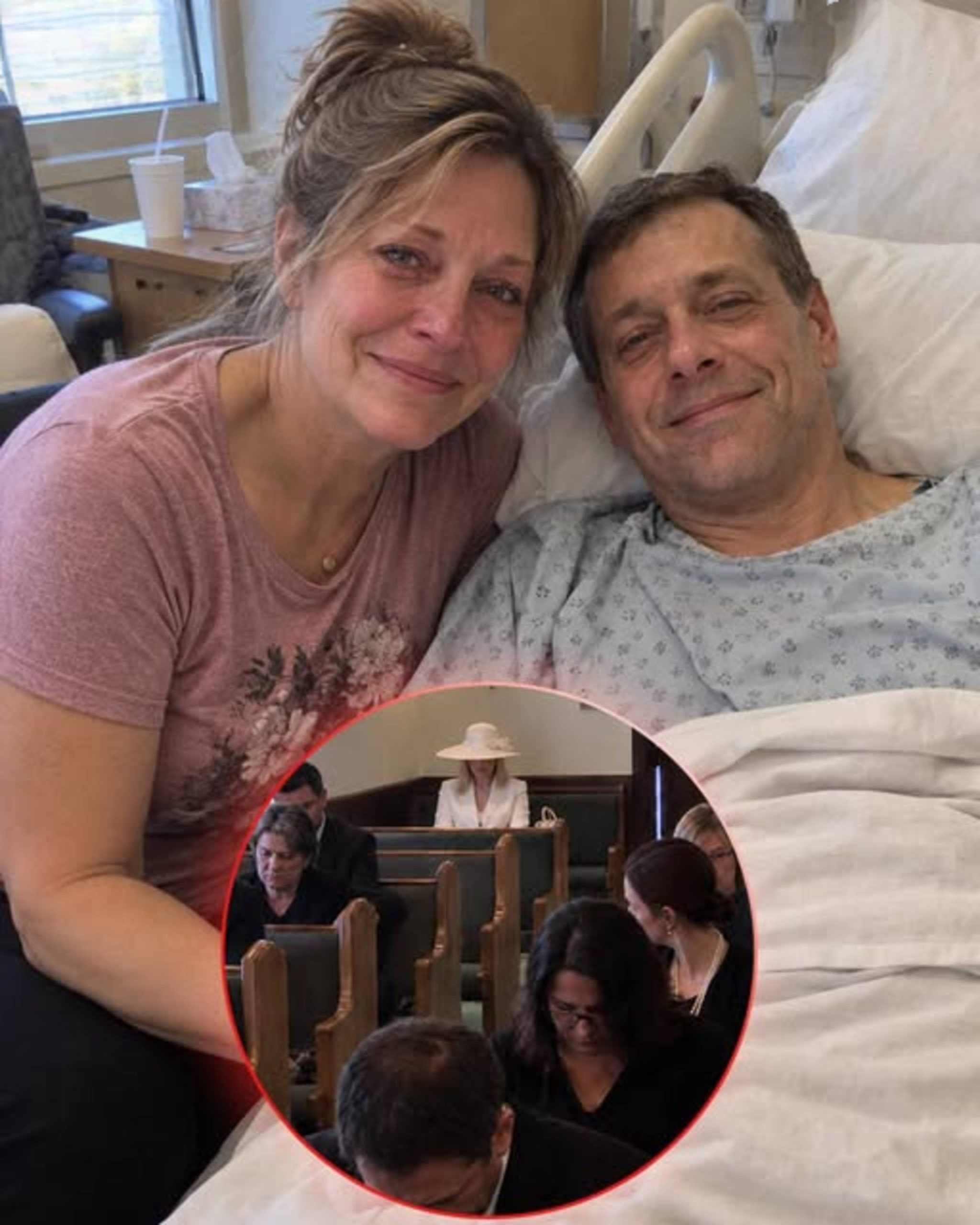
I arrived at my husband’s funeral prepared to say goodbye to the love of my life. I had spent the entire morning telling myself that this was what I had to do. I had to walk into that church, sit beside my children, listen to the prayers, look at the casket, and somehow accept that the man I had loved for twenty-seven years would never walk through our front door again. I thought I was prepared for the pain. I thought I had already experienced the worst of it the morning he died. I wasn’t prepared to leave that church with a question that would keep me awake all night.
The hymn ended, and the last note seemed to hang in the air long after the organ went silent. I gripped the edge of the wooden pew so tightly that my fingers began to ache. If I let go, I was certain my legs would give out and I would slide right onto the church floor in front of everyone.
The sanctuary was filled with familiar faces. Neighbors we had known for decades. Friends from work. People Archer had grown up with. Couples who had watched us raise our children. There were people sitting in the back whom I barely recognized, yet they had somehow come to say goodbye to my husband.
Everything felt strangely normal and completely wrong at the same time.
Sunlight filtered through the stained-glass windows, painting soft colors across the floor. Somewhere behind me, someone sniffled. A woman quietly closed her purse. A child shifted in a pew. Ordinary little sounds continued around me, and I couldn’t understand how the world could still make ordinary sounds when mine had just ended.
Ismael sat on my left, his big hand steady on my shoulder. My son had always been the strong one. Even as a little boy, he was the child who tried to make everyone else feel safe. Now he sat beside me in a dark suit, his jaw clenched, his eyes fixed straight ahead.
Reyna sat to my right, quietly crying into a folded tissue that had long since given up on its job. She kept wiping her cheeks anyway, almost as if she could somehow erase the tears before anyone noticed them.
“Mom, you’re shaking,” Reyna whispered.
I looked down at my hands.
She was right.
“You don’t have to,” she added softly. “You don’t have to be strong right now.”
I wanted to tell her that I wasn’t trying to be strong. I wanted to tell her that I didn’t even know what strong meant anymore.
But I couldn’t answer her.
If I opened my mouth again, I was certain the sound that came out wouldn’t belong to a 54-year-old woman. It would belong to a girl who’d just lost the boy she met at twenty-seven and never let go of.
Twenty-seven years.
That was how long Archer and I had been together.
Twenty-seven years of mornings and arguments, holidays and vacations, bills and birthdays. Twenty-seven years of knowing exactly how he took his coffee and which side of the bed he preferred. Twenty-seven years of hearing his footsteps in the hallway and knowing it was him before he even opened the door.
I honestly thought we’d grow old together.
I thought we’d become that old couple who complained about the weather while sitting on the porch. I imagined Archer becoming more stubborn with age and me pretending not to hear him. I imagined our children bringing their own families home for holidays while Archer stood at the grill insisting everyone was cooking the meat wrong.
I thought we had time.
He was the love of my life, and Lord knows, we had a happy marriage.
Not a perfect one.
No marriage is perfect.
We had arguments. We had bad months. We had moments when money was tight and moments when one of us slept on the couch after saying something the other didn’t want to hear.
But we always found our way back to each other.
That was Archer.
That was us.
We raised Ismael and Reyna in the same house, with the crooked porch step Archer kept promising to fix. Every year, he said, “I’ll get to it next weekend.”
Next weekend became next month.
Next month became next spring.
Eventually, the porch step became one of those family jokes nobody questioned anymore.
“Your father is going to fix that step one day,” I would tell the kids.
And Archer would call from the kitchen, “I heard that.”
“You were supposed to hear it.”
Then he would laugh.
I would give anything to hear that laugh now.
Sunday mornings were my favorite. Archer would wake before everyone else and shuffle into the kitchen, still half asleep, and start making coffee. He always hummed while he worked, always the same tune, some old song his father used to sing.
I never knew the name of it.
I had asked him once.
He had shrugged and said, “It’s just a song.”
“Your father sang it?”
“All the time.”
“Then what’s it called?”
“I don’t know.”
I smiled at the memory now, even though it hurt.
That tune had become part of our house. Part of our mornings. Part of him.
For twenty-seven years, I never imagined that one day I would wake up and realize I would never hear it again.
Two years ago, the doctor said the word “cancer,” and I decided, right there in that office, that we would beat it.
I remember the room.
I remember the fluorescent lights overhead. I remember the doctor’s careful expression and the way Archer squeezed my hand underneath the desk.
I remember looking at him and thinking, No.
Absolutely not.
This wasn’t how our story was going to end.
I believed we would beat it through every round of treatment, despite how serious the prognosis was. I believed it when the treatments left him exhausted. I believed it when he stopped complaining about things that would have annoyed him before. I believed it when his clothes began hanging loosely from his shoulders.
I believed it when he lost the weight.
I believed it when he lost his hair.
I believed it when the color disappeared from his cheeks.
I believed it when his voice became quieter.
Every time someone looked at me with pity, I wanted to tell them they were wrong.
“He’ll get better,” I would say.
Sometimes I said it because I believed it.
Sometimes I said it because I needed everyone else to believe it too.
Archer never liked people treating him differently. Even when he was sick, he tried to make jokes. He would complain about hospital food. He would make fun of the nurses. He would tell me I was hovering too much.
“I’m right here,” I would say.
“I know.”
“Then stop complaining.”
“I’m not complaining.”
“You are.”
“I’m making observations.”
“You’re complaining with a better vocabulary.”
He would smile.
Those little moments became everything.
I believed until the very end.
I believed it on the morning last week when Archer squeezed my hand once.
Just once.
His fingers were weak, but I felt them close around mine.
I leaned toward him.
“I’m here,” I whispered.
His eyes opened slightly.
I thought he heard me.
Then his hand went still.
And it never squeezed mine again.
Watching the man I loved lose that fight broke something in me that I didn’t know could break.
There are different kinds of heartbreak.
There is the heartbreak of an argument. The heartbreak of disappointment. The heartbreak of watching your children grow up and move away.
And then there is the kind that comes when the person you built your entire life around simply isn’t there anymore.
One day, you have the love of your life and the father of your children beside you.
You complain about the dishes.
You argue about what to watch on television.
You remind him to take out the trash.
You tell him he needs to fix the porch.
And the next day, you’re supposed to figure out how to live without him.
There is no instruction manual for that.
Nobody tells you what to do when you wake up and instinctively reach across the bed, only to touch cold sheets.
Nobody tells you what to do when you hear a familiar song in the grocery store and suddenly have to leave because it reminds you of him.
Nobody tells you how to stand in front of a room full of people and listen to them describe the man you loved in the past tense.
And nobody tells you how to say goodbye when every part of you is screaming that you aren’t ready.
—
“Dad looks peaceful,” Ismael said quietly.
His voice pulled me back into the church.
I looked toward the casket.
He did look peaceful.
Archer’s face had been carefully prepared, but somehow they had still managed to make him look like himself. His expression was calm. His hands rested neatly in front of him.
For a moment, I could almost pretend he was sleeping.
“He does,” I whispered.
I swallowed hard.
Then, somehow, a laugh escaped me.
It was small and strained, almost painful.
“He would,” I said.
Ismael looked at me.
I nodded toward his father’s tie.
“He always said ties were nooses invented by people who hated men.”
For half a second, neither of my children spoke.
Then Reyna smiled through her tears.
“That’s Dad.”
Ismael lowered his head, and I could see the corners of his mouth move.
“He said that at my graduation,” he whispered.
“He said it at everything,” I replied.
“Funerals too, probably,” Reyna said.
I almost laughed again.
Instead, I pressed my lips together and stared at the casket.
That was the cruel thing about grief.
A memory could make you smile and break your heart at the exact same time.
Pastor Anderson stepped down from the pulpit and touched my arm as he passed.
His hand was warm.
I looked up at him.
He gave me the kind of sympathetic smile people give when there are no words capable of fixing anything.
I nodded because words felt like something I’d forgotten overnight.
Then I looked once more toward Archer.
There were flowers surrounding the casket. Photographs of our family sat on a small table nearby. In one of them, Archer was holding Reyna when she was a baby. In another, Ismael was standing beside him with missing front teeth and a baseball glove tucked under his arm.
I remembered taking that picture.
I remembered Archer complaining that I was taking too many photographs.
“One day you’ll be glad I did,” I had told him.
He had rolled his eyes.
Now those photographs were all I had.
Or at least, I thought they were.
Because as the service continued and people began preparing to say their final goodbyes, I noticed something on the far side of the church.
A woman I didn’t recognize was standing alone near the back.
She wasn’t crying.
She wasn’t praying.
She was simply staring at Archer’s casket.
And when our eyes met, her expression changed.
It was only for a second.
But I saw it.
Recognition.
Fear.
And something else I couldn’t explain.
Then she quickly looked away.
I turned toward Ismael.
“Who is that?”
He followed my gaze.
“I don’t know, Mom.”
Reyna looked too.
Neither of them recognized her.
The woman reached into her purse and pulled out a small envelope.
She held it tightly in one hand.
Then she looked directly at me again.
And this time, she began walking toward us.