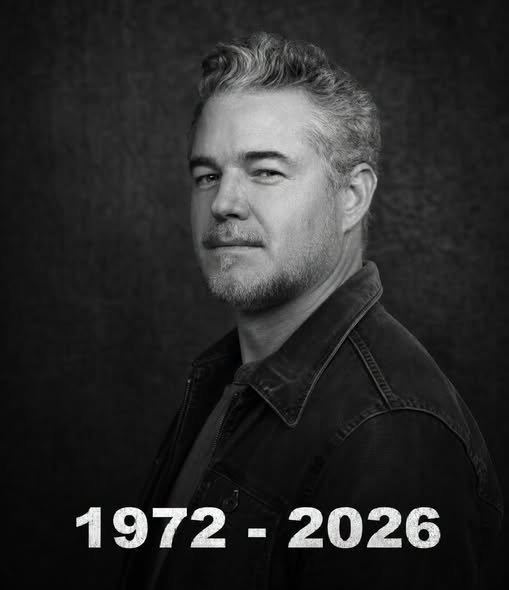
**The news hit like a punch to the chest. Eric Dane, the man millions knew as “McSteamy,” is gone at just 53.**
Fans are reeling. Castmates are shattered. And Hollywood is once again being forced to confront the devastating reality of a disease that can quietly take away the things a person once took for granted.
Eric Dane’s battle with ALS was public, but the private reality of living with the disease was something few people could truly see.
His story began long before the fame.
A California kid chasing small acting opportunities in the 1990s, Dane spent years taking roles that slowly built his reputation. He wasn’t an overnight success. He worked his way through television appearances and supporting parts, waiting for the role that would finally change everything.
That moment arrived in 2006.
As Dr. Mark “McSteamy” Sloan on *Grey’s Anatomy*, Dane didn’t simply join one of television’s biggest shows. He became a cultural phenomenon.
McSteamy initially appeared to be exactly what his nickname suggested: confident, handsome, charismatic, and completely aware of the effect he had on everyone around him. But beneath the swagger was something more complicated. Dane gave the character warmth, vulnerability, humor, and eventually a depth that made audiences care about what happened to him.
The role transformed his career.
Soon came other major chapters.
He took on the role of Tom Chandler in *The Last Ship*, portraying a determined leader facing impossible circumstances. Later, in *Euphoria*, he revealed another side of his abilities as Cal Jacobs, a deeply conflicted and troubled character whose contradictions made him difficult to forget.
His film work added even more variety, with appearances in projects including *X-Men: The Last Stand*, *Marley & Me*, and *Bad Boys: Ride or Die*.
But for many fans, none of those roles could separate Dane from the image that first made him famous.
McSteamy.
That is what made the news of his ALS diagnosis in 2025 so painful.
The diagnosis could have pushed him away from the spotlight. It could have made him retreat into privacy and allow the world to remember him only through old performances.
He chose a different path.
He continued showing up.
He continued working.
And he spoke publicly about what it meant to live with a progressive disease that could gradually take away physical abilities while leaving the person inside still completely aware of what was happening.
There is a particular cruelty in that reality.
The actor who had spent his career portraying strength, confidence, leadership, and physical presence was suddenly facing a condition capable of challenging all of those things.
Yet Dane refused to let the diagnosis erase his identity.
He continued connecting with audiences and colleagues. He allowed people to see vulnerability rather than hiding it behind the polished image of a television star.
That may ultimately become one of the most important parts of his legacy.
People will remember the characters.
They will remember McSteamy’s smile, the dramatic storylines, the swagger, the romances, the television moments that became part of pop culture.
But they may also remember the man who chose not to disappear when life became painfully difficult.
ALS changed what his body could do.
It did not erase his voice, his history, his relationships, or the work he had already given the world.
And perhaps that is why his story reaches beyond Hollywood.
Eric Dane’s legacy isn’t only about the roles he played when he was young and healthy.
It’s also about the courage required to keep showing up when the circumstances change completely.
In the end, the screen may preserve his performances forever.
But his greatest performance may have been something he never acted out at all:
**the courage to remain present, honest, and human while facing the loss of almost everything he once took for granted.**