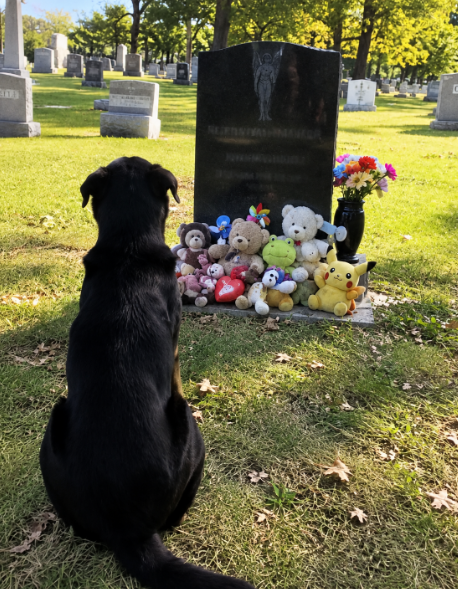
For months, the same strange dog waited beside my son’s grave every Sunday. He always appeared before I arrived and disappeared before I left, as if he had his own reason for being there. At first, I told myself it was a coincidence. Maybe someone from the neighborhood walked him there. Maybe he simply liked the quiet cemetery.
But week after week, he returned.
And then, one Sunday, I finally decided to follow him home.
I had no idea that the decision would lead me to a weathered door, a familiar face, and a truth that would change everything I thought I knew about my son.
My name is Diane, and I lost my son Caleb three years ago in a car accident that still doesn’t feel real most mornings when I wake up.
Three years sounds like enough time for a person to understand what happened.
People say grief becomes easier. They tell you that eventually you learn to live with the loss, that the sharp pain softens into something quieter. Maybe that happens for some people.
For me, it never followed a straight line.
Some mornings, I open my eyes and reach for my phone before I remember there will never be another message from him.
No late-night question.
No photograph of some terrible meal he was proud of making.
No short text asking if I could transfer $20 because he had somehow spent everything he had.
For a few seconds after waking, my brain still expects him to be somewhere in the world.
Then the memory returns.
And everything goes quiet.
There are days when that truth arrives gently, almost like a whisper. Other days, it feels brand new, as though someone has just walked into my room and told me Caleb is gone for the first time.
He was 19 when the accident happened.
Nineteen.
Old enough to believe he was independent, but still young enough that half his belongings were scattered around my house.
His old sneakers remained near the garage door for months because I couldn’t bring myself to move them. Every time I walked past them, some irrational part of me expected him to come through the door and complain that I’d touched his things.
There was a hoodie hanging behind his bedroom door that still smelled faintly like his detergent.
I knew the smell would eventually disappear.
I hated knowing that.
Not everything has to make sense after someone dies.
Grief makes you irrational about objects.
A chipped coffee mug can become sacred.
An old grocery receipt can feel impossible to throw away if your child’s handwriting is on the back.
A jacket can sit untouched for years because moving it feels like admitting the person who wore it isn’t coming home.
I kept things I would once have considered meaningless simply because Caleb had touched them.
His old backpack.
A broken pair of headphones.
A movie ticket.
A birthday card he had forgotten to sign.
None of those things could bring him back.
But they gave me somewhere to put the love that had nowhere else to go.
The cemetery became the one place where I allowed myself to stop pretending I was doing better than I was.
At first, I went because staying home felt worse.
Then it became routine.
Every Sunday morning, I bought coffee from the same little shop near my neighborhood. The woman behind the counter eventually stopped asking for my order because she knew it by heart.
I drove across town, parked under a row of old trees, and walked the familiar path toward Caleb’s grave.
Sometimes I brought flowers.
Sometimes I brought nothing.
Sometimes I talked.
“I saw your old friend at the grocery store,” I might say.
Or, “Your cousin got married.”
Or, “You would hate the weather today.”
Once, after my car battery died, I stood beside his headstone and said, “You would have laughed at me. I spent twenty minutes looking for the hood release.”
I actually laughed after saying it.
Then I cried.
Talking to a grave sounds strange until you have someone inside one.
Then it feels perfectly reasonable.
I never expected anyone else to understand what those Sunday mornings meant to me.
They were my time with Caleb.
No explanations.
No forced smiles.
No one telling me I needed to move on.
Just me, the trees, the stone, and the memory of the boy I had carried in my arms nineteen years earlier.
Then, sometime during those visits, I began noticing a dog.
At first, I barely paid attention.
He was just another stray animal wandering through a cemetery.
But then I saw him again the following Sunday.
And the Sunday after that.
For the past several months, I noticed the same dog there almost every single time, a scruffy mixed breed with no collar, always lying quietly beside Caleb’s headstone.
He was there when I arrived.
And somehow, he was always gone by the time I left.
It became so consistent that I started wondering whether he was waiting for me.
That thought was ridiculous.
I told myself so more than once.
Dogs don’t understand grief the way humans do.
At least, that’s what I thought.
He was medium-sized, with uneven brown and gray fur that looked as if someone had trimmed it with kitchen scissors. His coat was dusty in places, and there were patches where the fur had grown unevenly.
One ear stood upright while the other folded over at the tip.
His ribs weren’t visible, but he was thin enough to make me wonder how regularly he ate.
Some Sundays, I brought an extra piece of food from home.
He accepted it carefully, never rushing toward me.
He didn’t bark when I approached.
He didn’t growl.
He simply lifted his head.
His dark eyes followed me as I walked toward Caleb’s grave.
The first few times, I assumed he was interested in the food.
Then I noticed something that made me stop.
The dog wasn’t watching me.
He was watching the headstone.
That was when I realized where he had been lying.
Right beside Caleb’s headstone.
Not near it.
Beside it.
Close enough that his body almost touched the stone.
I stood there for a long moment.
“Do you know him?” I whispered.
The dog simply looked at me.
I felt foolish for asking.
Still, I couldn’t stop myself.
“What are you doing here?”
He lowered his head again.
I knelt beside Caleb’s grave, and for several minutes neither of us moved.
The dog moved a few feet away when I reached toward him, but he didn’t leave.
Instead, he turned his body so he could continue facing the grave.
That small gesture stayed with me all week.
The next Sunday, he was there again.
And the Sunday after that.
Eventually, I began arriving earlier, almost without admitting to myself why.
I wanted to see him.
I wanted to understand.
I started watching the cemetery entrance whenever I saw his familiar shape in the distance. He never came from the direction of the main road. He always appeared from somewhere beyond the old stone wall at the far end of the property.
One morning, I decided to follow him.
I waited until I had finished speaking to Caleb.
Then I stood.
The dog looked back at me.
He started walking.
I followed.
He moved slowly at first, stopping every few yards to glance over his shoulder as if checking whether I was still there.
We left the cemetery.
Then we crossed a quiet road.
Then another.
My heart began beating faster.
I had no idea where he was taking me.
After nearly twenty minutes, the dog stopped in front of a small, weathered house with peeling paint and an old wooden porch.
He climbed the steps.
Then he turned around and looked directly at me.
The front door opened.
And the face of the person standing behind it was one I hadn’t seen in years.
My breath caught.
Because suddenly, the dog made sense.
And so did the reason he had been waiting beside my son’s grave.
What I learned behind that weathered door would force me to question the last years of Caleb’s life—and finally understand that there had been parts of his story I had never known.