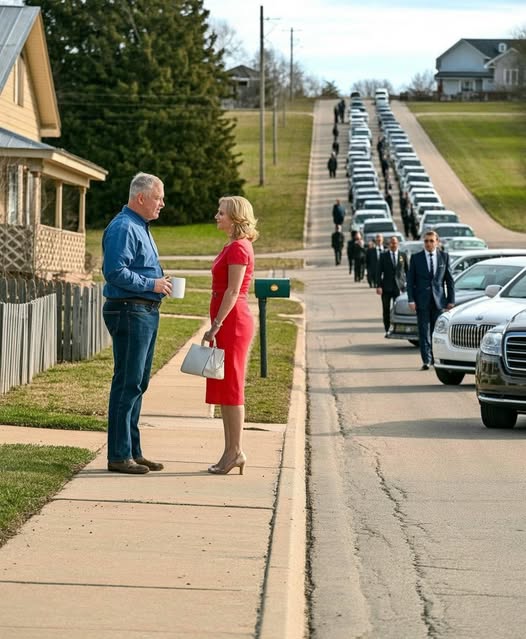
Caleb Morrow stepped out onto his front porch at precisely seven forty-three in the morning, a warm mug of coffee resting in his hand, and then he stopped mid-step.
The road stretching out in front of his house was no longer a road in any ordinary sense. It was swallowed whole—hidden beneath a line of black hoods, polished chrome grilles, and the low, expensive hum of engines that had likely never touched a dirt path in their existence. A procession of black Escalades stood bumper to bumper. A sleek silver Bentley caught the morning light. And directly across from his mailbox sat a gunmetal Rolls-Royce, perfectly still, almost unreal. Caleb didn’t move. He simply stood there, coffee in hand, staring at the scene the way one stares at something that refuses to make sense.
Across the yard, his neighbor Ray Cutler had already emerged in his bathrobe, phone raised high, his mouth slightly open in disbelief.
At Caleb’s side, Eli appeared, still blinking sleep from his eyes, dressed in pajamas and holding a bowl of cereal that was tilting at a dangerous angle—seconds away from spilling. He looked at the road. Then at his father. Caleb looked at the road again.
And then, one of the car doors opened.
A woman stepped out of the lead vehicle with calm precision, her movements unhurried, controlled, and deliberate—the kind of confidence that came from someone who no longer needed to prove anything through dramatic entrances. She wore a fitted red dress, bold and unapologetic, with a cream-colored coat draped elegantly over her shoulders, shifting gently in the cool morning air. Her heels struck the packed dirt with a steady rhythm. The structured white handbag hanging from her arm likely cost more than Caleb’s truck—maybe even more than the truck and the fence he had been meaning to repaint since September. Her dark golden hair fell freely past her shoulders, and her face was striking enough to make Ray slowly lower his phone without even realizing he had done it.
She walked straight across the road, her path unwavering, and stopped at the base of Caleb’s porch steps. Looking up at him, she held his gaze with complete focus—not aggressive, not demanding, just entirely present in a way that made everything else seem distant.
Caleb studied her. Looked again. Nothing connected. No flicker of recognition—not her face, not her posture, not a single detail that belonged to any memory he could access.
“I’m sorry,” he said finally. “Have we met?”
Something shifted briefly across her expression.
“You let me into your house last night,” she replied. “I’m a little surprised you don’t remember.”
Caleb glanced at the convoy, then back at her. Eli tugged at his shirt. “Dad, who is she?”
Caleb shook his head slowly. “I honestly have no idea, buddy.”
To understand how a woman like Nora Ashby ended up on a quiet dirt road outside Clover Ridge, Tennessee at eleven seventeen on a stormy Tuesday night—with a dead GPS and her phone battery hovering at eight percent—you had to go back to the morning she left Chicago. Back to her father. Back to the small piece of paper he had pressed into her hand with more strength than she expected from someone who had been fading for months.
On that paper, written in slightly uneven handwriting, were three simple lines: Clover Ridge, Tennessee. Caleb Morrow. Find him, Nora. He’s the only one left.
She had chosen not to take a driver. She hadn’t told Dennis, her chief of staff—who would have arranged security, logistics, backup plans, and likely introduced just enough hesitation to stop her from going at all. Instead, she left Ashby Capital’s parking garage at two in the afternoon in a rented sedan and drove south, straight into worsening weather.
By the time she crossed into Tennessee, the rain was relentless—thick, slanted sheets that the windshield wipers couldn’t keep up with. The GPS signal disappeared somewhere past a town called Fairview. Her phone battery dipped into single digits.
She turned off the highway based on her last known direction. The road narrowed. Then narrowed again. Soon it became nothing more than dark clay, boxed in by trees. And then the tire sank—softly, finally—into the mud.
She turned off the engine and sat there as the rain pounded the roof. Nora Ashby—CEO of a multibillion-dollar company—sat alone in a ditch in rural Tennessee with no plan. It wasn’t a version of herself she would ever describe publicly. But it was real. And for two long minutes, she stayed there, facing it.
Then she saw the light.
One small window, faint and yellow, about two hundred yards through the trees. Ordinary. Steady. Enough.
She moved before she fully thought it through.
Pulling her coat over her head, she stepped out into the rain and ran.
The porch light was on. She knocked. The man who opened the door was tall, broad-shouldered, with dark eyes and the look of someone used to physical work. In the dim light and heavy rain, he couldn’t see her clearly. She was soaked, her hair clinging to her face. She looked exactly like what she was—someone who needed help.
“My car got stuck,” she said. “I just need somewhere to wait out the storm.”
He didn’t ask for her name. Didn’t ask where she came from. He simply stepped aside and held the door open.
He gave her dry clothes, pointed her to a small bedroom, and told her he and his son would take the couch. He said it simply, like it was nothing unusual. Then he walked away.
She lay down intending only to rest.
She was asleep within minutes.
She woke before dawn. Charged her phone just enough. Called Dennis. Folded the borrowed clothes neatly—corners aligned—and left them on the bed. Then she slipped out the door quietly, closing it behind her with care.
The boy found the empty room first.
“She left?” he asked.
His father looked at the folded clothes. “Looks like it.”
Back on the porch that morning, standing before a line of luxury cars that didn’t belong on his road, Caleb slowly began to connect the pieces. The folded clothes. The quiet departure. The thoughtfulness.
“That was you,” he said, more statement than question.
She extended her hand, her tone shifting—polished, practiced. “Nora Ashby. CEO of Ashby Medical Devices, Chicago.”
The man beside her stepped forward, offering a business card. Caleb took it without looking.
He was staring at her.
At the name.
Ashby.
He had heard it before—in another life.
He had been thirty-one, sitting in a Boston coffee shop near a conference, when a man sat across from him and asked questions no one else had thought to ask. They spoke for hours—real conversation, sharp and precise. At the end, the man had asked him what he would do when his ideas outpaced the system meant to support them.
That man was Richard Ashby.
Caleb looked at Nora again—and this time, something clicked.
She explained everything—her father, the tumor, the specialists who had all said the same thing: inoperable. Too dangerous. Too risky. Three to six months left.
But her father had remembered something.
A conversation. A name.
Caleb Morrow.
“The only one who can help.”
Caleb listened. Quiet. Still.
Then he asked one question. “Who are you looking for?”
She answered carefully. “A neurosurgeon. Caleb Morrow.”
Eli looked up at his father.
Caleb’s expression didn’t change.
He looked at Nora. At the cars. Back at her.
“Come inside,” he said. “I’ll make more coffee.”
Inside, in the small kitchen filled with morning light, she told him everything in full.
The missing license. The abandoned apartment. The years of silence.
She had followed a ghost.
And found him.
Later, she saw the diploma.
Johns Hopkins. Neurosurgery.
His name.
She stood there for a long moment, then returned to the kitchen doorway.
“You,” she said quietly.
“You’re him.”
Caleb dried his hands and turned to face her.
“I don’t practice anymore,” he said.
She stepped forward.
“My father is dying.”
Not as strategy. Not as persuasion. Just truth.
He looked at her—really looked this time.
The strain. The control. The weight she carried.
From the hallway, Eli appeared, then quietly disappeared again.
“My father didn’t want the best surgeon on paper,” she said. “He wanted someone who sees patients as people.”
Silence settled between them.
Later that afternoon, Caleb told her about Sarah.
He hadn’t planned to. But the moment found him.
A photograph. A memory.
His wife.
The accident. The hospital. The surgery he performed himself.
Every decision right.
Every action precise.
And still—she died.
After that, something in him shut down.
He left everything. His career. His identity. His life.
And came here.
To a place where no one knew his name.
Where he didn’t have to be that man anymore.
Where his hands didn’t have to remember what they had lost.
He told Nora all of this in a low, even voice, without emphasis, his gaze resting on the table instead of meeting hers. When he finished speaking, the kitchen fell into a deep, unmoving silence.
After a moment, Nora spoke. “He didn’t send me to find credentials,” she said. “He said you spoke about the brain as something worth protecting. That was the word he used—worth protecting.” She paused briefly. “He said it was one of the clearest conversations he remembered from that entire decade.”
Caleb didn’t respond right away. But for the first time since she had arrived that morning, he pulled out a chair and sat down at the table. Not standing anymore, not holding that careful distance of someone still deciding whether to engage. Sitting across from her.
Nora explained what she needed in a direct, unembellished way. She wanted him to come to Chicago and review her father’s case. To go through the scans, the surgical opinions, the notes compiled by four different specialist teams. She wasn’t asking him to guarantee anything. She wasn’t asking him to decide immediately whether he would operate. She just wanted him to look. Nothing more. Just to look.
He told her he couldn’t. His medical license had lapsed—not revoked, simply allowed to expire. He had no current hospital privileges, no active patients, no recent clinical work. Years had passed since he had touched a chart. He laid these out plainly, not as excuses, but as facts.
Nora didn’t treat them as final. She outlined legal pathways—consultation allowances, emergency credentialing, provisions for external advisors. She mentioned that her legal team had already explored options. She made it clear that money was not the issue, nor had it ever been. Caleb listened, letting her finish without interruption. Dennis tried another angle—framing it as a technical review, something advisory, rehearsed and polished. Caleb looked at him calmly. “You know that’s not what this is,” he said. Dennis fell silent.
The room quieted again. Nora had reached the edge of what logic, influence, and preparation could achieve. She had nothing else to offer from that side.
Then Eli came downstairs.
He hadn’t been hiding—just listening, present in the way children are when they sense something important. He walked over, placed his hand on his father’s arm, and said softly, clearly enough for everyone to hear:
“Dad, if someone’s dad is sick, you help. That’s what you always tell me.”
Caleb looked at him for a long moment. Something shifted in his expression—something that hadn’t been there all morning. Not the stillness he had been holding onto since the cars arrived. Something more human, more open.
Then he looked at Nora.
“I’ll review the files,” he said. “All of them. And if I go through everything and nothing changes, I come back home. That’s the agreement.”
Nora nodded immediately. No hesitation. No conditions.
It wasn’t the legal reasoning. Not the credentials or the resources or the carefully constructed arguments. It was an eight-year-old boy repeating what his father had taught him. That was what changed everything.
They flew to Chicago that same evening. Caleb wore the only suit he owned—a charcoal one, originally bought for a funeral and worn only once since. Eli stayed behind in Clover Ridge with Gloria, a dependable neighbor who arrived within forty minutes of Caleb’s call, already holding a casserole and asking only the necessary questions.
Ashby Medical Center occupied the top four floors of a building on North Michigan Avenue. Richard Ashby’s room was a corner suite with windows facing the city in three directions, quiet in the way only expensive places are. Caleb moved through it without comment, silently noting the equipment.
Richard was propped up in bed. Thinner than the photos, hands slightly trembling—but his eyes were the same. Sharp. Present. Fully aware.
He studied Caleb for a moment. “I knew you’d come,” he said, voice rough but steady. “I just didn’t expect Nora to find you like that.” A faint smile. “She never does anything the usual way.”
Caleb pulled a chair close and sat. “I’ll review everything. No promises.”
“That’s all I need,” Richard replied.
The file was four hundred and twelve pages. Caleb read beside the bed for hours. Nora waited outside. Dennis brought coffee she didn’t drink. Nurses moved in and out quietly.
When Caleb finally looked up, he asked Nora to come in.
The MRI scans were lit on the wall. He pointed to one sequence—overlooked, underanalyzed. There was a subtle asymmetry. Easy to dismiss. But not insignificant.
He traced the margin in the air.
There it was—a narrow separation between tumor and critical tissue. A small but real boundary that others had assumed didn’t exist.
“This isn’t inoperable,” Caleb said quietly. “It’s just never been approached from this angle. The posterior lateral route is narrow. It requires precision beyond standard technique. But the margin is there.”
Nora couldn’t read the scan like he could. But she could read him.
“What’s the difference,” she asked, “between can’t and won’t?”
Caleb held her gaze for a moment.
“I’ll do it,” he said.
The next forty-eight hours were preparation. Detailed. Exact. He reviewed imaging, worked with radiologists, mapped every step, practiced on simulations, refined the approach repeatedly. Sleep was minimal.
The night before surgery, he sat alone in the waiting room, diagrams spread across a yellow legal pad.
Nora joined him quietly. They sat without speaking at first.
“I came alone,” she said eventually, “because I didn’t want anyone calculating the odds of failure. I couldn’t hear that. I just needed to keep looking.”
“Yes,” he said.
“Are you scared?” she asked.
“Yes,” he answered. “I always was. But you do it because someone needs it—and you’re the one who can.”
She didn’t reply. She just sat with it.
The surgery began at 7:15 a.m.
Nora waited.
At 8:20, Eli called. “Is my dad helping?” he asked.
“Yes,” Nora said. “He is.”
“Is he going to be okay?”
She looked at the closed doors. “I think so,” she said.
Nine hours and eighteen minutes later, Caleb walked out.
He was exhausted, but steady.
Nora stood. Walked to him.
He nodded once.
She nodded back.
Behind her, Dennis exhaled deeply.
Richard recovered steadily. The tumor was fully removed. His speech returned. His memory remained intact. The tremor faded. Within weeks, he was reading again.
Six weeks later, he called Caleb.
“Would you consider coming back?” he asked. “Not fully. Not in a way that disrupts your life. But the world you left—it’s smaller without you.”
Caleb looked out his window.
“I’m not ready,” he said.
“I understand,” Richard replied. “Just know the door is there.”
In late November, Nora returned—alone.
No convoy. No announcements.
Just her.
Caleb and Eli were painting the fence. She walked across the yard like anyone else.
They sat on the steps.
“You didn’t recognize me that morning,” she said.
“I remember the folded clothes,” he replied.
A quiet moment passed.
“My father asked if you’d come back,” she said.
“What did you tell him?”
“That I didn’t know,” she said. “But I thought you might. Because you didn’t lose the ability. You just stopped allowing yourself to use it.”
Caleb said nothing. He went inside, returned with coffee, and sat beside her.
Eli joined them, talking nonstop about school.
Nora listened. Fully present.
No phone. No distractions.
Just listening.
The road stayed empty. The air still. The light fading slowly.
Caleb looked at the fence, the unfinished board, the yard.
He thought about the operating room. About his hands.
About what still existed.
He didn’t say it out loud.
He just sat there, drinking coffee, listening to Eli.
And for the first time in a long while, everything felt… possible again.