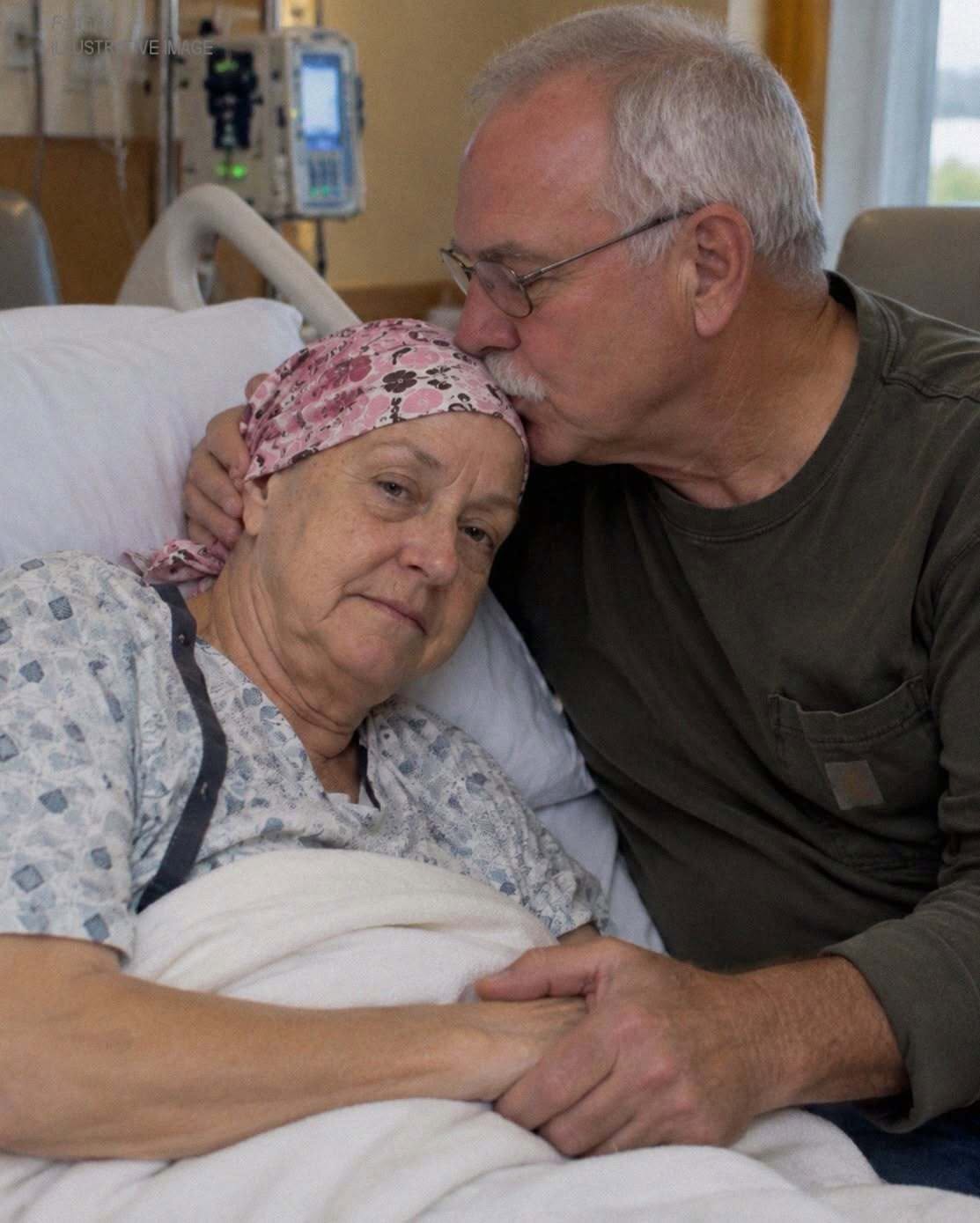
A Man Divorced His Wife After 35 Years of Marriage When She Became Seriously Ill — A Year Later, His Best Friend Brought Her a Box and Said, “He Wanted You to See This Only After You’d Recovered”
For thirty-five years, Margaret believed she had built a marriage that could survive anything.
She had stood beside her husband, Richard, through financial struggles, career disappointments, the death of his father, and the countless ordinary difficulties that slowly shape a lifetime together. She had raised their two children, helped him build his business, and spent decades making sure that everyone in their family had what they needed.
She never imagined that the greatest test of their marriage would come when she became too ill to do the things she had always done.
Margaret was sixty-two when doctors discovered a serious illness that would require months of treatment and an uncertain recovery. Until then, she had been the energetic center of her family, the woman who remembered every birthday, prepared Sunday dinners, and called her children simply to make sure they were doing well.
Suddenly, she was the one who needed help.
The diagnosis changed everything.
At first, Richard promised that they would face it together.
He sat beside her during medical appointments, held her hand in the hospital, and assured her that she would never have to fight alone.
“We’ve been through thirty-five years together,” he told her one evening. “You think I’m going anywhere now?”
Margaret believed him.
She believed him because she had spent most of her adult life believing him.
But as the months passed, the man she knew began to disappear.
Richard became impatient with the appointments, the medication schedules, and the exhaustion that made even ordinary conversations difficult. He started staying late at work. He stopped asking what the doctors had said. When Margaret tried to explain how frightened she was, he often stared at his phone or told her that she needed to remain positive.
One evening, after she had struggled to walk from the bedroom to the kitchen, she found him sitting at the dining table with a stack of papers.
“What are those?” she asked.
Richard did not immediately look up.
“Something we need to discuss.”
She lowered herself into the chair opposite him.
He pushed the papers across the table.
Divorce documents.
For several seconds, Margaret could not understand what she was seeing.
“Richard?”
He rubbed his forehead.
“I can’t keep living like this.”
She stared at him, waiting for him to explain that he was frightened, overwhelmed, or simply having a terrible day.
Instead, he told her that he wanted a divorce.
“I didn’t sign up for this,” he said quietly. “I don’t know how to be a caregiver. I can’t spend the rest of my life in hospitals and worrying about what happens next.”
Margaret felt something inside her break.
“I’m not asking you to cure me,” she whispered. “I’m asking you to stay.”
Richard looked away.
“I can’t.”
Those two words destroyed thirty-five years of certainty.
She signed the papers several weeks later, not because she wanted the marriage to end, but because she could no longer bear to beg someone to remain in a life he had already abandoned.
When Richard moved out, he took his clothes, his personal documents, and the framed photograph of his parents that had stood in his study for decades.
He left Margaret in the house they had bought together when their children were young.
For the first time in thirty-five years, she was alone.
And she was seriously ill.
The Months Nobody Saw
The months that followed were the hardest of Margaret’s life.
Her daughter, Emily, called every morning before work. Her son, Daniel, visited whenever he could, bringing groceries, preparing meals, and fixing the little things around the house that Margaret had once handled without thinking.
But the nights were different.
At night, she missed the familiar sound of Richard moving through the house. She missed the way he used to complain about the temperature, the newspapers scattered across the kitchen table, and the ridiculous jokes he repeated so often that she had stopped pretending they were funny.
She even missed the small arguments.
Grief was strange that way. It could make a person long for things she had once taken for granted.
Some evenings, Margaret sat in the living room with the television turned off, staring at the empty chair beside the window.
She wondered whether Richard ever thought about her.
She wondered whether he felt guilty.
Most painfully, she wondered whether their entire marriage had meant less to him than she had believed.
There were days when she was too weak to leave her bedroom. On those days, Emily sat beside her, brushing her mother’s hair and trying to make her laugh.
“You don’t have to pretend you’re okay,” Emily told her once.
Margaret looked at her daughter.
“I don’t know how to be anything else.”
“You don’t have to be strong every minute.”
That was when Margaret finally cried.
Not quietly, not politely, but with the raw desperation of a woman who had spent her entire life caring for other people and suddenly had no idea how to care for herself.
Yet slowly, with medical treatment, support from her children, and a determination she had not realized she possessed, Margaret began to recover.
Progress came in small victories.
The first morning she could make her own breakfast.
The first afternoon she walked around the garden without stopping to rest.
The first evening she laughed so hard at something Daniel said that she forgot, for a moment, how much her life had changed.
A year after Richard left, Margaret was still recovering, but she was stronger.
She had learned to live without waiting for his phone calls.
She had begun planting flowers again.
She had even started meeting a neighbor for coffee once a week.
She was discovering that a life could be rebuilt, even when the person you had expected to grow old beside you chose to leave.
Then, one rainy Thursday afternoon, someone knocked on her door.
It was David.
Richard’s best friend.
The Box at the Door
David had been part of their lives for nearly forty years.
He had attended their wedding, helped Richard move into his first office, and spent countless holidays sitting around their dining table. He was the sort of friend who knew where Richard kept the spare keys and which cupboard Margaret used for the good glasses.
But after the divorce, David had become strangely distant.
He still called Margaret occasionally to ask how she was feeling, but he never discussed Richard. Whenever she asked whether her former husband was doing well, David gave a vague answer and changed the subject.
Now he stood on her doorstep holding a medium-sized cardboard box.
He looked older than she remembered.
“Margaret,” he said softly.
“David. Is everything all right?”
He glanced at the box.
“I think it’s time you had this.”
She stepped aside to let him in.
They sat at the kitchen table, the same table where Richard had once placed the divorce papers.
David set the box between them.
For a moment, he did not speak.
Then he said, “Richard asked me to bring this to you.”
Margaret felt her stomach tighten.
“Why?”
“He gave me very specific instructions. He told me not to bring it until you had recovered enough to deal with what was inside.”
She stared at him.
“Recovered from what?”
David took a long breath.
“From the illness. And from everything that happened between you.”
Margaret pulled her hands into her lap.
“I don’t understand.”
“Neither did I, at first.”
He reached into his coat pocket and removed a folded envelope.
“He made me promise that I wouldn’t tell you anything before you opened the box.”
Margaret looked at the envelope, then at the box.
For a year, she had tried to stop asking questions about Richard. She had told herself that the marriage was over, that his choices belonged to him, and that she could not spend the rest of her life searching for explanations from a man who had chosen to leave.
Now the past sat directly in front of her.
“Is he sick?” she asked.
David’s eyes filled with tears.
“Margaret, I think you need to open it.”
Her hands trembled as she lifted the lid.
Inside were several neatly arranged folders, a small velvet pouch, a thick stack of letters, and a photograph of her and Richard on their wedding day.
She was twenty-seven in the photograph, wearing a simple white dress. Richard stood beside her, smiling as though he believed the world had just given him everything he could ever need.
Margaret touched the photograph.
Then she opened the first folder.
What she found made her stop breathing for a moment.
The Truth Behind the Divorce
The folder contained financial documents, correspondence, and records she had never seen before.
There were statements showing that Richard had sold several investments and withdrawn a substantial amount of money from his personal accounts. There were receipts from payments made to a specialist treatment center and copies of correspondence with a financial adviser.
At first, Margaret could not understand how any of it connected to her.
Then she saw her own name.
Her medical expenses.
Her treatment.
Her future care.
Richard had been paying for them.
Not through their joint account, and not through the money he had been required to disclose during the divorce. The documents showed that he had arranged a separate fund intended to cover expenses that her insurance did not meet.
Margaret looked up sharply.
“What is this?”
David leaned forward.
“Keep reading.”
The next document was a letter from Richard’s solicitor explaining that a portion of his assets had been placed in a protected arrangement for Margaret’s benefit.
It was not a fortune. It did not erase the financial difficulties she had endured. But it was enough to ensure that she would not lose her home or be forced to choose between essential expenses and treatment.
She turned another page.
There was a letter addressed to David.
Richard had written it shortly before the divorce became final.
David,
I have done something I never imagined I would do. I have asked Margaret for a divorce at the moment she needed me most.
I know how it looks. I know what she must think of me.
I cannot explain everything to her now. If I tell her what I am afraid of, she will spend every remaining bit of strength trying to save me from my own decisions.
I have spent years convincing myself that I can solve every problem if I work hard enough. Now I am facing something I cannot solve, and I have discovered how frightened I really am.
I have made arrangements to protect her finances as much as I can. Please make sure she receives the documents when she is strong enough to understand them.
Do not tell her that I did this out of love. Let her decide for herself what it means.
Richard.
Margaret read the letter twice.
Then a third time.
Her eyes filled with tears.
“What does he mean?” she whispered. “What was he afraid of?”
David looked down at the table.
For a long moment, he said nothing.
Finally, he explained that Richard had been struggling with his own serious health problem when Margaret received her diagnosis.
Richard had discovered that he needed treatment for a condition that he had initially refused to discuss with anyone. The news had terrified him. He had spent weeks convincing himself that he could handle it privately, but his fear had gradually turned into anger, withdrawal, and a desperate need to control something in a life that suddenly felt uncontrollable.
When Margaret became ill, the pressure intensified.
Instead of admitting that he was frightened and overwhelmed, Richard made a terrible decision.
He left.
He told himself that he was protecting her from his problems, even as his behavior inflicted a different kind of suffering.
“He was wrong,” David said quietly. “He knows that. I told him so.”
Margaret pressed a hand against her mouth.
“Why didn’t he just tell me?”
“Because Richard has always believed that being a husband means being the person who fixes everything. He didn’t know how to be frightened beside you. He didn’t know how to ask you to help him.”
David paused.
“That doesn’t excuse what he did. He hurt you deeply, and he knew it.”
Margaret looked back at the letter.
For the first time in a year, she could see the outline of the man she had married.
Not the perfect husband she had once believed him to be, but a flawed, frightened man who had made a devastating choice rather than admit that he was no longer in control.
She did not know whether she could forgive him.
But she finally understood that the divorce had not been as simple as she had believed.
And the box still contained more.
The Letters He Never Sent
Beneath the financial records was a bundle of envelopes tied together with a blue ribbon.
Each one had Margaret’s name written across the front.
Some were dated during the first months after the divorce. Others had been written only a few weeks before David arrived at her house.
Margaret opened the first.
Margaret,
Today I drove past the garden center where you bought those ridiculous yellow flowers you loved. I remembered how you insisted they made the house look cheerful, even though I told you they looked like little suns.
I wanted to call you.
I didn’t.
I told myself you needed peace, but the truth is that I was afraid you would answer. I was afraid you would ask me how I could leave you when you needed me.
I still don’t have an answer that makes what I did acceptable.
She set the letter down and opened another.
I heard from Emily today. She told me you had managed to walk around the garden again. I cannot describe how relieved I felt.
I wanted to be there.
I had no right to ask for a place beside you after I had walked away from it.
The letters continued.
Some described ordinary memories: their first apartment, the terrible dinner he had cooked when they were newlyweds, the night their son was born, the way Margaret always fell asleep during old detective films.
Others contained apologies he had apparently been unable to say aloud.
In one letter, he wrote:
You deserved a husband who could sit beside your hospital bed and admit that he was frightened. Instead, you got a man who mistook running away for being strong.
I have spent a year trying to understand how I became someone capable of hurting the person I loved most.
I don’t expect you to forgive me.
I only hope that someday, when you think of our thirty-five years together, the last few months will not be the only thing you remember.
Margaret began to cry.
Not because the letters erased what he had done.
They did not.
She cried because they reminded her of the years that had come before the betrayal: the children they had raised, the homes they had built, the holidays they had shared, and the quiet moments that had once made their marriage feel unbreakable.
Thirty-five years could not be reduced to a single decision.
But neither could a single decision be dismissed because thirty-five years had preceded it.
She had to hold both truths at once.
And that was harder than either loving him or hating him.
The Final Envelope
At the bottom of the box lay a small velvet pouch and one final envelope.
The envelope was marked:
FOR MARGARET — PLEASE READ THIS LAST.
She opened it carefully.
Inside was a handwritten letter and a single key.
My dearest Margaret,
If David has brought you this box, it means you have reached a point in your recovery when I can no longer pretend that silence is protecting either of us.
I owe you the truth, and I owe you an apology that does not ask anything in return.
When you became ill, I was terrified. When I learned that I was facing my own medical problems, I became even more frightened. I convinced myself that leaving would spare you from having to carry my fear as well as your own.
That was not protection. It was cowardice.
You spent thirty-five years standing beside me. When the moment came for me to stand beside you, I failed.
I cannot change the day I placed those papers on our table. I cannot give you back the nights you spent alone, or the times you wondered whether you had ever truly been loved.
I can only tell you that I am sorry.
The key in this envelope belongs to the little house by the lake where we spent our tenth anniversary. I bought it years ago, hoping that one day we might return there when we were older, with grandchildren running through the garden.
I kept the house because I could not bear to sell the place where I had once been happiest.
It belongs to you now, if you want it.
Not as payment. Not as a request for forgiveness. And certainly not as a way to buy back the years I damaged.
I want you to have a place where you can begin again, whether I am part of that future or not.
I have spent too much of my life believing that love is something you prove by providing, fixing, and protecting.
You taught me that love is also the courage to stay when there is nothing left to fix.
I am sorry it took losing you for me to understand.
Richard.
Margaret held the letter against her chest.
The house by the lake.
She remembered it immediately. It was a small wooden cottage surrounded by trees, with a narrow porch and a view of the water. They had spent their tenth anniversary there, talking until sunrise about the life they wanted to build.
She had always assumed they would return someday.
Then children arrived, work became demanding, and ordinary responsibilities pushed the dream farther into the future.
Now Richard had given her the key.
But she did not know whether she wanted the house, the memories, or anything else connected to him.
She looked at David.
“Is he still alive?”
David’s expression changed.
“Yes,” he said. “But he isn’t well.”
Margaret closed her eyes.
“How long has he been ill?”
“Longer than he admitted. He has been receiving treatment, but the outcome is uncertain.”
She looked down at the letters.
“Why didn’t you tell me?”
“Because he asked me not to interfere. And because I thought you deserved to recover without being pulled back into his life before you were ready.”
David paused.
“But I also knew that if I waited much longer, you might never get the chance to decide what you wanted to do with the truth.”
Margaret sat quietly for several minutes.
Then she picked up the key.
“Where is he?”
The Visit She Never Expected to Make
David drove her to a modest rehabilitation facility on the edge of town.
Richard was sitting near a window when they entered his room. He looked older than he had a year earlier. His hair had thinned, and his face carried the exhaustion of someone who had spent too long pretending he was stronger than he felt.
When he saw Margaret, he went completely still.
For a moment, neither of them spoke.
Then Richard slowly pushed himself to his feet.
“Margaret.”
She looked at the man who had once been her entire world.
She remembered the young man who had held her hand at their wedding. The father who had paced hospital corridors when their children were born. The husband who had made her laugh during difficult years.
She also remembered the divorce papers.
The empty house.
The nights she had cried herself to sleep.
All of it belonged to the same story.
“I read your letters,” she said.
Richard lowered his head.
“I’m sorry.”
“You keep saying that.”
“I know.”
“But do you understand what you did to me?”
His eyes filled with tears.
“I think I’m only beginning to.”
Margaret sat in the chair beside his bed.
“You made me feel as though my illness had made me unworthy of being loved.”
Richard covered his face with his hands.
“I know.”
“You made me wonder whether thirty-five years had meant anything.”
“They meant everything.”
“Then why did you leave?”
He struggled to answer.
Finally, he looked at her.
“Because I was afraid. And because I was ashamed of being afraid. I thought if I walked away, I could control at least one part of what was happening.”
Margaret swallowed hard.
“You chose to make me suffer rather than let me see you frightened.”
“Yes.”
It was the first time he had answered without defending himself.
She looked at him for a long moment.
“I don’t know whether I can forgive you, Richard.”
He nodded.
“You don’t have to.”
“And I don’t know whether I want to go back to the way things were.”
“I wouldn’t ask you to.”
For the first time since she had entered the room, Margaret felt that he was listening rather than waiting for her to absolve him.
She reached into her bag and took out the small key.
“I found this.”
Richard stared at it.
“The lake house.”
“Yes.”
“You don’t have to keep it.”
“I know.”
She placed it on the table between them.
“I haven’t decided what I’m going to do with it.”
He nodded again, his eyes wet.
“That’s fair.”
Margaret stood.
For a moment, she thought about leaving without saying anything else. It would have been easier to walk away with the letter, the key, and all the questions that still had no answers.
Instead, she reached for his hand.
It was thinner than she remembered.
“I loved you for thirty-five years,” she said. “That doesn’t disappear because you hurt me. But loving you doesn’t mean I have to pretend you didn’t.”
Richard began to cry.
“I understand.”
“I hope you do.”
She squeezed his hand once, then let go.
She had not promised to return.
She had not promised to forgive him.
But she had finally spoken the truth without allowing his pain to erase her own.
And for Margaret, that was enough for one day.
A Year Later, the House by the Lake
Margaret did not move into the cottage immediately.
For several months, she kept the key in a drawer beside her bed. Sometimes she took it out and remembered the woman she had been when Richard first bought the place. Other times, she wondered whether keeping it was simply another way of remaining attached to a marriage that no longer existed.
Eventually, she visited the house with Emily.
The cottage needed repairs. The garden had become overgrown, and the porch boards creaked beneath their feet. But the lake was beautiful, and the morning light fell across the water exactly as Margaret remembered.
She stood by the window for a long time.
“I think I want to keep it,” she said.
Emily smiled.
“Then keep it.”
Margaret began spending weekends there. She planted flowers along the path, repaired the porch, and filled the rooms with things she had chosen for herself.
She did not restore the cottage to recreate her marriage.
She restored it because she wanted a place that belonged to the woman she was becoming.
She and Richard continued speaking occasionally. Their conversations were difficult, but they became more honest. He stopped asking whether she would return to him. She stopped pretending that forgiveness, if it ever came, would mean forgetting.
They were no longer husband and wife.
But they were two people who had shared thirty-five years, a family, and a lifetime of memories.
Some bonds change shape without disappearing entirely.
On a warm afternoon in early summer, Margaret sat on the cottage porch, watching sunlight shimmer across the lake. She opened one of Richard’s letters again and read the final paragraph.
You taught me that love is also the courage to stay when there is nothing left to fix.
She folded the letter and placed it in the box.
For a long time, she had believed that surviving her illness meant returning to the life she had known before it began.
Now she understood that recovery was not a journey backward.
It was the process of learning how to live with what had happened without allowing it to define every day that followed.
Richard’s decision had wounded her deeply. His letters had given her answers, but they had not erased the consequences of his actions.
And the box had not delivered a perfect ending.
It had delivered something more complicated.
The truth.
The freedom to choose.
And the understanding that a woman could love someone, grieve what they had done, and still decide that her own future mattered.
Margaret looked out at the water and smiled.
She had spent thirty-five years building a life with Richard.
Now, at sixty-four, she was finally learning how to build one for herself.
And for the first time in a very long while, the future did not frighten her.
It belonged to her.
Because sometimes the greatest gift a person can receive is not an apology that changes the past, but the strength to stop letting the past decide what happens next.