For twenty years, Margaret measured her life by a single absence.
Everything she remembered seemed to belong to one of two worlds.
Before Daniel.
And after him.
Before, she was simply a mother driving down Route 9 with her seven-year-old son beside her. Daniel was talking excitedly about getting a Sprite, using the endless optimism and persistence that only children possess when they believe victory is within reach.
After, she became the woman whose child vanished without a trace.
She had stepped inside a rest stop for less than two minutes.
When she returned, Daniel was gone.
The search that followed consumed the region. Police officers, volunteers, search dogs, helicopters, and investigators combed through the area. Every lead was pursued. Every possibility was explored.
Margaret answered the same questions countless times.
What was he wearing?
Did he know not to wander away?
Could someone have taken him?
Could he have become lost?
Days turned into weeks.
Weeks became months.
Eventually, the search slowed.
Volunteers returned to their lives.
News crews moved on.
The investigation was reduced to files and paperwork.
But Margaret never stopped looking.
On the first anniversary of Daniel’s disappearance, she drove Route 9 again. The experience nearly broke her. By the time she pulled into a gas station miles later, she could barely breathe.
After that day, she avoided the road completely.
Every destination had an alternative route.
Every trip was carefully planned.
Anything to avoid returning to the place where her life had shattered.
For two decades, she succeeded.
Until last Tuesday.
A traffic accident forced her GPS to suggest a different route.
Without thinking much about it, she followed the directions.
Only when she saw the familiar sign did she realize where she was heading.
Route 9.
Immediately, memories flooded back.
Her hands tightened around the steering wheel.
Part of her wanted to turn around.
Part of her wanted to escape before the road could hurt her again.
But another part of her was tired.
Tired of letting one stretch of highway dictate her life.
So she continued.
About twenty miles later, disaster struck.
A tire exploded.
Margaret guided the vehicle onto the shoulder and sat frozen behind the wheel.
Then she cried.
Not because of the tire.
Not because she was stranded.
But because she was back on that road.
The trees looked the same.
The light looked the same.
Everything felt exactly as it had twenty years earlier.
A knock against the window startled her.
An older man stood outside.
He wore a worn work coat and carried himself with the confidence of someone accustomed to solving practical problems.
Margaret lowered the window slightly.
“You okay?” he asked.
“No,” she answered honestly.
The man glanced at the damaged tire.
“You have a spare?”
“Yes.”
“Open the trunk.”
Without another word, he began working.
Within minutes, he had changed the tire.
The entire time, Margaret watched silently.
It seemed strange that such an ordinary act could happen on a road associated with so much pain.
When he finished, he wiped his hands and looked directly at her.
“Take care, Margaret.”
Every muscle in her body locked.
She had never told him her name.
“What did you say?”
But the man had already started walking away.
He headed toward the trees at the edge of the road.
By the time Margaret climbed back into her vehicle, her heart was racing.
Then she saw it.
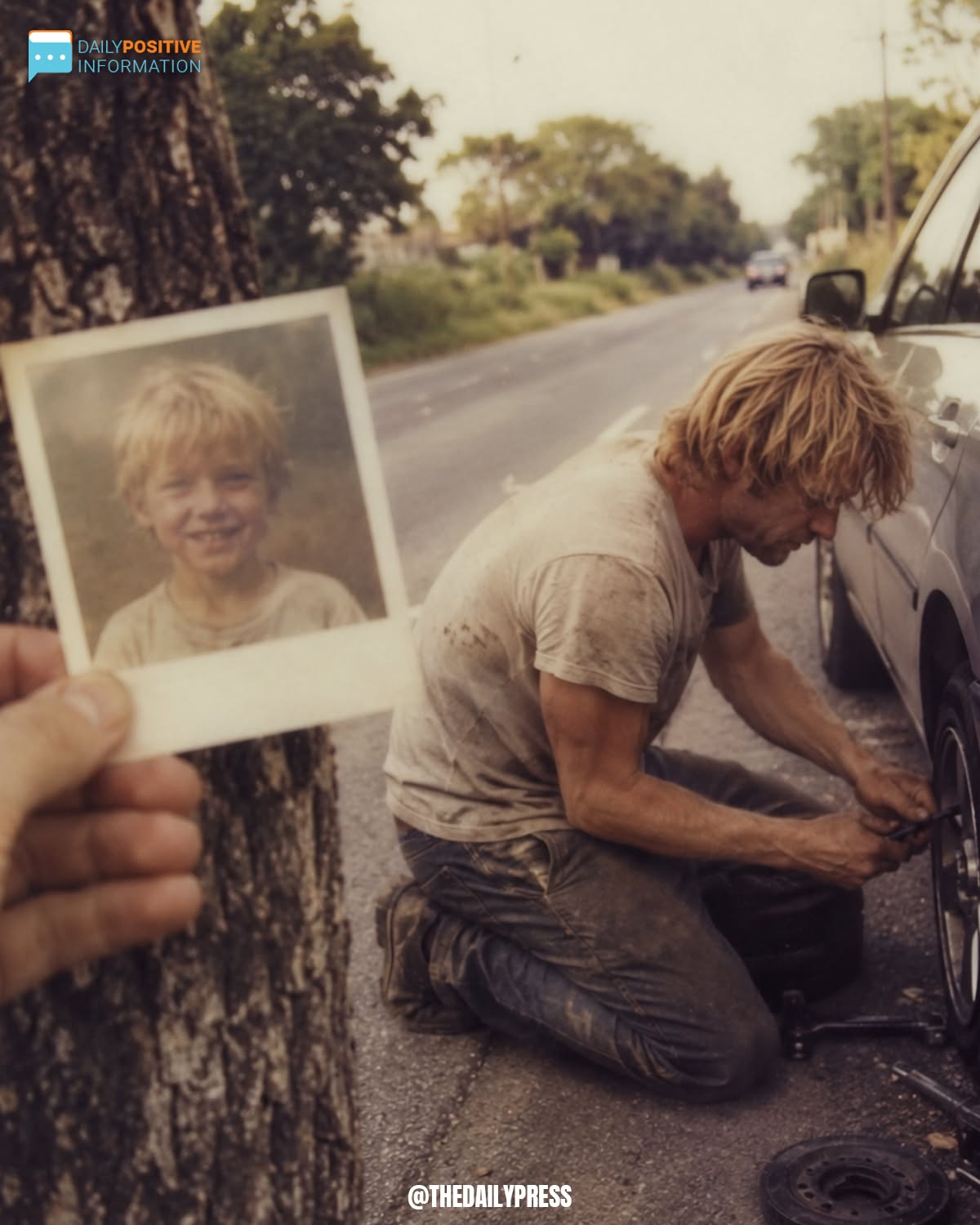
A Polaroid photograph resting on the passenger seat.
She picked it up.
The image showed a young boy wearing a red shirt.
His hair fell into his eyes.
One front tooth sat slightly crooked.
Margaret felt the world tilt beneath her.
She knew that face.
Not because she had seen it recently.
Because she had spent twenty years looking at it.
The photograph on her nightstand.
The age-progressed images investigators created.
The newspaper articles.
The missing-person posters.
It was Daniel.
On the white border of the photograph was an address.
Beneath it was her name written in shaky handwriting.
Immediately, she called the former sheriff who had led the original investigation.
He had long since left law enforcement and entered politics.
When she showed him the photograph through a video call, the color drained from his face.
“Where did you get that?” he asked.
Margaret explained.
The former sheriff grew visibly uneasy.
He mentioned a maintenance worker named Roy who had worked along Route 9 during the years surrounding Daniel’s disappearance.
Investigators questioned him at the time.
Roy claimed he knew nothing.
“If that address connects to Roy,” the former sheriff said carefully, “and if that boy is Daniel…”
“That is my son,” Margaret interrupted.
A long silence followed.
Then he admitted something that haunted him.
“If that’s true, I missed something twenty years ago.”
He urged her to wait.
She didn’t.
Margaret was already driving toward the address.
The house she found looked completely ordinary.
A truck sat in the driveway.
Children’s toys covered part of the yard.
Wind chimes hung from the porch.
Nothing about the place suggested it contained the answer to a twenty-year-old mystery.
Before she reached the front door, it opened.
A woman stepped outside.
Behind her stood a small child holding a toy dinosaur.
The woman noticed the Polaroid in Margaret’s hand and immediately went pale.
“Oh God,” she whispered.
Margaret stepped forward.
“That boy in this picture is my son.”
The woman looked down.
Then she said something Margaret never expected.
“That’s my husband.”
The room seemed to spin.
“Where is he?”
“At work.”
“What’s his name?”
The woman hesitated.
“Danny.”
Margaret shook her head.
“No. His name is Daniel.”
The woman introduced herself as Kate.
As they talked, the truth slowly emerged.
Roy had raised Daniel.
He told everyone the child belonged to a friend who could no longer care for him.
He moved frequently.
Changed details.
Avoided questions.
Most people accepted the story.
Only after Roy died three weeks earlier did Kate begin discovering evidence that something was terribly wrong.
She found newspaper clippings.
Missing-child articles.
Stories about a mother named Margaret searching endlessly for her son.
Then she found the photograph.
And finally, she learned enough to realize the truth.
Kate gave Margaret an address.
A lumberyard.
That was where Daniel worked.
Margaret drove there immediately.
When she arrived, she saw him.
Not the seven-year-old boy she remembered.
A grown man.
Broad shoulders.
Work clothes dusted with sawdust.
A stranger.
And yet not a stranger at all.
“Can I help you?” he asked.
“Daniel.”
He frowned.
“My name’s Danny.”
Margaret took a breath.
“Your mother bought you a Sprite at a rest stop on Route 9.”
Something changed in his expression.
She asked him about his earliest memory.
After a long pause, he answered quietly.
“I remember having cold hands.”
Margaret walked away without explaining.
She drove to a nearby gas station.
Purchased a bottle of Sprite.
Returned.
Then placed the cold bottle into his hands.
The moment his fingers touched it, his face changed.
“I remember a vending machine,” he whispered.
Margaret remained silent.
“I had a red shirt.”
“Yes.”
“I got lost.”
“Yes.”
His voice trembled.
“I couldn’t find the door again.”
The bottle slipped.
Margaret caught it.
Then he looked directly at her.
For the first time, recognition appeared.
“Mom?”
Twenty years vanished in a single word.
Margaret placed her hands against his face.
He was real.
Alive.
For two decades she had imagined this moment.
None of those fantasies came close to reality.
Because reality was quieter.
Messier.
More human.
A grown man standing in a lumberyard with sawdust on his sleeves and tears in his eyes.
“I never stopped looking,” she told him.
Daniel stared at her.
Then nodded.
“I know.”
Later, investigators discovered a note hidden among Roy’s belongings.
The explanation was horrifying because of its simplicity.
Roy found Daniel crying behind the rest stop.
The child told him his name.
Told him his mother’s name.
Roy intended to contact authorities.
But he had legal troubles of his own.
He panicked.
One bad decision became another.
Then another.
Until days became years.
And years became an entire stolen childhood.
No elaborate conspiracy.
No criminal network.
Just one cowardly choice repeated for twenty years.
That night, after the police left and the house grew quiet, Margaret finally asked the question she had carried since the day Daniel disappeared.
“Did you ever think I stopped looking?”
Daniel stared at the Sprite bottle.
Then shook his head.
“No.”
Tears filled Margaret’s eyes.
“I don’t know how,” he said softly. “But I always felt like you were still searching.”
For Margaret, that answer mattered more than anything.
More than the photograph.
More than Roy’s confession.
More than the reunion itself.
Because somehow, despite everything, her refusal to give up had reached him.
Not through letters.
Not through conversations.
But through something deeper.
Hope.
She never recovered the lost years.
She missed his childhood.
His graduation.
His first job.
His wedding.
The birth of his son.
Those moments could never be returned.
But she gained something else.
A grandson who handed her a dinosaur sticker.
A kitchen table filled with crayons and homework.
A son sitting across from her, alive.
Present.
Real.
Late that night, Daniel looked at her and said:
“I don’t know how to be your son.”
Margaret smiled through tears.
“You already are.”
For twenty years, her life had been divided into two parts.
Before Daniel.
And after Daniel.
Standing in that kitchen, holding a dinosaur sticker and looking at the son she thought she had lost forever, she realized there might be a third chapter waiting.
After Route 9.
And for the first time in twenty years, she was ready to discover what that chapter would become.