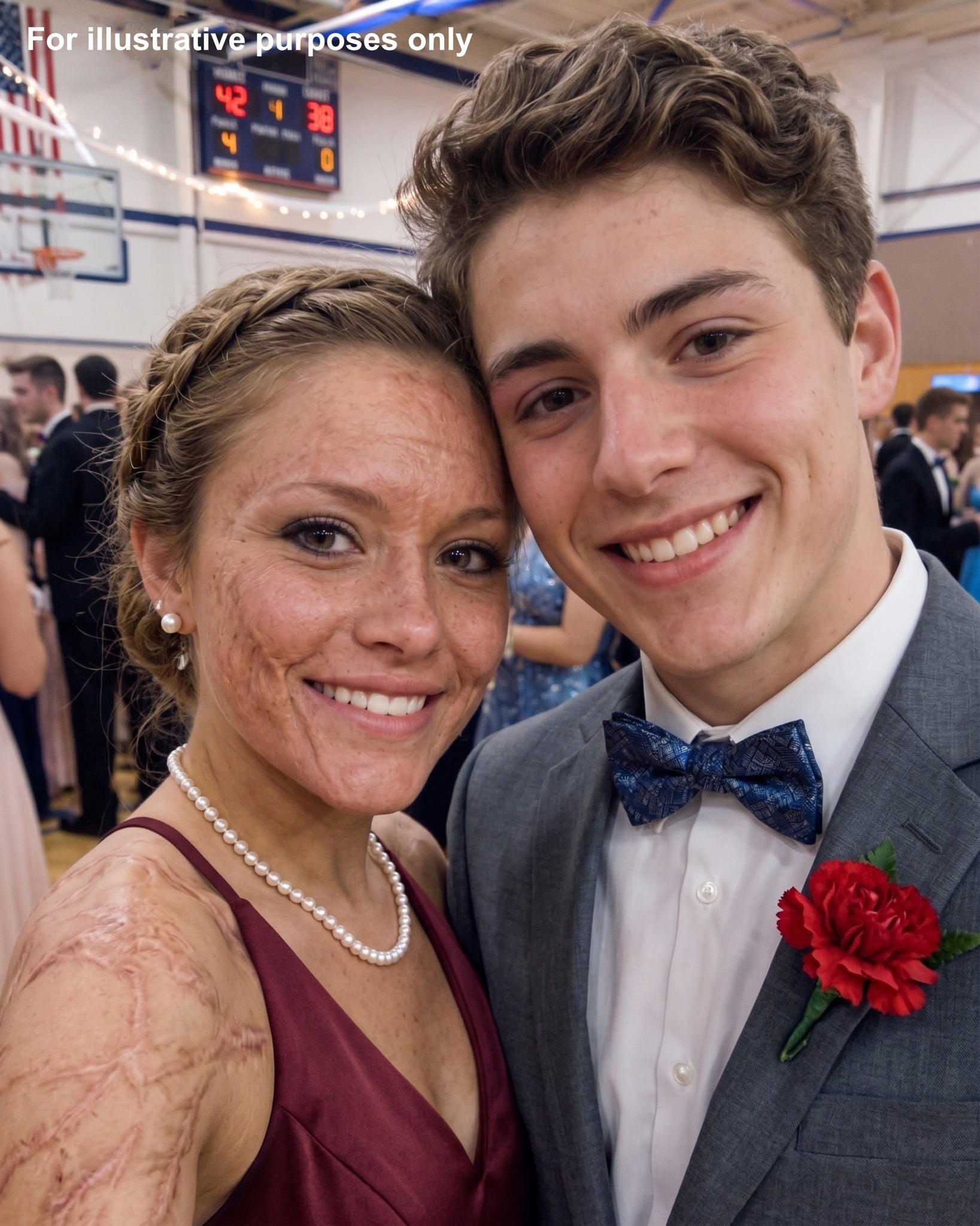
I used to believe the fire had already taken everything from me.
It took my childhood first. Then my sense of safety. Then my reflection.
By the time I was seventeen, I had learned how to survive being stared at long before I learned how to live with myself again. People thought scars only changed skin, but they change the atmosphere around you too. Conversations pause for half a second too long. Children ask blunt questions their parents rush to silence. Strangers pretend not to look while looking anyway. Over time, you begin shrinking yourself automatically, trying to disappear before anyone else can make you feel visible in the wrong way.
So when prom arrived, I never planned on going.
The idea of standing beneath bright lights in a dress while everyone whispered behind fake smiles sounded unbearable. I already knew what people at school called me when they thought I couldn’t hear. Burnt girl. Monster. Tragedy case. Some were cruel intentionally. Others were worse because they pitied me. I learned to hate both equally.
But then there was Ezra.
Ezra never looked at me the way other people did. Not carefully. Not nervously. Not with forced kindness that felt heavier than cruelty. When he spoke to me, it felt terrifyingly normal, like he genuinely saw the person underneath the scars instead of stopping at them. At first, I distrusted him because of that. Nobody was kind without wanting something in return. I had learned that lesson early.
Yet somehow he kept showing up anyway.
He sat beside me in class when nobody else did. He laughed at my sarcastic comments instead of flinching from them. He asked questions about books, music, dreams — never once about the fire itself. Being around him felt dangerous in a different way because it made me want things again. Hope. Attention. The possibility of being loved.
When he asked me to prom, I almost said no.
Not because I didn’t want to go with him, but because wanting something that badly felt risky. Hope always came with consequences. Still, he stood there waiting patiently for my answer, nervous in a way that made him seem oddly fragile for someone everyone else admired so easily.
So I said yes.
The night of prom, I spent nearly an hour staring at myself in the mirror trying to decide whether bravery and humiliation sometimes looked identical. My dress covered most of the scars climbing my shoulder and neck, but not all of them. Nothing ever covered all of them. My hands shook while doing my makeup. Part of me kept waiting for panic to win.
Then Ezra arrived at my door.
And when he looked at me, he smiled like I was beautiful.
Not inspirational. Not tragic. Beautiful.
That single expression shattered something hardened inside me.
At prom, I still felt the stares at first. They followed me through the gym decorated with cheap lights and glittering streamers. But Ezra kept his hand wrapped around mine the entire night, grounding me whenever anxiety threatened to drag me under. We danced badly. We laughed. For a few fragile hours, I forgot to hate being seen.
It felt like rebellion against every terrible thing the fire had done to me.
Then Ezra disappeared.
At first, nobody worried. Teenagers wandered in and out of prom constantly. But as the night stretched longer, concern slowly replaced annoyance. Calls went unanswered. His friends couldn’t find him. By morning, police were knocking on my front door while my mother stood pale beside the kitchen counter.
“Are you sure you don’t know what Ezra’s been doing?” one officer asked carefully.
The question made no sense.
Until they told me what they had found.
A burned-out storage building on the edge of town. Evidence Ezra had been there recently. Witnesses claiming they saw him arguing with someone before prom. Suddenly the boy who made me feel safe was being spoken about like a suspect in something dangerous.
And somehow, buried beneath the confusion, I already knew the fire connected to me.
Because trauma recognizes itself.
The deeper the investigation went, the stranger everything became. Ezra’s parents looked terrified every time they saw me, like they were carrying guilt heavy enough to drown them. The police kept asking about my childhood fire — the one that killed my father and scarred me permanently when I was seven years old. A fire officially ruled accidental years earlier.
Except now, someone believed it hadn’t been.
Following the truth felt like reopening wounds I had spent a decade trying desperately to survive. Every memory returned sharper than before: smoke swallowing the hallway, heat clawing at my skin, my father screaming my name somewhere beyond the flames. I spent years trying not to remember those sounds.
Now I was forced to walk back into them.
Eventually, I found Ezra hiding in a cabin owned by his uncle several towns away. When I saw him sitting there alone, exhausted and terrified, anger should have been the first thing I felt.
Instead, I saw someone drowning.
He looked at me like he had rehearsed losing me a thousand times already.
And then he told me the truth.
Years ago, before either of us truly understood consequences, Ezra had been there the night of the fire. Not alone — with older boys he desperately wanted acceptance from. What began as reckless vandalism spiraled into horror faster than anyone expected. Fire spread beyond control almost instantly. Panic replaced bravado. Everyone ran.
Except the fire didn’t stop.
Ezra had spent the next ten years haunted by what happened. The guilt consumed him so completely that when he recognized my name in high school, it shattered whatever illusion of escape he had built for himself. Meeting me was never coincidence. At first, he only wanted to see whether I survived. Then he got to know me.
And everything became worse.
Because he fell in love with the person he believed he helped destroy.
The confession hollowed me out.
Part of me wanted to scream at him until the entire world split apart. Another part remembered every moment he treated me gently when no one else did. The boy sitting in front of me wasn’t cruel. He was broken by something terrible he had done as a child — something reckless, horrific, and irreversible.
The hardest truth was this:
He never intended for anyone to die.
That did not erase my scars. It did not erase my father. It did not erase years spent hiding from mirrors and strangers and myself. But somewhere inside his shaking voice, I realized revenge would not heal me either.
I was so tired of letting the fire define every version of my future.