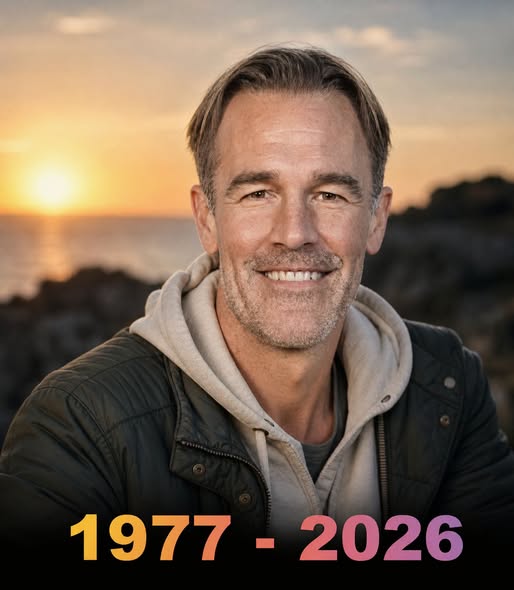
The news hit like a punch to the chest.
James Van Der Beek, the face of a generation’s coming-of-age, is gone at just 48. For millions who grew up watching him as Dawson Leery, the news feels almost impossible to process. He was part of a television era when young viewers saw pieces of their own fears, friendships, heartbreaks, and dreams reflected back at them on screen. Now, the actor who became so closely tied to those memories has reached a final chapter that fans never expected to read.
For those who knew him first as Dawson, the loss feels deeply personal. His face is connected to a particular time in life—a time of first loves, impossible decisions, late-night conversations, and the complicated emotions of growing up. *Dawson’s Creek* did more than make him recognizable. It made him part of the memories of an entire generation.
But James Van Der Beek’s story did not end with Dawson Leery.
He spent years working to move beyond the teen-heartthrob image that had defined his early career. He took on roles that allowed him to be funny, vulnerable, self-aware, and sometimes completely different from the character audiences had first fallen in love with. Projects such as *Varsity Blues* and *Don’t Trust the B—- in Apartment 23* showed another side of his range and willingness to laugh at the expectations attached to his name.
Then came the private battle that would change everything.
Van Der Beek was diagnosed with stage III colorectal cancer in 2024. What followed was a deeply difficult period of scans, surgeries, uncertainty, fear, and decisions that were far more personal than anything an audience could see from the outside. Yet rather than disappearing completely into privacy, he chose to speak honestly about what he was experiencing.
He talked about the frightening parts.
He talked about medical appointments.
He talked about uncertainty.
And he continued working while confronting a disease that had suddenly made the future feel far less predictable.
That honesty mattered because illness can make a person feel isolated. Even when surrounded by family, doctors, and loved ones, there can be an enormous loneliness in facing something that changes the way you think about tomorrow. By speaking openly, he gave other people a glimpse into that reality without pretending that courage meant never being afraid.
He was afraid.
But he kept moving.
And throughout the fight, his family remained at the center of his world. His wife, Kimberly, and their six children were not simply names mentioned in interviews. They were the people around whom his priorities increasingly revolved. Fame, career, recognition, and the expectations of Hollywood could all become secondary when measured against the simple desire to remain present for the people he loved most.
That perspective gave the final years of his life a different meaning.
The actor who once played a young man trying to understand adulthood was now living through a reality far more serious than anything written for television. Yet the same vulnerability that had made audiences connect with his performances seemed to emerge again in his real life.
There was no scripted ending.
No guaranteed next season.
No promise that everything would work out exactly as hoped.
There was simply the next appointment, the next conversation, the next day with his family.
And that is what makes his story so difficult and so human.
His death on February 11, 2026, following his battle with stage III colorectal cancer, closes a chapter in the career of an actor who helped define a particular era of television. But reducing his life to the diagnosis or the date of his death would miss the larger story.
He was more than Dawson.
He was an actor who continued to reinvent himself.
He was a husband.
A father.
A performer willing to make himself vulnerable.
And, during his illness, a person who chose to share some of the hardest parts of his experience rather than allowing silence to tell the story for him.
For fans, however, there will always be that first image.
Dawson standing at the center of a story about growing up.
The character became a symbol of adolescence for millions of viewers, and because of that, James Van Der Beek became connected to memories that belong to people who never actually knew him personally. That is one of the strange powers of television. An actor can enter someone’s home week after week and become woven into the emotional landscape of an entire generation.
When that actor dies, people do not mourn only the person they saw in the headlines.
They sometimes mourn the younger version of themselves who watched him.
They remember where they were.
Who they watched with.
The songs.
The friendships.
The heartbreaks.
The years when adulthood still felt impossibly far away.
That is part of the legacy Van Der Beek leaves behind.
His career evolved, but his connection with audiences remained. He demonstrated that an actor does not have to remain trapped inside the role that made them famous. He could step outside the familiar image, embrace comedy, take risks, and show audiences different versions of himself.
And later, through his openness about cancer, he showed another kind of vulnerability—one that had nothing to do with acting.
Those closest to him have described a man who tried to meet the end with clarity, protectiveness, and devotion to his family. He did not allow despair to become the only story people could tell about him.
That may ultimately be the most important part of his legacy.
Not simply that he was famous.
Not simply that he played a beloved character.
But that he continued to live, work, love, and communicate while facing something frightening and uncertain.
His life reminds us how quickly the person we remember from a screen can become part of our own personal history. Characters grow older with us. Actors become attached to chapters of our lives. And when they are gone, it can feel as though a small piece of that chapter disappears too.
But the stories remain.
The performances remain.
The memories remain.
And for the millions who once watched Dawson Leery grow up, James Van Der Beek will always occupy a unique place in that shared cultural memory.
He gave audiences stories during one part of their lives.
Later, by confronting illness with honesty and keeping his family at the center of his world, he gave them something different: a reminder that life beyond the screen is fragile, complicated, and deeply precious.
The final chapter may have come far earlier than anyone wanted.
But the story he leaves behind is larger than its ending.
It lives in the characters he played, the risks he took, the people he loved, and the viewers who once saw themselves reflected in him.
And perhaps that is why his passing hurts so much.
For many fans, they were not simply saying goodbye to an actor.
They were saying goodbye to a piece of their own growing-up years.