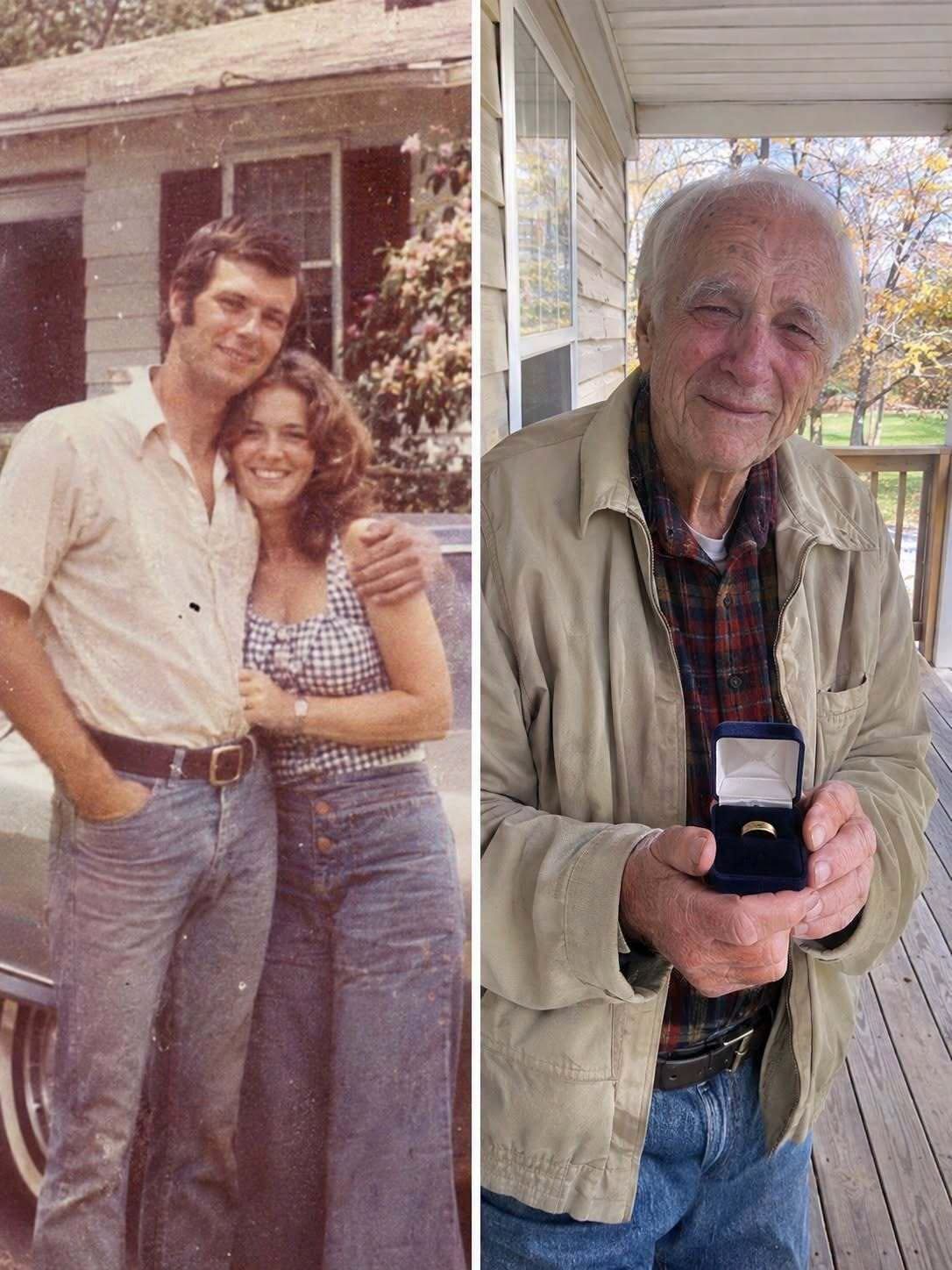
The stranger placed a small blue box beside my red carnations, and for a moment, I completely forgot how to breathe. I had been standing beneath the old willow tree, just as I had every June for more than six decades. The familiar branches moved gently in the breeze, casting shadows across the grass. It was a place filled with memories, a place where I had returned year after year to remember the one man I had loved and believed I had lost forever.
But this time, something was different.
When I looked up at the stranger, my heart began pounding. There was something strangely familiar about his face. His eyes reminded me of Benjamin’s. Then I noticed his smile, followed by a small dimple in his cheek. It was a resemblance so unmistakable that I struggled to understand what I was seeing.
He introduced himself as Edward and explained that he had been trying to find me for some time. Before I could ask why, he pointed toward the little blue box resting beside my flowers.
Inside was something I never imagined I would see again.
There was a ring, an old piece of jewelry connected to a promise Benjamin and I had made when we were young. Beneath it was a name that made my hands tremble. It was Benjamin’s name.
For sixty-two years, I had believed that Benjamin had died during the war. I had built my entire understanding of the past around that loss. I remembered the last time I saw him, the promises we made, and the future we imagined sharing. I had waited for him, hoped for him, and eventually learned to live with the painful belief that he would never return.
But Edward was about to tell me that the story I had carried for most of my life was not the whole truth.
I was young when I first met Benjamin. We were the kind of couple who believed that love could overcome almost anything. We spent our afternoons walking together, talking about the future, and making plans that seemed so simple at the time. We imagined a little house, a family, and a lifetime of ordinary moments that we would never take for granted.
Benjamin had a particular way of making me laugh. Even on difficult days, he could make everything feel lighter. I loved his eyes, his smile, and the small dimple that appeared whenever he tried to hide his happiness.
Then the war came, and everything changed.
He left with the promise that he would return. I remember standing there, watching him disappear, holding on to the belief that our separation would only be temporary. We exchanged words that I would repeat to myself for years afterward. He told me not to forget him, and I promised that I never would.
But the days became weeks, and the weeks became months. Eventually, the news arrived that changed my life. I was told that Benjamin had died during the war. There was no proper goodbye, no final conversation, and no opportunity to see him again. There was only the terrible emptiness left behind by someone who had once been the center of my world.
I never married.
People sometimes asked why I had remained alone for so long. Some assumed I had simply never met the right person. Others believed I had become too comfortable with my independence. But the truth was that a part of my heart had remained connected to Benjamin.
That did not mean I stopped living.
I devoted myself to helping others. I became a teacher and spent years working with children, watching them learn, grow, and discover the world around them. I volunteered wherever I could, served meals to people who had nowhere else to turn, and spent time with those who were sick or lonely.
I discovered that even a broken heart could still make room for kindness.
Every June, however, I returned to the willow tree. I brought red carnations, the flowers Benjamin had loved, and placed them beneath the branches. Sometimes I spoke to him quietly. Other times, I simply sat there and remembered the life we had once imagined.
It became my personal tradition, a way of keeping his memory alive.
And then Edward appeared.
As he explained what had happened, I learned that Benjamin had not died in the way I had been led to believe. He had survived, but his life had taken a heartbreaking turn. Over the years, circumstances had separated him from the people and places he once knew. Eventually, his health declined, and he ended up living in a care home.
Edward had discovered the connection between Benjamin and me and had decided that I deserved to know the truth.
My niece had also known more than she had told me. She had helped keep the discovery a secret because she wanted to arrange something meaningful, something that would allow the truth to reach me in a way I would never forget.
I could hardly process what I was hearing.
Benjamin was alive.
The man I had mourned for sixty-two years had been living somewhere, breathing, growing older, and carrying his own memories of a life that had never turned out as planned.
Edward offered to take me to see him.
I did not know what to expect. I imagined that he might recognize me immediately, that he might smile and call my name as though no time had passed. Perhaps he would remember our promises and ask why I had never come looking for him.
But reality was much more painful.
When I finally entered the care home and saw Benjamin, I recognized him immediately. His face had changed with age, and his body was much weaker, but I could still see the young man I had loved so many years earlier.
He looked at me, however, without recognition.
Benjamin was suffering from memory loss, and he no longer remembered much of his past. The life we had shared had become something distant and inaccessible to him. I stood beside his chair, trying to hold back my tears, while he looked at me like a stranger.
I wanted to tell him everything.
I wanted to remind him of the willow tree, the promises, the walks, the laughter, and the life we had once imagined. But I understood that I could not force his memories to return.
So I made a decision.
I would visit him.
I began returning to the care home regularly. I brought flowers, sat beside him, and read aloud from books he might have enjoyed when he was younger. Sometimes I held his hand while he rested. Other times, I told him stories about our past, even when his expression gave no indication that he understood.
I spoke about the summer evenings we had spent together, the little things that had made us happy, and the promises we had exchanged before the war separated us.
I never demanded that he remember me.
I simply wanted him to feel that he was not alone.
The staff at the care home gradually became familiar with my visits. They saw how carefully I treated him and how much those quiet hours meant to me. Some days Benjamin seemed peaceful when I was there. Other days, he barely reacted to my presence.
Still, I kept coming back.
I had already spent more than half a century believing he was gone. I was not going to turn away simply because he could no longer remember who I was.
Then one afternoon, something extraordinary happened.
I had arranged for Benjamin to spend some time outside beneath the willow tree. It was the same tree where I had placed carnations every June, the same place where I had preserved our memories for so many years.
I sat beside him and began speaking about the past.
I told him about the day we first met. I described the clothes I had been wearing, the way he smiled at me, and the promise we had made beneath those branches.
For a while, he remained quiet.
Then he slowly turned toward me.
His eyes changed.
He looked at my face more carefully, as though he were searching through a distant memory. His expression softened, and for the first time in a very long while, I saw something familiar in his smile.
He remembered.
Not everything, and perhaps not with perfect clarity, but enough.
He remembered my face. He remembered the dress I had worn when we first met. He remembered the willow tree and the promise we had made so many years earlier.
Then he spoke to me in a way that made the entire world seem to stop.
It was a brief moment, but it contained more emotion than I could ever explain. Sixty-two years of unanswered questions, grief, and longing seemed to come together beneath those familiar branches.
I held his hand and cried.
I had spent so many years talking to a man I believed could never hear me again. Now, for a moment, Benjamin was there with me, not simply as a memory, but as the person I had loved all those decades ago.
His health continued to decline, and there were no guarantees that his memories would remain. I knew that the moment might never happen again. But I no longer needed anything more than the time we had been given.
When Benjamin eventually passed away, I was holding his hand.
It was heartbreaking, but it was also peaceful. This time, there was no unanswered letter, no distant battlefield, and no uncertainty about whether he had known he was loved.
I was there.
I had found him, and he had found his way back to me, even if only for a little while.
For sixty-two years, I had returned to that willow tree believing I was honoring a love that had ended in tragedy. I now understood that our story had been much more complicated than I had ever imagined.
I never received the lifetime with Benjamin that we had dreamed about when we were young. But I received something I had stopped believing was possible: the chance to see him again, hold his hand, and know that our love had not simply disappeared into the past.
Sometimes life does not give us the ending we imagined. Sometimes it gives us a final moment we never thought we would have.
And that June, beneath the old willow tree, with red carnations beside us, I finally felt that Benjamin had come home.