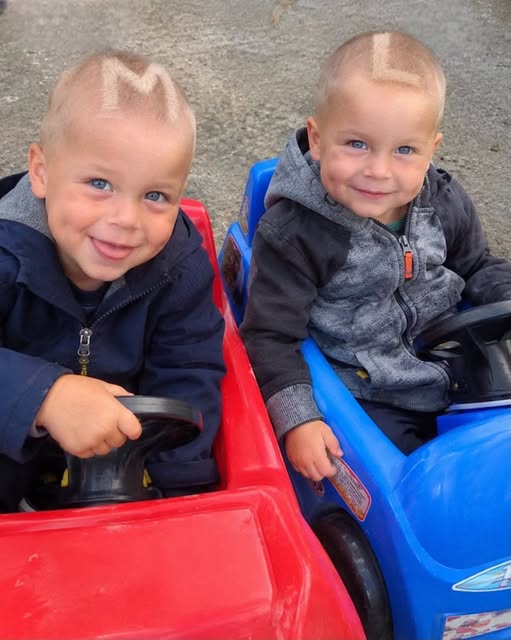
The clippers were still in his hand when I opened the bedroom door, and for a moment, I couldn’t understand what I was seeing. Our identical twin boys were sitting together, wide awake and smiling, while Henry stood nearby looking as though he had been caught doing something he could never explain. Their haircuts, the ones I had always loved and carefully maintained, were already gone.
I looked from one child to the other, trying to understand why their hair had been cut so differently. The boys seemed unusually pleased with themselves, exchanging little smiles as if they had accomplished something important. Henry, meanwhile, looked nervous and exhausted.
Then one of the boys quietly said something that changed the entire meaning of the moment.
“Daddy said he was bad at being our daddy.”
Those words hurt more than the unexpected haircuts. I had entered the room expecting to find a mess, perhaps a disagreement or another parenting decision made without discussing it with me. Instead, I was suddenly faced with the possibility that my husband had been carrying a painful feeling of failure that neither the boys nor I had fully understood.
At first, I was confused and upset. Why would Henry say something like that to our children? Why had he allowed them to hear him speaking about himself that way? And why had he decided that cutting their hair was the solution?
But as the conversation continued, the real story began to emerge.
Henry had not acted out of vanity, anger, or a desire to control the boys’ appearance. He had been struggling with something he found difficult to admit. Because our twins looked so much alike, he sometimes could not tell them apart. He worried that confusing their identities meant he was failing at one of the most important responsibilities of his life.
For him, the problem had gradually become more than an occasional mistake. Every time he called one boy by the other’s name, he felt embarrassed. Every time he had to stop and look more carefully before responding, he wondered whether other parents would consider him careless.
He loved both children deeply, but he had begun measuring his ability as a father against something he could not always control.
The boys had heard him expressing those fears. In their own understanding of the situation, they decided they could help. If they looked different, perhaps Daddy would never confuse them again. Their solution was simple in their minds, even if the result was a pair of unexpected haircuts that would take some getting used to.
What followed was a messy, emotional, and strangely funny evening. There were questions, explanations, and moments when nobody quite knew whether to laugh or cry. The boys were proud of what they had done, Henry was struggling with guilt, and I was trying to understand how something that had seemed so upsetting could have begun with such a sincere attempt to help.
As the evening went on, I realized that Henry needed something different from criticism. He needed to know that confusing the boys sometimes did not make him a bad father. He was frightened that his difficulty recognizing them meant something terrible about his relationship with them, when in reality he was simply facing a challenge he had not known how to explain.
Eventually, we began talking more openly about what had been happening. Henry admitted how much pressure he had placed on himself. He had been trying to solve the problem quietly, hoping nobody would notice how difficult it was for him. Instead, keeping everything inside had made him feel increasingly isolated.
The boys also needed reassurance. They had not done anything wrong by wanting to help their father, but they needed to understand that they were not responsible for fixing his worries. Their job was to be children, not to carry the emotional burdens of adults.
Later, we consulted a specialist, who explained that Henry’s brain processes faces differently. This offered a possible explanation for why recognizing and distinguishing between the twins could be so difficult for him. Suddenly, many of his experiences began to make more sense.
The explanation did not mean that every difficulty would disappear overnight, but it gave us a better starting point. Instead of treating the problem as a personal failure, we could begin understanding it as a difference in how he processed facial information.
We also learned to pay attention to details beyond appearance. The boys had individual habits, voices, expressions, and ways of moving. Their personalities offered clues that were much more meaningful than simply comparing their faces or hairstyles.
Little by little, we stopped treating their resemblance as a test Henry had to pass. We focused instead on getting to know each child as an individual. We could use their names more consistently, notice their different preferences, and develop routines that helped everyone feel more confident.
The haircuts eventually became part of a family story we would remember for years. What had initially looked like a disaster became a reminder of how much children notice, how deeply they care, and how differently they sometimes understand the problems adults are facing.
Henry was not a bad father. He was a scared father who had been struggling with a problem he did not know how to name. His fear had made him question something that should never have been measured by a single ability: how much he loved his children.
That night changed the way we understood one another. It reminded me that parents can carry insecurities they rarely discuss, and that children sometimes notice far more than adults realize. It also taught us that family problems become easier to face when people can speak honestly instead of hiding their fears.
In the end, our sons did not need a haircut to become easier to love, and Henry did not need perfect recognition to prove that he belonged in their lives.
Love does not always look like recognizing someone immediately. Sometimes it looks like making an effort, listening carefully, asking for help, and learning new ways to understand the people closest to you.
And sometimes, in the middle of a messy evening involving clippers, uneven haircuts, and tears, a family discovers something much more important than the appearance of two identical boys: that nobody has to be perfect to be loved.