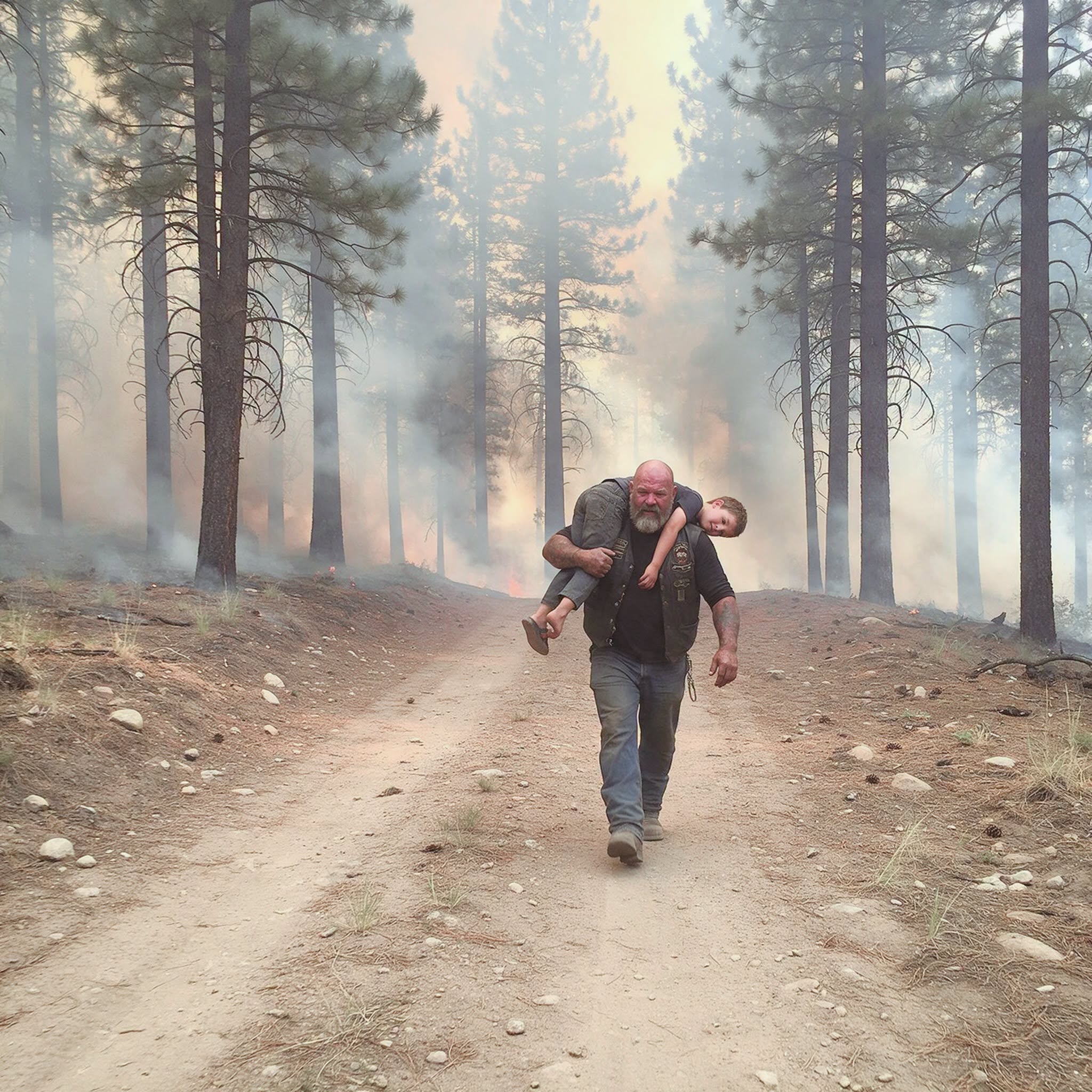
I’m a biker, and in thirty-one years I have never once left my bike behind.
I left it on October 9th. Burning in a ditch off Forest Service Road 22, about six miles east of nowhere.
The fire jumped the ridge faster than the radio said it would. One minute I was riding through smoke I thought I could beat. The next minute that smoke had an orange bottom to it and the air was too hot to breathe through my mouth.
I went down hard trying to turn around. Gravel, then a ditch, then my bike on top of my leg with the tank already cooking.
I got out from under it. That’s when I heard something that wasn’t the fire.
A dog. Barking its head off about forty yards into the tree line, in the exact direction no sane man walks.
I walked that direction.
The dog was standing over a kid. Eight years old, maybe nine. Blue backpack, face down in the pine needles, one shoe off and soot all through his hair.
I said something stupid like “hey buddy” and rolled him over. His eyes were half open and not tracking anything.
Breathing, though. Shallow and wet, but breathing.
The road behind me was already gone. I could see the glow through the trees where I’d come from. The only way out was west, down the service road, toward the roadblock I’d passed five miles back.
Five miles. With a kid on my back. Through a fire moving faster than I could walk.
I put my helmet on him. I don’t care how that sounds. A visor down filters a little of what’s in the air, and he had a whole lot less lung left than I did.
Then I got him over my shoulder and started west. The dog came with us for the first mile. After that it didn’t.
About twenty minutes in, the kid woke up enough to talk.
He said four words into the back of my neck.
“My sister’s still there.”
I stopped walking. I want you to understand that I stopped in the middle of a road with pitch boiling out of the trees on both sides, because that is how much those four words cost me.
“Where,” I said. “Where is she, bud. Tell me where.”
He didn’t answer. His head went heavy against my shoulder blade again and he was gone, back under, and I was standing there with sixty pounds of unconscious kid and a question I had no way to solve.
I want to tell you I turned around. I’ve replayed it probably four hundred times since and in about half of those versions I turn around.
Here’s the arithmetic I did instead, standing there, in about six seconds.
East was already burning. Not coming. Burning. I had watched it take my bike. I didn’t know where she was, how far off the road, which direction, whether she was fifty yards in or a half mile. I didn’t have a light. I didn’t have water. I had a kid breathing wet against my neck who was going to die of what was in his lungs if he didn’t get to oxygen, and I could not carry two.
If I went back for her, three people die instead of one.
That’s the math. It’s clean and it’s correct and I have never once been able to make myself feel better with it.
So I turned west and I walked, and for the next five miles I was a man carrying a boy away from his sister.
The first mile was the easy one, which tells you something.
The dog stayed with me for it. German shepherd mix, no collar I could see, limping on a back foot and still trotting ahead of me like he knew the road. Every so often he’d stop and look back to make sure I was coming.
Somewhere around the first bend he stopped and didn’t come. I turned around and he was standing in the middle of the road facing east with his ears up.
I called him. He looked at me, and then he looked back the way we’d come, and then he went that way at a dead run.
I didn’t have the breath to call him twice.
My legs were still working fine at that point. The kid wasn’t heavy yet. The smoke was bad but it was moving crossways over the road instead of down it, and I could see maybe sixty feet ahead, which felt like a gift.
I talked to him the whole time. Not because I thought he could hear me. Because when you stop talking in a place like that you start listening, and you do not want to hear what a forest sounds like when it goes up. It isn’t a crackle. It’s a sound like a freight train stacked on top of a flag in high wind, and it comes from every direction at once.
So I talked. I told him about my first bike, a ‘78 Shovelhead that I bought at twenty with money I should have spent on my own teeth. I told him my name, Ray, and asked him his, and when he didn’t answer I just started calling him Chief.
Mile two is where it started costing me.
The road climbed. Not much, maybe a four percent grade, but a four percent grade with a child on your shoulder is a different road than the one on the map.
I had him in a fireman’s carry at first. Across the shoulders, one arm hooked around his leg, one arm holding his wrist. That’s the carry you use when you want to go far. It was also crushing his chest, which I figured out when his breathing got worse instead of better.
So I switched. Got him around onto my back, arms over my shoulders, hands locked in front of my chest, and I hooked my elbows under his knees.
Worse carry. Way worse for distance. All of it goes into your lower back and your forearms and it burns like you’re being charged interest.
But he could breathe.
About halfway through that mile he came up again. Not all the way. Enough to make noise.
“Hannah,” he said.
“That your sister?”
“Hannah ran.”
“Ran where, Chief. Which way did she run.”
He said something that wasn’t words. Then, clear as a bell, in a voice that sounded completely normal, like we were sitting at a kitchen table, he said, “She told me to stay by the quad.”
Then he was out again.
A quad. There was a quad somewhere back there. That meant a trail, and a trail meant she maybe had a way out, and I held onto that scrap of nothing for the next three miles like it was a rope.
Mile three is the one I don’t have all of.
What I know is the wind shifted. The smoke that had been crossing the road came straight down it instead, and the visibility went from sixty feet to about eight. I could not see the ground I was putting my boots on. I found the edge of the road twice with my ankle and the second time I went down onto one knee and nearly dropped him.
What I know is the heat came up like somebody opened an oven on the left side of my body. The whole north side of the road lit at once. Not spread. Lit. The flames went over the top of the road and met the trees on the other side, and I was standing underneath that.
What I know is I remembered the culvert.
I’d ridden that road an hour earlier and I’d noticed the culvert because I notice that kind of thing, a big corrugated pipe running under the roadbed at a drainage, four foot diameter, dry as a bone in October.
I don’t remember getting to it. I remember being in it.
I had him in front of me, both of us down in the bottom of that pipe with his face pushed into my chest and my vest pulled up over the back of his head, and the air at the mouth of the pipe was moving past us orange.
I counted. That’s what I did. I counted out loud because I couldn’t hear myself and counting was the only thing left in my head that had an order to it.
I got to about two hundred and forty before the light outside went from orange to a dull red.
My back was wet. I thought it was sweat. It wasn’t all sweat.
When I crawled out of that pipe the road was black in both directions and the trees along it were standing there burning like somebody had set up a hundred torches, and the air was breathable in the way that a hot shower is breathable, and I thought, with total clarity, we’re going to live.
Then I picked him up and my knees did something they had never done before, which was simply not participate.
I went down on the road. Both knees, then one hand, with the kid still on my back.
I want to be honest about this part because people always want the version where the biker gets up roaring.
I didn’t get up roaring. I knelt on a burning road in Grant County at fifty-four years old and I cried like a kid, because my legs were done and we had two miles left and I had just understood that I was going to have to watch him die on my back.
Then he said something into my shoulder.
I couldn’t make it out. I turned my head and said “what,” and he said it again, slurring, barely there.
“Is Hannah with you.”
And I said, out loud, to a nine-year-old boy who could not hear me, “Yeah, buddy. She’s right here.”
I don’t know if that was the right thing to say. I’ve thought about it a lot.
What I know is my legs worked after that.
Mile four I walked in sets.
Two hundred steps, stop. Count to thirty. Two hundred more. I did that for a long time. At some point the number came down to a hundred steps and then to fifty, and the rests got longer, and I started losing track of whether I was resting or just standing there.
I kept talking. I don’t remember most of what I said. I know I told him about my daughter, who is thirty-one and lives in Billings and who I had not called in four months because of a stupid argument about a man she’s going to marry anyway. I know I made a promise about that out loud on that road, the way men do when they’re bargaining with something they don’t believe in.
I know that at some point I started saying Hannah’s name every time I set my left foot down. Hannah. Hannah. Hannah. Like it was a metronome. Like saying it enough times would put her somewhere safe.
Around then the smoke started thinning in front of me, and I saw something I didn’t understand at first.
Blue light.
Not fire. Blue, and it was turning.
The roadblock was two sawhorses, a Grant County Sheriff’s Tahoe, and a brush engine that had no business still being there.
There was a deputy standing on the hood of the Tahoe with binoculars, which is why he saw me a good thirty seconds before I saw him, and he was already off that hood and running up the road at me when I registered he was a person.
He got to me and said, “Sir. Sir, is that Owen.”
I’d been carrying that kid for five miles and a stranger told me his name.
I said, “I don’t know. I don’t know who he is.”
He was already pulling him off my back and yelling over his shoulder for the medics, and I sat down. Not sat. Fell into a sitting position on that road and stayed there.
A medic came at me with shears and cut my vest off, which you do not do to a man’s vest, and I said something about that, and then he and another guy went quiet behind me in a way I didn’t like.
“Sir, how were you carrying him?”
“On my back. Arms over, like a pack.”
“And your vest was down.”
“Yeah.”
“Okay,” he said. “Sir, I need you to lie down on your side for me.”
The back of my vest had come down, is the thing. Somewhere in that culvert, with my arms up around a kid’s head, the leather had ridden up and the whole lower half of my back had been against the inside of that pipe while it cooked.
Second degree, mostly. One patch of third where the metal snap on the back of my belt had been. I didn’t feel it until about ten minutes after I sat down, and then I felt it enough for both of us.
But I’m not telling you that part for sympathy. I’m telling you because of what the deputy said while they were working on me.
He crouched down in front of my face so I could see him and he said:
“Sir, we’re only still up here because his sister wouldn’t let us leave.”
Her name is Hannah. She’s twelve.
She and Owen had taken the quad up to a spot on Pinto Creek that their grandfather used to take them to, which they were not supposed to do, which is the kind of thing that twelve-year-olds decide on a Saturday when the sky looks fine.
The fire came over the ridge while they were up there. The quad wouldn’t start. She told Owen to stay with it and she ran for the road to flag somebody down, and when she got there, there was nobody, and she kept running.
She ran four miles west on Forest Service Road 22 and she came out at that roadblock about two hours before I did.
And then she would not stop.
The deputy told me they’d already called it. The fire had crossed the road east of there, the engine had been ordered off the hill, and the decision had been made that nothing was going back up that road tonight.
And a twelve-year-old girl with no shoes on stood in front of a county fire captain and screamed at him that her brother was still up there, and when they put her in the Tahoe she got back out, and when they put her in the ambulance she got back out of that too.
So the captain kept one engine and two deputies at that roadblock. Against orders, as I understand it. For a kid who wouldn’t shut up.
Which is the only reason there was a human being standing on the hood of a truck with binoculars at 7:40 at night pointed up a road that everybody had already given up on.
I didn’t save that boy. I carried him. That’s a different job.
His sister saved him from four miles away, by being the loudest person in Grant County.
I was in Bend for nine days. Skin grafts on the one patch, a lot of debridement that I’d rather not describe, and a bronchoscopy that told me my lungs were going to be mad at me for a while but not forever.
Owen came out of the ICU on day three. Smoke inhalation, a hairline fracture in his left wrist from however he went down, and two corneal abrasions. He doesn’t remember any of the road. Not one step of it. Which I think is a mercy.
Their mother is named Shannon. She came into my room on day four and she didn’t say anything for a long time. Just stood at the end of the bed with her hands over her mouth.
Then she said, “They told me you had a helmet.”
And I said, “Yeah.”
And she said, “And you put it on him.”
I didn’t have a good answer. I said something like, he was smaller.
She sat down and she held my hand for about twenty minutes and neither of us said one more word, and that’s the closest thing to church I’ve been to in forty years.
Hannah came in behind her, hanging back by the door the way kids do when the adults are being strange.
Twelve years old. Bandaged feet in hospital socks. Chewing on the string of her hoodie.
I said, “You’re Hannah.”
She nodded.
I said, “Come here a minute. I want to tell you something and I want you to actually hear it, because the adults are going to tell you a bunch of stuff about how brave I was, and they’re going to have it backwards.”
She came over.
I said, “I found him. You’re the reason anybody was looking. If you’d gotten in that ambulance when they told you to, me and your brother would both still be up on that road.”
She looked at the floor and said, “I left him there.”
Which about took the top of my head off, because that’s my sentence. That’s the one I’d been carrying for five miles with her name under my boots.
So I told her the truth. I said, “I did the same thing you did. I left somebody too. I left you.”
And I told her about stopping in the middle of that road when Owen said her name. And how I did the math and the math said keep walking. And how I was sure, the whole way down, that I was walking away from a girl who was going to burn.
“And the entire time,” I said, “you were already down the hill screaming your head off at a fire captain. You weren’t up there at all. You were out in front of me the whole way.”
She cried. I cried. Shannon cried. It was not a dignified afternoon for anyone in that room.
Three things, and then I’m done.
The dog turned up at an evacuation shelter in John Day eleven days later with both back pads burned raw and no interest in anybody. He wasn’t theirs. He wasn’t anybody’s that anyone could find. He’s mine now. His name is Chief, which was going to be Owen’s name for about five miles, and which Owen says he’s fine with.
My bike is gone. There is a melted shape in a ditch on Forest Service Road 22 that used to be a 2009 Road King with 94,000 miles on it, and if the county ever hauls it out I don’t want to know.
And I called my daughter from the hospital on day two with a voice like a rusty gate, and I apologized for four months of being a stubborn old man, and she’s getting married in June and I am going to be there in a suit.
So here’s where I land on it.
I’m a biker, and in thirty-one years I’d never once left my bike behind. I used to say that like it meant something about me.
I left it in a ditch and I walked five miles the other way with somebody else’s kid on my back, and I have never in my life been less interested in a motorcycle than I was at mile four.
You don’t find out what you’ll leave behind until something makes you choose.
Turns out I’ll leave anything.