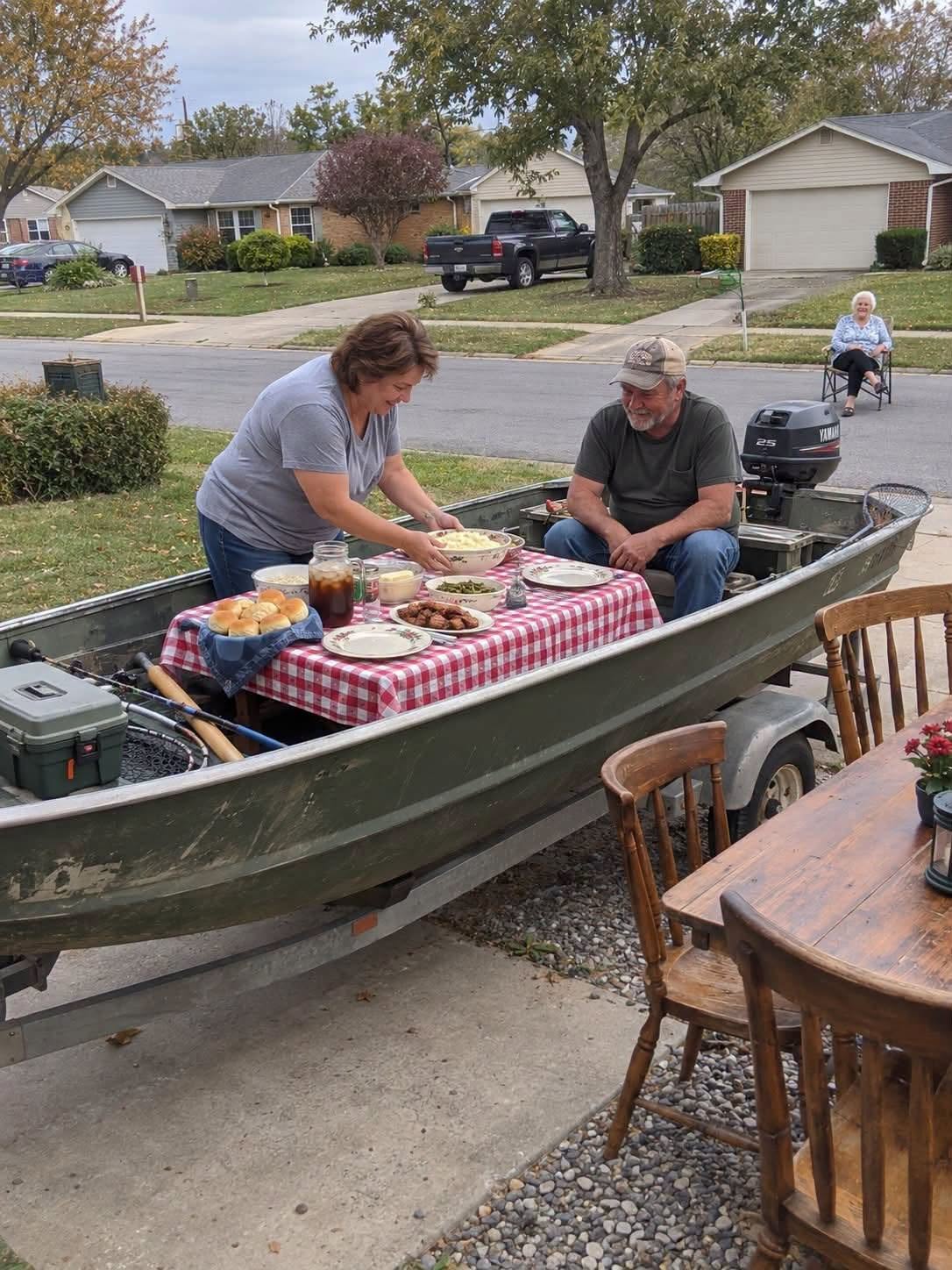
Nine Dinners, One Small Fishing Boat — The Fisherman’s Promise That Changed Nine Families Forever
Every morning, he took his little fishing boat out onto the water, hoping to catch enough fish to feed his family. But one evening, when nine hungry families knocked on his door, an elderly fisherman made a decision that would change their lives—and his own—forever.
The village of Bellhaven was a quiet place where the sea provided almost everything its people needed. Fishermen left before sunrise, returned before noon, and sold their catches at a small market beside the harbor.
Among them was Thomas Reed, a 67-year-old widower who lived alone in a weather-beaten cottage near the shore.
Thomas owned almost nothing.
His house had a leaking roof, his kitchen table had one uneven leg, and his fishing boat was so old that every strong wave made its wooden boards creak. Yet, despite his poverty, Thomas had a reputation for being the most generous man in the village.
His wife, Margaret, had taught him something years earlier.
“No one should have to go to bed hungry while someone else has more than enough to share.”
Thomas had never forgotten those words.
Then came the winter when everything changed.
The Night Nine Families Came Knocking
It began with a terrible storm.
For three days, powerful winds battered the coastline. Fishing boats remained tied to the harbor, the market closed, and deliveries from neighboring towns stopped arriving.
Families who depended on daily wages suddenly had no income.
At first, people managed with whatever food they had stored. But by the third evening, cupboards were empty, children were crying from hunger, and several elderly residents had gone nearly two days without a proper meal.
That was when Thomas heard the first knock on his door.
It was Mrs. Collins, a mother of three whose husband had been injured at work.
“Thomas,” she whispered, embarrassed by her own words, “do you have anything we could eat tonight?”
He looked toward his kitchen.
There was a small pot of vegetable soup, half a loaf of bread, and one piece of fish he had saved for his own dinner.
“Come inside,” he said.
He divided the soup, cut the bread into smaller pieces, and gave the fish to her children.
He told himself he would find something else to eat tomorrow.
But before Mrs. Collins had even left, another knock came.
Then another.
By sunset, nine families had arrived at his cottage.
Some had young children. Others cared for elderly parents. One family had lost its home in the storm, while another had spent its last savings on medicine.
Thomas listened to each story.
He had enough food for perhaps two people.
Instead, he set nine places around his small kitchen table and began preparing dinner.
He stretched the soup with water, divided the bread into tiny portions, and cooked the remaining fish with potatoes from his pantry.
There was not much.
But that night, nine families ate.
Thomas himself drank a cup of tea and pretended he was not hungry.
Nobody noticed until a little girl named Lily looked at his empty plate.
“Mr. Reed,” she asked, “why aren’t you eating?”
Thomas smiled.
“I had a big lunch.”
It was a lie, but it was the kind of lie told out of love.
The Boat That Was Almost Worthless
The next morning, Thomas woke before dawn.
His cupboards were empty, and the storm had left his fishing boat damaged. One of its wooden supports had cracked, and water seeped through a gap near the stern.
Repairing it would cost money he did not have.
Selling it would barely cover a few weeks of expenses.
But without the boat, Thomas could not fish.
And without fishing, he could not survive.
He stood beside the harbor for a long time, staring at the gray water.
Then he remembered the nine families.
He thought about Lily’s question and the children who had eaten their first proper meal in days.
He made a decision.
He would take the boat out.
Even if he caught only a few fish, he would divide them among the families who needed them most.
The harbor master warned him that the water remained dangerous.
“That boat is too old for these conditions, Thomas.”
Thomas tightened the rope around its bow.
“Then I’ll have to be careful.”
He pushed away from the harbor.
For hours, he worked in the cold, repairing his nets and watching the sky. By midmorning, he had caught only three small fish.
It was hardly enough to sell.
But he took them home, cleaned them, and delivered them to three of the families.
The following day, he tried again.
This time, he caught five.
On the third day, he caught enough to prepare a simple meal for all nine households.
The routine continued.
Every morning, Thomas went out to sea.
Every evening, he shared what he caught.
And every night, he went to bed wondering whether he would have enough left for himself.
The Secret the Village Never Saw
For nearly two weeks, Thomas kept his struggle a secret.
He repaired his own clothes rather than buying new ones. He stopped heating his bedroom at night. He ate oatmeal for breakfast and watered down his soup so that the fish could go to the families.
When the boat developed another leak, he plugged it with scraps of wood and cloth.
He told nobody.
He did not want gratitude.
He did not want praise.
He simply remembered what hunger felt like when he was a boy.
His father had died when Thomas was eleven, leaving his mother to raise four children alone. During one particularly difficult winter, a fisherman had quietly left a basket of fish outside their door.
Thomas never discovered who had done it.
But he remembered the feeling of walking into the kitchen and seeing food on the table.
It had given his mother hope.
And hope, he had learned, could sometimes be as important as food itself.
What Thomas did not know was that the nine families had begun noticing the sacrifices he was making.
Mrs. Collins saw him rubbing his hands together because his gloves had worn through.
An elderly couple noticed that his cottage was colder than usual.
Lily’s older brother saw him carrying a basket of fish while limping from an injury he had refused to have treated.
They began asking questions.
Eventually, they discovered the truth.
Thomas was giving away nearly everything he caught.
And his own situation was becoming desperate.
The Morning the Boat Didn’t Return
One Thursday, Thomas left the harbor before sunrise.
The weather looked calm, although dark clouds were gathering in the distance.
He promised the harbor master he would return before noon.
By midday, his boat had not appeared.
At first, nobody worried.
Thomas often stayed out longer when the fish were plentiful.
But by two o’clock, the wind had strengthened, and waves were breaking against the harbor wall.
Mrs. Collins was the first to raise the alarm.
She ran to the harbor and asked whether anyone had seen Thomas.
The harbor master shook his head.
Within minutes, several fishermen launched their boats to search the nearby waters.
The nine families gathered along the shore.
Children stood beside their parents, watching the horizon.
Lily held a small knitted scarf she had made for Thomas.
She had planned to give it to him that evening.
Hours passed.
Then, just before sunset, a fisherman spotted something floating near a rocky inlet.
It was Thomas’s boat.
The little vessel had drifted against the rocks, its nets tangled around the stern.
But Thomas was nowhere to be seen.
The search continued into the night.
People called his name across the water, carrying lanterns along the shore.
For the first time, the village understood how much one quiet man’s daily presence had come to mean.
He had not asked them to repay him.
He had not asked them to care about him.
Yet now, every family he had fed was praying for his safe return.
A Light Beyond the Harbor
At dawn, the searchers found Thomas.
He had managed to reach a small stretch of rocky shoreline beyond the inlet, where he had taken shelter beneath an overhang.
He was cold, exhausted, and badly bruised, but he was alive.
A passing coastal worker had spotted him and alerted the rescue team.
When Thomas finally returned to the village, he expected to find people angry that he had risked his life.
Instead, he found nine families waiting outside the harbor.
Mrs. Collins began crying when she saw him.
Lily ran forward and wrapped her arms around his waist.
“You came back!” she exclaimed.
Thomas smiled weakly.
“Of course I did.”
But then he looked toward the boat being pulled ashore.
Its hull was badly damaged.
The boat that had carried him through decades of work—and helped feed nine families during the storm—was no longer safe to use.
Thomas stood silently beside it.
He knew what it meant.
His fishing days might be over.
Nine Families Make a Promise
That evening, something unusual happened in Bellhaven.
Instead of going home to prepare dinner, the nine families gathered in the village hall.
They brought whatever they could spare.
Mrs. Collins brought a jar of preserved vegetables. The elderly couple brought flour and potatoes. A carpenter offered timber, while two local fishermen promised to help repair the damaged boat if it could be saved.
Lily arrived carrying her knitted scarf.
They agreed that Thomas had spent weeks making sure they had food.
Now it was their turn to make sure he did not go hungry.
The next morning, the harbor master organized a collection.
Word spread throughout the village.
Some people contributed money. Others donated tools, fishing equipment, or materials. A local mechanic offered to inspect the boat, and several experienced fishermen volunteered their time.
Within days, the villagers had raised enough money to repair Thomas’s vessel.
But they did something else, too.
They established a small community fund to help families facing temporary hardship, ensuring that no one would have to depend on a single person’s generosity again.
Thomas was invited to the village hall when the plan was announced.
He listened quietly, his eyes filling with tears.
“I only shared a little fish,” he said.
The harbor master shook his head.
“No, Thomas. You reminded us who we are supposed to be.”
The First Dinner After the Storm
Three weeks later, Thomas’s boat returned to the water.
Its wooden sides had been repaired, its nets replaced, and its old engine restored.
The villagers gathered at the harbor to watch him leave.
But that evening, Thomas did not eat alone in his cottage.
The nine families had prepared a meal together.
There were bowls of fish stew, fresh bread, roasted potatoes, and enough food for everyone to have seconds.
They arranged a long table outside Thomas’s cottage, beneath strings of warm lights.
Lily placed her knitted scarf around his shoulders.
Then she pointed toward his plate.
“Now you have to eat, Mr. Reed.”
Everyone laughed.
Thomas looked around the table.
He saw the children who had once arrived hungry, the parents who had been too embarrassed to ask for help, and the neighbors who had come together to rebuild what the storm had taken away.
For weeks, he had believed he was simply helping nine families survive.
He had never realized that his actions were also bringing an entire village back together.
He lifted his glass.
“To the sea,” he said.
“To Thomas!” the children shouted.
He laughed and shook his head.
“To everyone who remembers that a meal tastes better when nobody is left out.”
The Legacy of Nine Dinners
Years later, the story of Thomas Reed became a cherished part of Bellhaven’s history.
The village continued its community dinner tradition every winter. Fishermen donated part of their catches, local businesses contributed supplies, and volunteers prepared meals for anyone who needed them.
The old boat remained Thomas’s pride and joy until he was finally too old to fish.
When he retired, the villagers placed a small wooden plaque beside the harbor.
It read:
“One small boat. Nine hungry families. One man who refused to let his neighbors go without dinner.”
Thomas lived long enough to see the tradition grow beyond anything he could have imagined.
And whenever someone asked him why he had risked so much for people who were not his responsibility, he gave the same answer.
“Because somebody once did it for me.”
That was the secret behind the nine dinners.
It was never really about the fish.
It was about remembering what it felt like to need help—and deciding that, when the opportunity came, you would become the person who offered it.
Sometimes, one small act of kindness feeds more than a hungry family. Sometimes, it reminds an entire community how to care for one another.
And sometimes, the smallest boat carries the biggest lesson of all: no one should have to face life’s storms alone.