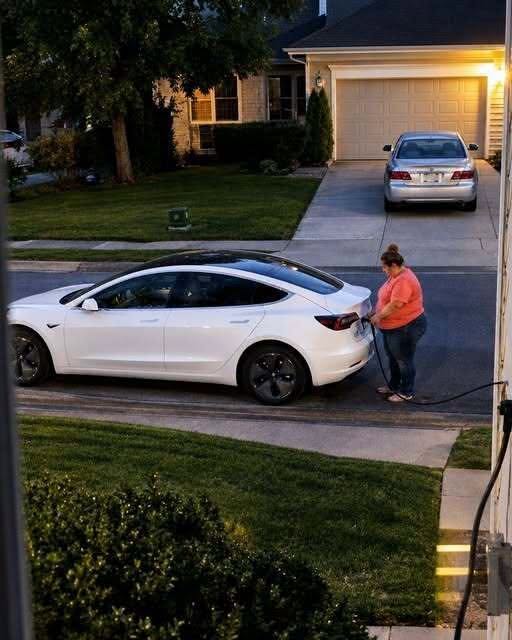
At sixty years old, I had learned that living peacefully often meant respecting other people’s boundaries and expecting them to respect mine. I never imagined that something as ordinary as my garage electrical outlet would become the source of an uncomfortable dispute with a neighbor. But one afternoon, I discovered Monica charging her vehicle using my electricity without asking for permission.
At first, I thought there must have been some misunderstanding. Perhaps she had accidentally connected the wrong outlet or assumed that I wouldn’t mind if she used it briefly. However, when I approached her and explained that the electricity belonged to me, her response left me genuinely surprised.
Monica offered me five dollars and suggested that because I lived alone, I could easily afford the extra expense. She spoke as though the matter were insignificant, as though my money and property were available simply because I didn’t have a large household to support.
I tried to remain calm and explain that the issue wasn’t just about a few dollars. It was about permission, respect, and the assumption that someone else could make decisions about my property without consulting me. I had worked hard throughout my life to maintain my home, and I didn’t believe living alone made my resources any less valuable.
Rather than turning the disagreement into a personal argument, I decided to establish the facts. I contacted my utility provider to ask whether my electricity consumption had increased. They confirmed that my usage had risen noticeably during the period in question. To make sure there wasn’t another explanation, I also hired a licensed electrician to inspect the system. After examining the installation, he found no electrical fault that could account for the increase.
With that information, I began keeping careful records. I saved my utility bills, documented the occasions when I had seen Monica’s vehicle connected to my outlet, and calculated the additional charging costs as accurately as possible. I then approached her again and requested fair reimbursement for the electricity she had used.
I wasn’t asking for anything unreasonable. I simply wanted her to acknowledge the expense and stop using my property without permission.
For a short time, I thought our conversation had settled the matter. Unfortunately, Monica continued connecting her vehicle to my outlet, apparently believing that I would eventually give up arguing about it. Each time I noticed the cable, I felt increasingly frustrated. It wasn’t just the additional cost anymore; it was the realization that my clearly stated boundary was being ignored.
I knew I had two choices. I could continue confronting her every time it happened, allowing the situation to become a source of daily tension, or I could find a practical way to prevent it from happening again.
I chose the second option.
I contacted a licensed electrician and arranged to have the outlet secured with a suitable lockable enclosure. The work was completed safely, and from that point forward, Monica could no longer access the outlet without my permission.
The lock solved the immediate problem, but I didn’t want the disagreement to turn into a long-running feud. We still lived next door to each other, and I believed there was a difference between protecting my property and deliberately making someone’s life difficult. I wanted a reasonable resolution, not revenge.
With my bills and records available for review, I gave Monica another opportunity to settle the outstanding amount. This time, she seemed to understand that I was serious about resolving the matter fairly. We discussed the additional electricity costs and agreed that she would repay the amount in installments rather than having to pay everything at once.
As the weeks passed, something unexpected happened.
Monica began acknowledging that the disagreement had been about more than electricity. During one of our conversations, she apologized for connecting her vehicle without permission and admitted that she had treated my concerns too casually. She also apologized for taking some of my other belongings without asking, something I hadn’t fully understood was connected to the same pattern of behavior until we discussed it openly.
Her apology didn’t erase what had happened, but it was a meaningful step toward repairing our relationship.
Eventually, Monica completed the repayments. She also arranged her own charging setup, ensuring that she could charge her vehicle without relying on my electricity or creating further problems between us.
Not long afterward, she came to my door carrying a small ceramic bird designed for a garden. She offered it as a gesture of goodwill and said she hoped we could move forward on better terms.
I accepted the gift and thanked her. It wasn’t an expensive present, but I appreciated the effort behind it. For the first time since the disagreement began, our conversation felt natural rather than defensive.
Over time, our relationship settled into something more comfortable. We greeted each other when we crossed paths, occasionally exchanged a few friendly words, and no longer felt the need to revisit the dispute. My electricity bills returned to their usual levels, and the charging problem stopped entirely.
I kept the outlet locked, not because I wanted to punish Monica or remind her of what had happened, but because it was my property and I preferred to control how it was used.
Looking back, I realized that the experience had taught me an important lesson. Being kind doesn’t mean allowing other people to disregard your wishes, and living alone doesn’t make your time, money, or belongings less valuable. Sometimes, the fairest solution is to remain calm, document what has happened, establish clear boundaries, and give the other person a reasonable opportunity to make things right.
I was glad Monica and I eventually found a way to move forward without hostility. But I was equally glad that I hadn’t sacrificed my boundaries just to keep the peace.
I learned that kindness and self-respect can exist together. You can forgive someone, accept an apology, and rebuild a neighborly relationship without giving them permission to repeat the behavior that hurt you in the first place.