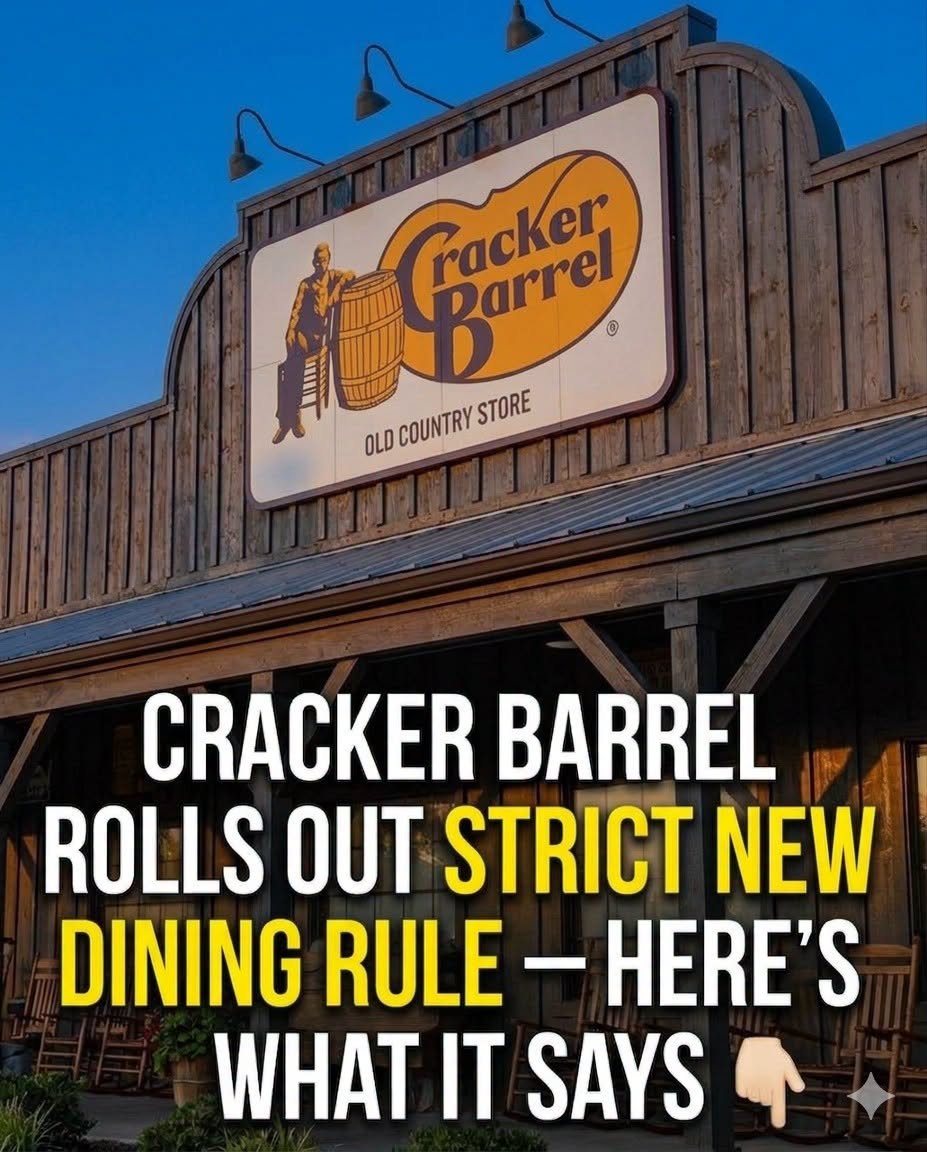
What’s unfolding inside Cracker Barrel is less a simple rebrand than a delicate negotiation with its own past.
For decades, the restaurant chain built its identity around something that went far beyond food. It sold a feeling—a carefully constructed version of a simpler America, where wooden porches, rocking chairs, country décor, familiar meals, and old-fashioned details created the impression that time moved a little more slowly.
For many guests, those details were not merely decoration.
They were part of the experience.
The weathered wood.
The rocking chairs outside the entrance.
The country-store atmosphere.
The familiar objects hanging on the walls.
The feeling of walking through the front door and entering a place designed to feel like somewhere from another time.
That is why the company’s attempt to modernize its logo and interiors triggered such a strong reaction.
From a corporate perspective, updating a visual identity can seem relatively harmless.
Companies refresh logos all the time.
They change fonts.
They simplify colors.
They redesign restaurants.
They update menus and layouts to make businesses feel more contemporary.
But Cracker Barrel discovered something important about its particular brand.
Its customers were not simply buying breakfast, dinner, or a piece of pie.
Many were buying familiarity.
They were buying the feeling that the restaurant would look the way they remembered it.
That matters because nostalgia is unusually powerful.
A modern logo can be replaced.
A menu can be redesigned.
But a memory attached to a place is much harder to change.
For some guests, the restaurant may be connected to childhood road trips, family celebrations, Sunday meals, holidays, or visits with parents and grandparents.
A rocking chair outside the entrance may remind someone of a relative who is no longer alive.
A particular piece of décor may bring back memories of a family vacation.
A familiar dining room can create the comforting feeling that, despite everything changing in the world, at least one place has remained recognizable.
That emotional connection helps explain why the backlash became so intense.
People were not necessarily objecting to every possible improvement.
They were worried about losing the identity they believed they were visiting in the first place.
And that distinction is important.
Customers can accept change when they believe the change improves something they value.
But when modernization begins to remove the very details that created the emotional connection, it can feel less like an improvement and more like a replacement.
Cracker Barrel’s response was therefore significant.
Rather than simply dismissing the criticism, leadership listened.
The company moved toward restoring key familiar elements while continuing with quieter refinements.
That approach represents a kind of compromise.
The goal is not to freeze the restaurant permanently in the past.
But it is also not to pretend that the past has no value.
The challenge is to modernize without erasing the reason people cared in the first place.
That may be one of the hardest problems for a legacy brand.
If a company refuses to change, it risks becoming outdated.
If it changes too quickly, it can alienate the people who built its customer base.
The answer often lies somewhere in between.
Keep the emotional foundation.
Improve the parts that genuinely need improvement.
And be careful about changing symbols that customers have already made part of their own memories.
In that sense, nostalgia is not simply a marketing strategy.
It can become the product itself.
A customer may forget the exact meal they ordered years ago.
They may not remember the price.
They may not even remember the conversation at the table.
But they remember how the place felt.
That feeling can be worth more than any individual menu item.
This is why the debate over Cracker Barrel’s identity became larger than a logo.
The logo became a symbol of a broader question.
What exactly is the company promising when it invites customers inside?
Is it promising modern convenience?
Traditional food?
A family atmosphere?
A connection to an imagined past?
Or some combination of all four?
The answer has to be clear because customers notice when the promise and the experience stop matching.
The same careful recalibration appeared in another controversy involving employee travel expectations.
Clarifying that employees were not required to eat at Cracker Barrel while traveling, while also tightening reimbursement rules, reflected a different kind of challenge.
This was no longer primarily about visual identity.
It was about communication.
Employees need to understand what is expected of them.
They need to know which expenses are legitimate, which rules apply, and where the boundaries are.
Ambiguity can create frustration even when the underlying policy may have a reasonable purpose.
By clarifying those expectations, the company signaled that tradition alone is not enough.
A company can preserve its image while still changing the way it communicates with employees.
That distinction matters because a brand is not only what customers see.
It is also how employees experience the organization behind the brand.
A restaurant can have the perfect rocking chairs, vintage signs, and carefully designed dining room, but the atmosphere becomes less meaningful if the people working there feel confused or unsupported.
The external image and internal culture ultimately have to coexist.
That is why the recent adjustments can be viewed as part of a larger effort to find balance.
Cracker Barrel is trying to protect the emotional qualities that made the brand recognizable while making practical changes that help it function in a changing marketplace.
That is not an easy task.
Modern customers expect speed.
They expect convenience.
They expect digital tools.
They expect restaurants to evolve with changing tastes and expectations.
At the same time, the very customers who demand convenience may also resist changes that make a beloved place feel unfamiliar.
That contradiction is at the heart of the challenge.
People often want their favorite places to improve—but not to become unrecognizable.
They want better technology without losing personality.
They want efficiency without losing warmth.
They want modernization without feeling as though something meaningful has been removed.
For Cracker Barrel, that balance may determine how successfully the company moves into the future.
The restaurant does not necessarily need to remain frozen in a particular decade.
But it does need to understand which elements are essential to the emotional promise of the brand.
The rocking chairs may seem simple.
The wood may seem old-fashioned.
The country-store atmosphere may appear deliberately nostalgic.
But together, those details tell customers what kind of place they have entered.
Remove too much, and the message changes.
Preserve everything forever, and the business risks becoming stagnant.
The real skill lies in knowing what can change and what should remain.
That is where humility becomes important.
When customers speak loudly about something they value, a company has a choice.
It can tell them that they are wrong.
Or it can listen and ask why the reaction is so strong.
Cracker Barrel’s willingness to restore familiar elements suggests that leadership recognized something deeper beneath the criticism.
The backlash was not simply about colors, fonts, or furniture.
It was about belonging.
It was about recognition.
It was about walking into a familiar place and still knowing where you are.
That kind of emotional loyalty cannot be manufactured overnight.
It is accumulated over years.
Sometimes decades.
It is built through repeated experiences until a business becomes part of someone’s personal history.
That is an extraordinary advantage.
But it is also a responsibility.
Once a company becomes woven into people’s memories, changing it requires more care.
Customers may forgive a slower computer system.
They may tolerate a new menu item.
They may even accept a new restaurant layout.
But changing the emotional identity of the place can feel much more personal.
The irony is that nostalgia itself is not necessarily about refusing change.
Nostalgia is about preserving meaning.
People do not necessarily want to live in the past.
They simply want pieces of the past that mattered to remain recognizable.
That is an important distinction.
A brand can evolve and still honor the memories that helped build it.
It can introduce new technology without removing warmth.
It can update operations without turning every location into an anonymous modern restaurant.
It can become more efficient while still giving customers the feeling that they are somewhere familiar.
That may be the path Cracker Barrel now has to follow.
Not a return to the past.
Not a complete rejection of the past.
But a conversation between the past and the future.
The company’s survival may depend on understanding that “home” is not defined by one logo, one piece of furniture, or one decade.
Home is a feeling of recognition.
It is the sense that something familiar remains even as everything around it changes.
And that feeling can evolve.
A family can return to the same restaurant years later and discover a few new things without losing the comfort of the old ones.
A younger customer can experience the brand for the first time while an older customer recognizes pieces of the place they remember.
That is perhaps the best version of modernization.
Not replacing one generation’s memories with another’s.
But creating enough continuity that different generations can find something meaningful there.
Cracker Barrel’s challenge is therefore much larger than a rebrand.
It is a test of whether a legacy company can modernize without abandoning the emotional promise that made it successful.
The answer will not be found in a logo alone.
It will be found in the details.
In what remains.
In what changes.
In how leadership responds when customers push back.
In how employees understand their responsibilities.
And in whether the company can make improvements without making longtime guests feel like strangers in a place that once felt like home.
That may ultimately be the lesson behind the controversy.
A brand built around nostalgia cannot treat nostalgia as disposable decoration.
It has to understand that, for many customers, the nostalgia is the reason they came through the door.
But honoring the past does not mean being trapped by it.
The strongest version of the brand may be one that says:
We remember what made this place special.
We understand why you cared.
We will protect the parts that still matter.
And we will carefully change the parts that need to change.
That is a difficult promise to keep.
But if Cracker Barrel can manage it, the future does not have to compete with the past.
The two can exist together.
The rocking chairs can remain.
The wood can remain.
The feeling of stepping into somewhere familiar can remain.
And behind those familiar details, the business can continue adapting to a world that will never stop changing.
Because in the end, “home” was never really about staying exactly the same.
It was about knowing that, even after everything changes, something still feels familiar when you return.