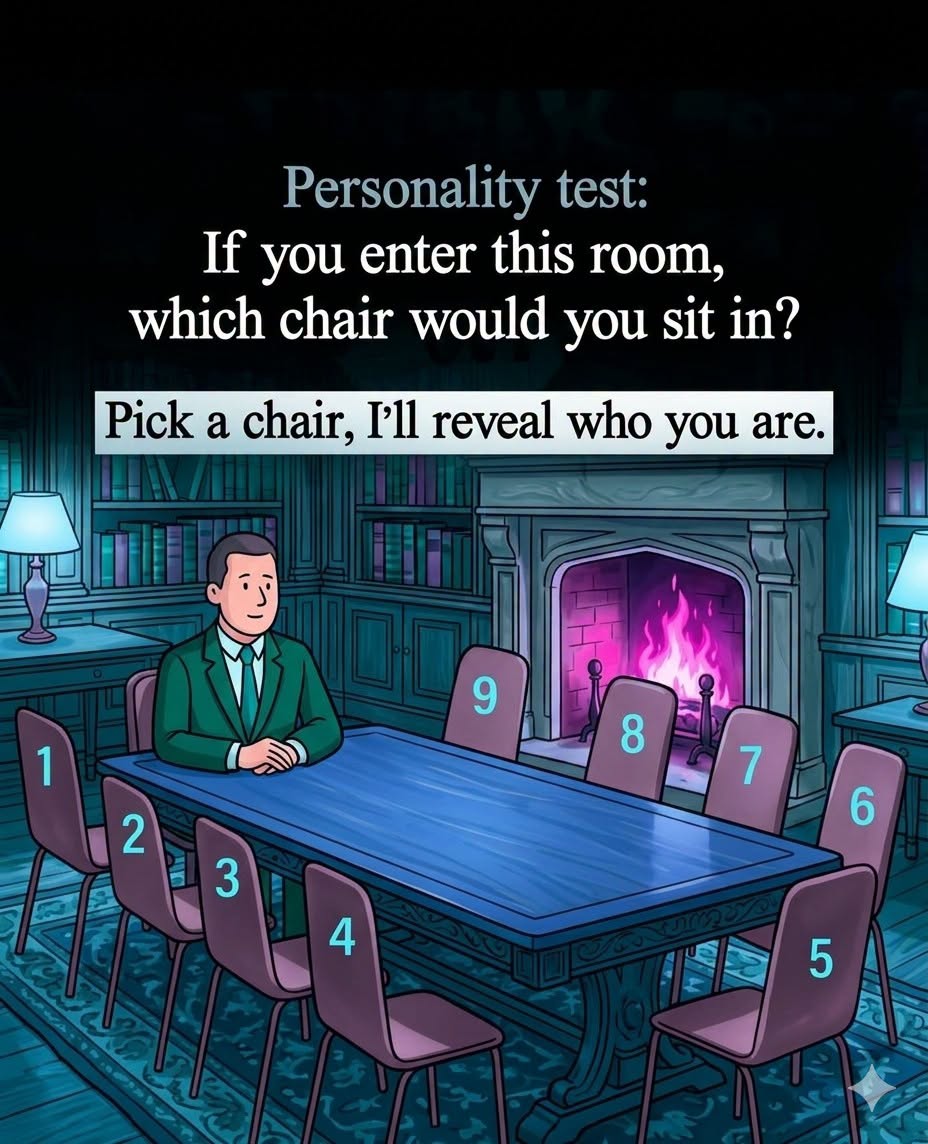
We rarely stop to think about how much a simple chair can shape the stories we tell about ourselves.
A table may seem like nothing more than a place where people gather to eat, talk, celebrate, or pass a few quiet minutes together. But the moment people take their seats, something subtle begins to happen.
Every position can carry a different feeling.
At the head of the table, one person often appears to carry a special responsibility. It may be the person who welcomes everyone, prepares the meal, starts the conversation, or keeps a family tradition alive.
For generations, the head chair has been associated with leadership.
It can belong to the person everyone expects to make decisions.
The parent.
The grandparent.
The host.
The person who has spent years bringing everyone together.
But leadership does not always mean control.
Sometimes the person at the head of the table is simply the one who makes sure everyone has enough to eat.
Sometimes it is the grandmother who has prepared the same meal for decades and still insists that nobody leave hungry.
Sometimes it is the father who says very little but quietly watches to make sure everyone is comfortable.
Sometimes the most important person at the head of the table is not giving instructions at all.
They are listening.
They are watching.
They are making space.
And perhaps that is one of the quietest forms of leadership there is.
Then there is the middle of the table.
The middle seat often carries a completely different kind of energy.
It can become the place of connection.
The person sitting there may be the one who talks to everyone.
They move naturally between conversations.
They ask the younger generation about school.
They ask the older generation about memories.
They introduce strangers who might otherwise sit silently beside one another.
They tell a story that makes everyone laugh, then notice when someone at the other end of the table has something to say.
The person in the middle can become a bridge.
They connect people who might otherwise remain separated by age, personality, or circumstance.
At a large family gathering, that role can be especially important.
Someone has to notice when one conversation is becoming too serious.
Someone has to bring laughter back.
Someone has to invite the quiet person into the discussion.
Someone has to say, “Tell us about that.”
The middle seat can become a place where people are reminded that they belong.
But then there is the corner.
The corner seat is easy to overlook.
It may belong to the person who does not feel the need to compete for attention.
Someone who watches more than they speak.
Someone who notices the smallest details.
They notice the expression on someone’s face when an old story is mentioned.
They notice the hesitation before someone answers a difficult question.
They notice when someone quietly passes the bread to another person without being asked.
They notice the laughter that comes after an uncomfortable silence.
They notice who is sitting alone.
And sometimes, the person in the corner remembers more than anyone realizes.
They remember who told which story.
They remember who laughed the hardest.
They remember the person who almost cried but smiled instead.
They remember the small acts of kindness that everyone else overlooked.
There is a special kind of awareness in being the quiet observer.
It does not necessarily mean being distant.
In fact, sometimes the person who says the least understands the room better than anyone.
They are paying attention to what is not being said.
They are noticing the pauses between words.
They are watching the way people care for one another without announcing it.
But there is an important truth about all these seats.
No position is permanently assigned a meaning.
A chair does not decide who a person is.
A head chair does not automatically make someone powerful.
A middle seat does not automatically make someone sociable.
A corner seat does not automatically mean someone is lonely.
The meaning comes from the person sitting there.
It comes from what they bring into the space.
A person at the head of the table can choose to dominate every conversation.
Or they can choose to listen.
They can use their position to remind everyone that their voice matters.
They can ask questions instead of giving orders.
They can create an atmosphere where people feel safe enough to speak honestly.
That is a very different kind of leadership.
It is not about being the most important person in the room.
It is about helping everyone else feel important too.
The person in the middle has choices as well.
They can fill every silence because they are uncomfortable with quiet.
Or they can use their position to connect people.
They can notice someone who has been left out and gently bring them into the conversation.
They can introduce two people who have never spoken before.
They can make room for different opinions without turning disagreement into conflict.
The middle seat can become a bridge instead of a spotlight.
And the person in the corner has choices too.
They can remain silent because they feel invisible.
Or they can recognize that their quiet presence may be exactly what someone else needs.
A corner can become a sanctuary.
Two people sitting slightly apart from the larger group may find themselves having the most honest conversation of the entire evening.
Perhaps someone needs to talk about something they have been carrying for months.
Perhaps someone needs to admit that they are afraid.
Perhaps someone simply needs another person to sit beside them without trying to fix everything.
In those moments, the corner is no longer a place of isolation.
It becomes a place of trust.
That is why we should be careful about assigning too much meaning to where people sit.
Human beings are more complicated than positions around a table.
The same person can sit at the head of the table one night and in the corner the next.
The same person who leads a conversation at a family celebration may become the quietest person in the room during a difficult moment.
Someone who usually sits in the middle may suddenly need the comfort of being surrounded by others.
And someone who normally stays in the corner may eventually become the person everyone turns to for wisdom.
Our roles change.
Our needs change.
Our relationships change.
The table changes with us.
Think about the tables from your own life.
Perhaps there was a kitchen table where you ate breakfast before school.
A dining table where holidays were celebrated.
A small restaurant table where you had an important conversation.
A desk where someone helped you with homework.
A table at a wedding where strangers became friends.
The furniture may have been ordinary.
But the memories were not.
The table simply gave those moments a place to happen.
The chairs gave people somewhere to sit.
What mattered was who was there.
That is the part we often forget.
We can spend too much time thinking about where we belong instead of asking what we can bring.
We can wonder whether we have the “right” seat.
Whether we are important enough.
Whether people are listening to us.
Whether someone else has more influence.
But perhaps the better question is much simpler:
What happens because I am here?
Do people feel more comfortable?
Do they feel heard?
Do they feel welcome?
Do I make space for someone who has been quiet?
Do I notice when someone needs kindness?
Do I listen when I could easily interrupt?
These choices matter far more than the physical position of the chair.
Because a table becomes meaningful when people bring presence to it.
Not perfection.
Not status.
Not performance.
Presence.
The willingness to actually be there.
To put the phone down.
To look someone in the eyes.
To listen to the story you have already heard three times.
To ask about someone’s day and genuinely care about the answer.
To notice the person who has become quiet.
To save a seat for someone who has not arrived yet.
To make room for another plate.
To move your chair slightly so someone else can fit.
These gestures may seem insignificant.
But relationships are often built from insignificant gestures repeated over time.
A family does not become close because of one extraordinary dinner.
It becomes close because people continue showing up.
Friends do not become trusted because of one deep conversation.
Trust grows through hundreds of small moments when someone proves that they will listen, remember, and remain present.
Even strangers can become connected through a simple invitation to sit down.
“Come join us.”
“There’s room here.”
“Sit with me.”
Sometimes those are the words someone needs most.
And perhaps that is the deeper lesson hidden in the simple image of a table.
There is almost always room for another person.
Not necessarily another chair, but another perspective.
Another story.
Another opportunity to listen.
Another chance to forgive.
Another moment to understand someone who sees the world differently.
A table can become crowded with food and still feel emotionally empty.
And a small table with very little on it can feel incredibly full when the people around it are present with one another.
The difference is not the furniture.
It is the attention.
It is the kindness.
It is the willingness to notice.
That is why no seat is truly fixed in meaning.
The head chair can become a place of humility.
The middle seat can become a place of connection.
The corner can become a place of honesty.
And an empty chair can become a reminder of someone who is no longer there but whose presence still lives in everyone’s memories.
Every seat can hold a different story.
Every person can change the meaning of the space around them.
So perhaps the question is not where you sit.
Perhaps it is what kind of presence you bring when you sit down.
Do you bring judgment?
Or curiosity?
Do you bring the need to be heard?
Or the patience to listen?
Do you make the table smaller by excluding people?
Or larger by making room?
Because in the end, the most meaningful place at the table may not be the head, the middle, or the corner.
It may simply be the place where someone chooses to show up fully.
The place where they notice another person’s sadness.
The place where they offer laughter when the room needs it.
The place where they listen without interrupting.
The place where they pass the bread, pour the drink, pull out another chair, and quietly say, “You belong here.”
That is what transforms an ordinary table into something more.
And perhaps that is what transforms an ordinary life as well.
Not the position we occupy.
Not the attention we receive.
Not the seat we are given.
But the way we make room for others while we are here.
Because every table eventually changes.
People leave.
New people arrive.
Chairs become empty.
Children grow up.
Families move.
Friends take different paths.
The conversations that once seemed endless eventually become memories.
But the feeling created around that table can remain.
Someone remembers that they were welcomed.
Someone remembers that they were listened to.
Someone remembers that, for one evening, they did not feel alone.
And sometimes, that is the greatest gift any seat can offer.
Not status.
Not importance.
But belonging.
So wherever you find yourself sitting, remember this:
You do not have to be at the head of the table to lead.
You do not have to sit in the middle to connect people.
And you do not have to be surrounded by others to make a meaningful difference.
You only have to be present.
Notice the people around you.
Listen carefully.
Make room when you can.
And when someone needs a place to belong, move your chair over just a little.
There may be more room than you think.