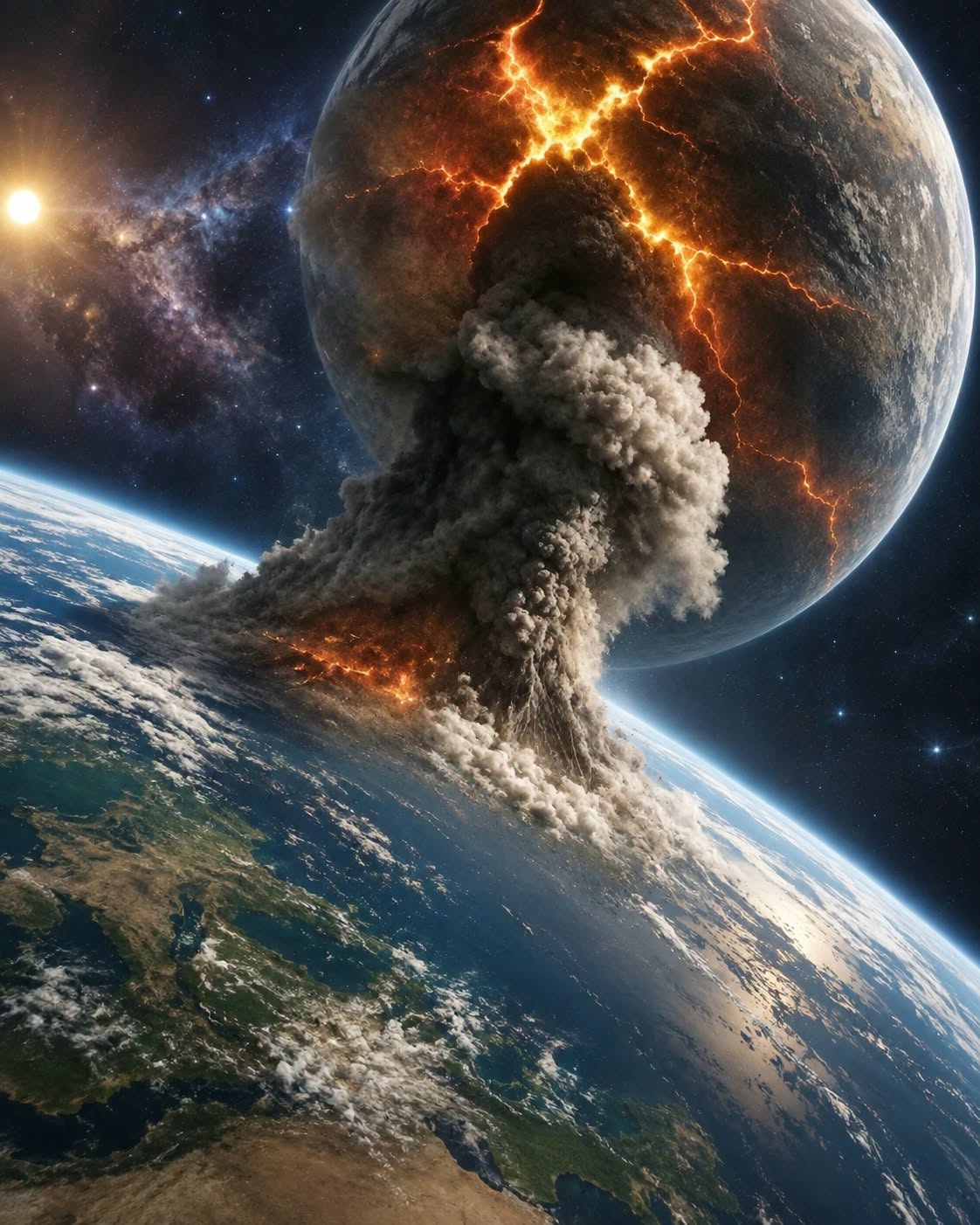
There is no scientific evidence supporting predictions that Earth will suddenly stop spinning, lose its gravity, or veer into a catastrophic new orbit in 2026. Claims like these may sound dramatic when presented alongside references to space agencies or scientific terminology, but extraordinary statements require extraordinary evidence. In this case, the material described does not provide credible scientific findings that would support such a scenario.
The posts appear to borrow the authority of NASA without providing an identifiable NASA announcement, scientific publication, or official statement that confirms the alleged planetary changes. That distinction matters. A headline can mention NASA, scientists, satellites, or space weather without actually representing what those organizations have concluded.
For readers unsettled by alarming predictions, the most important thing to remember is that repetition does not create evidence. A claim shared thousands of times remains unverified if its original source cannot be identified or its evidence cannot be independently examined.
Earth’s rotation is not perfectly constant, but that is very different from suddenly stopping. The planet’s rotation changes by tiny amounts over time because of natural processes, including interactions involving Earth’s atmosphere, oceans, and the Moon. These changes are studied and measured; they do not indicate that the planet is approaching a sudden halt.
The same principle applies to gravity and Earth’s orbit.
Earth’s gravity is connected primarily to its mass and the fundamental laws governing gravitational interaction. There is no credible indication that Earth is expected to simply lose its gravity in 2026. Likewise, Earth’s orbit around the Sun is governed by well-understood physical principles, and there is no established scientific prediction that the planet will suddenly veer into a catastrophic new path next year.
The real risks associated with space weather are considerably less cinematic but still worth taking seriously.
Solar Cycle 25 has produced periods of increased solar activity, including solar flares and coronal mass ejections. Powerful space-weather events can interfere with radio communications, navigation systems, satellites, and some aspects of electrical infrastructure. These effects can be significant, particularly for technologies that depend on satellites or long-distance communications.
But solar activity does not mean Earth is about to lose its orbit or stop rotating.
There is another category of real risk that is sometimes mixed into these stories: climate change. Rising global temperatures are contributing to changes in the frequency, intensity, or likelihood of certain extreme weather hazards, depending on location and event type. Those risks deserve serious attention because they affect communities, infrastructure, food systems, and human health.
Yet climate change is also unrelated to the dramatic claim that Earth will suddenly collapse as a planet.
NASA and other scientific organizations also continuously monitor near-Earth objects. Organizations such as NASA’s Center for Near Earth Object Studies, or CNEOS, track asteroids and other objects whose orbits bring them relatively close to Earth. Monitoring does not mean that every object represents a threat. In fact, careful observation is precisely how scientists distinguish potential hazards from objects that pose little or no danger.
The cited information does not establish a predicted catastrophic asteroid impact in 2026.
That is an important distinction because asteroid headlines often transform routine astronomical monitoring into an apparent emergency. Scientists can identify objects, calculate possible trajectories, update those calculations as new observations arrive, and communicate the resulting risk assessments. Uncertainty in an early calculation is not the same thing as a confirmed collision.
The broader lesson is about how misinformation often works.
A frightening prediction gains credibility when it is surrounded by real scientific concepts. Solar storms exist. Asteroids exist. Earth’s rotation changes slightly. Climate change is real. Space agencies monitor genuine hazards.
But combining those facts does not automatically produce the extraordinary conclusion being promoted.
A responsible reader should therefore ask simple questions: Who made the claim? When was it published? Is there an official statement? Is there a scientific paper or identifiable dataset? Do independent experts agree? Can the original source actually be found?
If those questions cannot be answered, caution is appropriate.
There is no need to ignore legitimate scientific risks, but there is also no reason to let unsupported predictions turn those risks into a story of imminent planetary destruction.
The practical response is much simpler than the rumors suggest: follow reliable updates from NASA, NOAA, and CNEOS, pay attention to genuine emergency information, and be skeptical of headlines designed to create fear before presenting evidence.
Earth’s future certainly deserves scientific attention.
But there is no established evidence in the material described that 2026 will bring the sudden planetary catastrophe being claimed online.