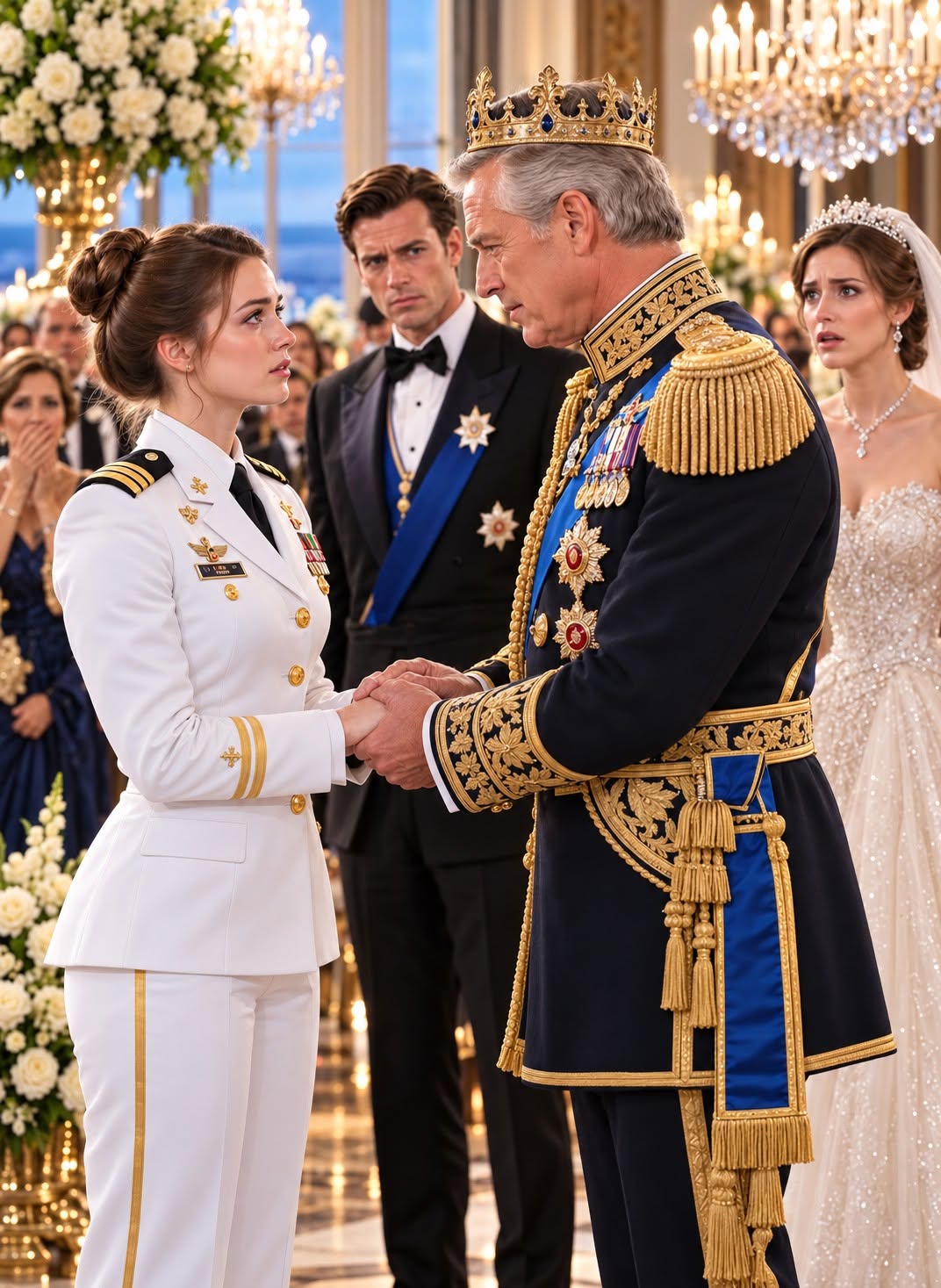
“We have been waiting for you.”
The king’s words settled over the room with such quiet certainty that I almost looked behind me.
Perhaps he was speaking to someone else.
Perhaps there was another Commander Carter standing just beyond the doors, someone more important, more expected, more deserving of a king’s attention.
But the king was still holding my hand.
His palms were warm, and his eyes were an unmistakable shade of blue—clear and steady, with the tired kindness of someone who had spent a lifetime learning how much people tried to hide.
“Why?” I asked.
The king glanced toward Alexander.
The prince had gone very still.
Behind him, Rachel stood surrounded by flowers, candlelight, and guests who had only minutes earlier been celebrating her. Her fingers tightened around the bouquet in her hands.
“Your Majesty,” she said carefully, “perhaps this is not the appropriate time.”
The king turned his head.
“On the contrary, Rachel. There may never be a more appropriate time.”
Her face paled.
I looked from her to him.
“Does this have something to do with my sister?”
“It has to do with all of you,” the king said.
That answer did not ease anything.
My mother stepped closer. “Could someone please explain what is happening?”
The king’s expression softened when he looked at her.
“Mrs. Carter, I apologize for bringing your daughter here without a proper explanation. But circumstances changed this afternoon, and we could not risk waiting.”
“Changed how?” my father asked.
His voice was restrained, but I heard the concern beneath it. My father had always been a quiet man. He rarely raised his voice, even when he was angry. That made his disappointment more difficult to bear.
Alexander took a step forward.
“Emily, do you remember the ferry accident near Port Aster in 2022?”
The question pulled me away from the wedding and into a memory I had not visited in a long time.
A gray morning.
Heavy rain.
A Coast Guard vessel pitching in rough water.
A damaged private ferry drifting too close to the rocks.
I had been serving as a Navy liaison during a joint maritime exercise. The work itself had not been unusual. We coordinated communications, assisted with evacuation procedures, and made certain the civilian passengers were moved safely to shore.
There had been twelve people on board.
One elderly couple.
A family of four.
Several crew members.
And a young man traveling under an assumed name.
At the time, I had known only that he was a foreign national whose security team had lost contact with him during the confusion. I remembered finding him in the lower passageway, soaked through and trying to help an injured crewman stand.
He had refused assistance until the crewman was safe.
Then, after everyone else had been brought aboard the rescue vessel, he had looked at me and said, “You stayed.”
I had thought he meant I had stayed with him in the passageway.
“I was doing my job,” I told Alexander.
His gaze did not leave mine.
“You did more than that.”
A cold awareness began moving through me.
“You were there.”
He nodded.
The room seemed to shift.
The young man in the dark coat. The quiet one who had spoken fluent English with only the faintest trace of an accent. The one who had laughed when I told him he was not allowed to help carry equipment while he was still shivering.
I had never known his name.
I had never seen his face again.
At least, I had thought I hadn’t.
“You were the passenger listed as Daniel Morris,” I said.
A small smile touched Alexander’s mouth.
“That was one of my names.”
My mother looked at him, then at me. “You knew the prince?”
“I didn’t know he was the prince,” I said.
“No one was supposed to know,” Alexander replied. “I was visiting the United States privately. There had been concerns about public attention, so the details of my travel were kept confidential.”
He spoke calmly, but there was something unsettled beneath the words.
The king motioned toward a quieter sitting area near the windows.
“Please,” he said. “Let us sit.”
No one argued.
The wedding guests remained gathered around the ballroom, watching us with the careful stillness of people who understood that something important was unfolding but had not yet been told what it was. A few cameras had turned in our direction, though the security team discreetly blocked their view.
I sat between my parents.
Rachel remained standing.
“You can sit too,” I told her.
She looked at me.
For one brief moment, she appeared less like a bride and more like the little girl who used to wait outside my bedroom during thunderstorms.
Then she sat at the far end of the sofa.
Alexander stood across from us while the king remained beside him.
“You saved my life,” Alexander said.
I shook my head immediately.
“No. I helped evacuate you. There’s a difference.”
“You found me after the lower passage flooded.”
“It was ankle-deep water.”
“And you went back for me after everyone else was out.”
“Because you were helping Mr. Alvarez.”
“The crewman?”
“Yes.”
Alexander’s expression became more serious.
“He was unconscious by then. You went back because you believed I could help carry him.”
“I believed you were still mobile.”
“You were willing to risk your safety for someone you believed was a stranger.”
“That was my responsibility.”
“Exactly,” the king said quietly.
I looked at him.
He had been listening to every word.
“Your Majesty, I’m not sure I understand why this is happening now. That was four years ago.”
The king reached inside his jacket and removed a cream-colored envelope.
It was thick, bordered in dark blue, and sealed with red wax.
My name was written across the front.
Not Commander Carter.
Emily.
My hand went cold.
“Where did you get that?”
“It belonged to my wife,” the king said. “Queen Helena wrote it several weeks after the accident.”
I stared at the envelope.
I had never met Queen Helena.
I knew who she was, of course. Everyone did. She had been admired for her work with veterans, maritime charities, and families affected by disaster. Her death the previous winter had been reported across the world.
But I had never exchanged a word with her.
“I don’t understand,” I said.
“She learned what happened at Port Aster,” the king continued. “Alexander told her about the officer who had stayed behind. He spoke of your calmness, your insistence that the crewman be treated first, and the fact that you refused any public recognition afterward.”
“I didn’t refuse anything. No one offered.”
“Because the incident was classified.”
Alexander lowered his eyes.
“My mother wanted to thank you. Privately, if necessary. She asked our staff to locate you.”
I looked at the letter again.
“Why didn’t she?”
The king’s face changed.
For the first time, grief moved visibly through his expression.
“She became ill before the arrangements could be completed.”
The room grew quiet.
I ran my thumb over the edge of the envelope.
“I’m sorry.”
“Thank you.”
He held my gaze for a long moment.
“After her death, I found the letter among her personal papers. She had written that you should be invited to Alexander’s wedding, not as a guest of obligation, but as someone whose character had shaped the man he became.”
My eyes moved toward Alexander.
He looked deeply uncomfortable—not with me, but with the weight of his mother’s words.
“She believed,” he said, “that I survived that day because you reminded me that being protected did not mean standing apart from everyone else.”
“That sounds like more credit than I deserve.”
“It sounds like my mother,” he replied.
The king handed me the envelope.
I did not open it.
Not yet.
There were too many people watching. Too many questions filling the room.
And one of them had been sitting in the center of my mind since the guards arrived.
“Why wasn’t I invited?”
No one moved.
My mother closed her eyes.
My father looked toward Rachel.
Alexander’s face tightened.
The king did not appear surprised by the question.
“That,” he said, “is why we brought you here before the ceremony concluded.”
Rachel stood abruptly.
“Your Majesty, I can explain.”
“Then please do.”
Her bouquet trembled in her hands.
“It was a misunderstanding,” she said.
I almost laughed, but nothing about her face seemed amusing.
“A misunderstanding is when someone sends an invitation to the wrong address,” I said. “You told me I was an embarrassment.”
Rachel’s eyes filled, though she did not cry.
“I know what I said.”
“Do you?”
“Yes.”
“Then why are you calling it a misunderstanding?”
She looked at our parents first, as if hoping one of them might rescue her.
Neither did.
The silence seemed to give her no choice but honesty.
“Because I was afraid,” she said.
The admission was so simple that it unsettled me more than an excuse would have.
“Afraid of what?”
Rachel swallowed.
“When Alexander told me about you, I thought he was exaggerating.”
Alexander’s jaw tightened.
“I never exaggerated.”
“I know that now,” she said. “But at the time, I didn’t understand what he saw in that story. He spoke about you constantly. The officer who stayed behind. The woman who kept everyone calm. The person who made him realize what kind of man he wanted to be.”
She gave a strained smile.
“And I was supposed to be the person standing beside him.”
“Rachel,” Alexander said quietly.
“No. She deserves to know.”
Her eyes returned to me.
“I was terrified that once people met you, they would compare us.”
“Compare us?”
“You were the brave one. The accomplished one. The one who had a career people respected. Even Mom and Dad—”
“Do not bring us into this,” my father said.
Rachel flinched.
“I know,” she whispered. “I know I’m the one who did this.”
Her confession did not erase the pain. It did not make the empty place at the wedding disappear. But it changed the shape of the hurt.
For weeks, I had believed she thought I was lesser.
Now I understood that she had been afraid I was more.
That did not excuse her.
But it made her human.
“I never wanted to compete with you,” I said.
Rachel’s mouth trembled.
“You didn’t have to. I competed with you all by myself.”
My mother began to cry silently.
I reached for her hand.
The king watched the sisters in front of him with a solemn expression.
“Rachel was told that a formal invitation had been prepared for you,” he said.
I looked at him.
“What?”
“A letter from Queen Helena. It included an invitation to the wedding and a request that you attend a private dinner afterward. The queen wished to meet you in person.”
I turned toward Rachel.
“Did you know about that?”
She nodded.
“When Alexander showed me the letter.”
“Why didn’t I receive it?”
Rachel looked down at the bouquet.
“I asked the wedding office to hold it.”
The words were barely audible.
My chest tightened.
“You stopped it?”
“I told myself I only needed time. I thought if I could speak to Alexander first, I could explain that the situation was complicated.”
“What situation?”
She lifted her eyes.
“The letter mentioned the ferry accident. It said the king wanted to recognize you publicly.”
Alexander turned toward her.
“You knew that?”
“I knew enough.”
“And you still told Emily she wasn’t invited?”
“I panicked.”
“You lied to me,” he said.
Rachel’s face crumpled.
“I was ashamed.”
The room seemed to draw inward around us.
Not a secret affair.
Not a criminal scheme.
Just fear, pride, and one terrible decision that had grown larger each time she chose silence.
I looked at the sealed envelope in my hand.
“Why bring me here in the middle of the wedding?”
The king answered.
“Because this afternoon, one of our staff members found the queen’s original letter in the wedding office. It had been filed under correspondence not to be delivered until after the ceremony.”
My fingers tightened around the envelope.
“The letter was still there?”
“Yes.”
“Then why not simply send it to me?”
“Because the queen’s final instruction was specific. She wanted the letter delivered by Alexander, in person, if possible.”
Alexander stepped closer.
“And because I wanted you here.”
I looked up at him.
“Why?”
“Because my mother was right. You should not be treated as a footnote in my life. You should have been welcomed.”
His honesty hurt in an unexpected way.
I had spent the afternoon assuming I had been excluded because I meant nothing.
Now I was being told I had mattered all along, but someone’s fear had hidden it from me.
That was not easier.
It was simply different.
I broke the seal.
The room remained silent as I unfolded the letter.
The handwriting was elegant and slightly slanted.
My dear Emily,
I hope you will forgive the late introduction. I have heard enough about you to feel that I have known you for years.
My son tells me that on a difficult morning, you reminded him that courage is not the absence of fear. It is the decision to remain present while fear is still there.
He does not know that I have needed that reminder many times myself.
I paused.
The words blurred.
My mother leaned against my shoulder.
I continued reading.
I hope you will attend his wedding. Not because the world expects it, and not because anyone owes you a place at the table, but because you have already earned one.
There was more.
A final paragraph that made me stop breathing for a moment.
I have also asked the king to tell you the truth about the man who helped raise you.
My eyes moved slowly across the page.
Your father did not leave because he was ashamed of you. He left because he believed he had no right to remain near the family after what happened aboard the Asteria.
I stared at the words.
The Asteria.
The ferry.
My hand began to tremble.
The letter continued.
He was the civilian engineer who kept the vessel’s emergency systems operating until the rescue team arrived. His name was Thomas Carter.
My father’s name.
I looked up.
My father had gone completely white.
The king’s voice was gentle.
“Your father was on the ferry that morning.”
I turned toward him.
My father did not deny it.
For four years, I had believed he had been at home in Ohio, recovering from a minor surgery, exactly as my mother had told me.
But he had been there.
On the Asteria.
With me.
And the man I remembered as an injured crewman—the man I had helped Alexander carry through the flooded passageway—had not been a stranger at all.
He had been my father.