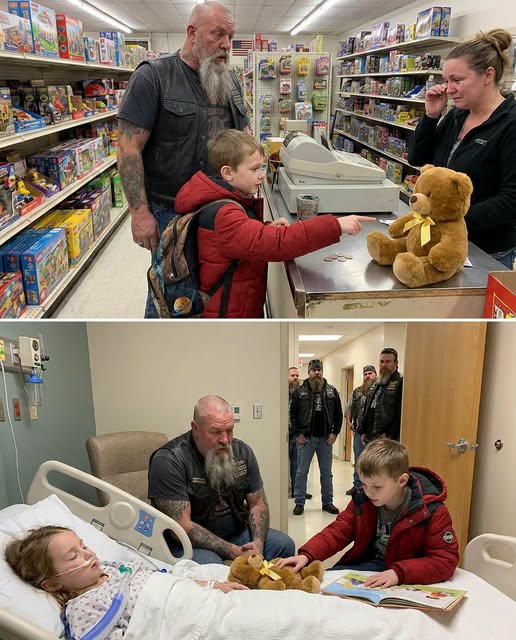
My name is Caleb “Grinder” Hayes, and I have ridden beside Rook for twenty-seven years. I have watched him pull motorcycles from ditches, sit through funerals without moving, and rebuild an engine after a shop fire warped half the tools around it.
I had never seen him afraid of a six-year-old girl.
Lucy looked impossibly small beneath the hospital blanket. A clear tube entered her nose. Adhesive sensors dotted her chest, and a brace kept one hand from curling inward. Machines measured rhythms most of us did not understand.
Eli understood more than any child should.
He washed his hands at the sink, checked the date on the whiteboard, moved a chair beside his sister, and positioned Rosie under her left arm without disturbing the lines. Then he opened his library book.
“Chapter Twelve,” he said. “Yesterday Mary found the key.”
He read slowly. When he encountered a difficult word, he sounded it out rather than skipping it. Lucy did not move.
Rook remained by the door.
Dr. Samuel Whitaker watched him from the opposite side of the bed. He had aged since the night he saved Michael Mercer. His white hair had thinned, and one hand trembled slightly when he was tired, but his eyes were unchanged.
“You got bigger,” Whitaker said.
“You got older.”
“That happens when you wait twelve years.”
Rook’s jaw tightened.
I did not understand the remark then.
Whitaker explained that he had retired from full-time surgical work three years earlier after developing arthritis in his right hand. He no longer operated, but he volunteered as a neurological recovery consultant on complex pediatric cases.
Lucy was the reason he had returned.
Her initial injuries had been severe: diffuse axonal damage, swelling, multiple fractures, and complications that nearly killed her twice. Most physicians agreed that further treatment would preserve her body without restoring meaningful awareness.
Whitaker disagreed.
Not because of optimism.
Because of evidence.
Lucy’s brain scans showed tiny changes when Eli read. Her heart rate shifted at the sound of his voice. During one session, her left index finger moved when he reached the part of a story they had read together before the accident.
The response could have been reflex.
Whitaker refused to dismiss it.
“He comes every day?” Rook asked.
“Every day.”
“And the parents?”
Whitaker looked toward Eli before answering.
“They love their children. Grief doesn’t always make people brave.”
After the ninth month, Lucy’s mother, Laura, began suffering panic attacks whenever she entered the hospital. Her father, Ben, started drinking heavily and lost his job at a machine shop. Their visits turned into arguments about bills, treatment, and whether keeping hope alive was helping Lucy or hurting everyone else.
They stopped coming.
Whitaker never called them heartless. Neither did Eli.
Rook did.
Not aloud. Not yet.
Eli finished one chapter and began another. Rosie’s yellow ribbon rested beneath Lucy’s chin.
Whitaker asked Rook about Michael.
“He lives in Cincinnati,” Rook said.
“Family?”
“Wife. Little girl.”
“You see them?”
Rook’s silence answered.
Whitaker removed his glasses and cleaned them with the hem of his coat.
“Michael wrote me last year.”
That landed harder than a fist.
Rook stepped closer. “Why?”
“He wanted the operative report from his accident.”
“Why?”
“He didn’t say.”
The answer angered Rook because it contained another unanswered door. He turned toward the hallway, but Eli stopped reading.
“Mr. Rook?”
Rook looked back.
“If Lucy wakes up, do you think she’ll like Rosie?”
Rook stared at the bear.
“My son had one like it,” he said.
That was new to me. Rook rarely mentioned Michael’s childhood. He reached into the inside pocket of his leather cut and removed a small square of blue fabric, frayed on every edge.
It had once been part of a stuffed bear.
Michael’s bear had been inside the car during his crash. Emergency workers cut through it while freeing him. Rook had kept a piece ever since.
He placed the cloth beside Rosie’s paw.
“She’ll like her,” he said.
Eli nodded and returned to the story.
Before we left, Whitaker handed Rook a visitor form. Lucy’s parents had given the hospital broad permission for approved volunteers, but minors could not remain without adult supervision. The neighbor who drove Eli was becoming ill and could no longer manage daily trips.
Without another adult, Eli’s visits would end.
Rook signed his name.
So did I.
That night, the Iron Lanterns gathered inside our clubhouse, an old brick feed store beside Route 104. The air smelled of motor oil, leather, road coffee, and the chili Mason “Grizzly” Hale had forgotten on the stove.
Rook told thirty grown men about fifty cents, a teddy bear, and a boy reading beside a silent bed.
Nobody made a joke.
Then he posted a blank calendar on the wall.
“Kid needs an adult every day,” he said. “Thirty days. Thirty names.”
Mason signed first.
I signed second.
Within four minutes, every square was filled.
The hospital did not welcome us.
One biker visiting a child could be explained. Thirty bikers rotating through a pediatric neurological ward looked like a security problem.
The administrator, Karen Lowe, met Rook in a conference room with two security officers. She spoke politely, which somehow made every refusal harder.
Volunteers needed background checks, health screenings, orientation, confidentiality training, and approval from Lucy’s legal guardians. The club could not simply walk into the hospital wearing patches.
Rook placed the calendar on the table.
“We’ll do the checks.”
“They can take weeks.”
“Start them.”
“Mr. Mercer, some members of your organization have criminal histories.”
“So do some hospital donors.”
The security officers shifted.
I put one hand on Rook’s shoulder before his voice became the reason we were removed. He breathed once, then pulled his leather cut open and showed Karen the old blue scrap sewn into the lining.
“My boy lived because somebody stayed when I couldn’t think straight,” he said. “This kid is staying alone. Tell us the rules.”
That changed the room.
Not completely.
But enough.
Whitaker supported the application. The pediatric social worker reviewed every member individually. Three men were rejected from unsupervised visits because of old convictions, but they were permitted to contribute books and transportation. Two brothers refused the required vaccinations and gave up their dates rather than argue.
The rest completed training.
We learned how to wash our hands properly, how to move around tubes without touching them, and why we could never promise Lucy would wake. We learned to announce ourselves before entering, even if she appeared unconscious. We learned that hearing could persist when outward response did not.
Rook took the first day.
He brought a children’s book about a stubborn little train, sat in a chair too small for him, and read in the same gravelly voice he used at club meetings.
Eli corrected his pronunciation three times.
On the second day, Mason read Charlotte’s Web and cried near the ending while insisting hospital air irritated his eyes. On the third, a former Marine named Tucker read a cookbook because it was the only book in his saddlebag.
Lucy heard seventeen pages about soup.
The nurses began waiting to see what came next.
Jesse brought comic books and described every picture. Boone sang country songs badly enough that a nurse threatened to revoke his clearance. I read a motorcycle repair manual until Eli complained, then switched to The Wind in the Willows.
Each biker brought a book.
Each left it behind.
A shelf appeared in Lucy’s room. Then another.
Eli labeled them by reading difficulty. Rosie sat beneath Lucy’s left arm through every story.
The ritual held for six weeks.
Then Lucy developed pneumonia.
Her oxygen level dropped during the night. Infection spread quickly, and doctors transferred her to intensive care. Eli arrived after school to find the room empty and the bear lying inside a clear belongings bag.
Nobody had warned him.
He stood in the doorway.
“Where is she?”
A nurse knelt and explained, but he heard only fragments: infection, breathing support, unstable.
He ran.
Rook found him inside the parking garage, crouched between two cars with Rosie pressed against his face. The boy was shaking so hard his teeth clicked.
“She can’t hear us downstairs,” he said.
“She can.”
“They locked me out.”
“They moved her to help her breathe.”
“Mom said machines mean it’s over.”
Rook went still.
Laura and Ben had returned that morning after receiving the emergency call. They were meeting Whitaker and the intensive-care team to discuss whether Lucy should undergo another aggressive treatment if her condition worsened.
Eli was not permitted inside the conference.
Neither were we.
For fourteen months, he had shown up. Now adults were deciding whether his sister had reached the end without allowing him to say what he had seen.
Rook took the boy’s hand and led him toward intensive care.
Security stopped them.
The hallway tightened.
Rook did not shout, but his size did the shouting for him. Two officers stepped between him and the unit doors. Leather creaked across his shoulders. His knuckles turned white around the paper bag containing Rosie.
“Move,” he said.
I reached him before the officers placed hands on him.
“Brother.”
“He gets to see her.”
“Not this way.”
Eli tugged Rook’s vest. “Don’t get arrested.”
That one sentence stopped him.
Rook looked down at the boy, then backed away.
We waited outside the conference room for nearly two hours. Laura emerged first. She was thirty-six but looked fifty. Ben followed with red eyes and both hands buried in his coat pockets.
They recognized Eli.
Laura opened her arms.
The boy did not move.
“Are you stopping?” he asked.
His father flinched.
Whitaker came into the hall and explained that Lucy needed a bronchoscopy and stronger treatment. It carried risks. Her parents had agreed.
Eli stepped toward them.
“Because she can hear me?”
Laura covered her mouth.
“Because she’s our girl,” Ben said.
Eli answered quietly.
“Then come read.”
Neither parent could.
Not that day.
Lucy survived the procedure, but the pneumonia weakened her badly. Her responses disappeared. No finger movement. No change in pulse when Eli read. Nothing.
Days became weeks.
Several brothers began questioning whether our visits helped. Boone said we might be feeding Eli a promise medicine could not keep. Tucker argued that leaving would teach him the same lesson his parents had taught.
The clubhouse split.
Rook ended the argument by placing the calendar on the table.
“We never promised she’d wake,” he said. “We promised she wouldn’t be alone.”
The schedule continued.
Yet Rook began missing his own dates.
At first, I thought the hospital had become too painful. Then I followed him after a club meeting and discovered where he went.
He was standing outside a small house in Cincinnati, staring at a lighted window.
Inside, a man about thirty played on the floor with a little girl.
Michael.
Rook’s living son.
The boy he had not spoken to in four years.
Rook had lied about why Michael stopped speaking to him.
He allowed us to believe it was a family argument—one of those hard, private disagreements that grow around pride. The truth was uglier because nobody had meant for it to become permanent.
Twelve years earlier, when Michael was nineteen, his motorcycle struck a guardrail on Interstate 71. Dr. Whitaker repaired a torn artery and operated through the night.
Michael survived, but his left leg never fully recovered.
Rook blamed himself.
He had taught Michael to ride. He had helped rebuild the motorcycle. Worse, they had argued before the crash. Michael rode away angry after Rook called him weak for wanting to leave the family repair shop and study nursing.
Rook sat beside him through eleven hospital nights.
When Michael woke, Rook apologized badly.
He paid bills. Modified the house. Rebuilt a car with hand controls in case Michael could not walk. He did everything except say the words Michael needed.
“I was wrong.”
Michael eventually walked again. He became a pediatric nurse, married, and moved to Cincinnati.
Four years before we met Eli, Michael asked Rook to attend his daughter’s baptism. Rook arrived late after a memorial ride and still wore his club cut. Michael accused him of choosing the club over every family milestone.
Rook replied, “The club showed up when family didn’t.”
Michael told him to leave.
Rook did.
Neither called.
Now Michael worked at St. Catherine Children’s Hospital.
He had been assigned to another floor and deliberately avoided Lucy’s room whenever the Iron Lanterns visited. Whitaker knew. That was why he asked Rook about his son.
The operative report Michael requested had not been for a lawsuit or medical concern.
He wanted to understand what Whitaker had done during those nine hours because he was considering advanced training in pediatric trauma nursing.
Whitaker believed Michael should join Lucy’s care team.
Michael refused.
“Your father isn’t the patient,” Whitaker told him.
“He makes himself part of everything.”
“So remove him from the equation. There is still a child.”
Michael agreed to one overnight shift.
Lucy’s condition deteriorated during it.
Her fever rose. Her oxygen saturation fell, and her body stiffened. Michael called the physician, adjusted her position, and worked beside the respiratory team while alarms filled the room.
Eli had fallen asleep in a family lounge. Rook sat outside the unit because visiting hours had ended.
When the emergency doors opened, he saw Michael pushing equipment toward Lucy’s room.
Father and son stopped.
Four years of silence stood between them.
Then Michael said, “Stay with the boy.”
Rook nodded.
That was their first exchange.
Eli woke during the crisis and tried to enter intensive care. Rook caught him before he reached the doors, wrapped both arms around him, and held him while the boy kicked and shouted Lucy’s name.
“She needs Rosie!”
“I know.”
“She can’t do it alone!”
“She ain’t alone.”
Rook’s voice broke.
Inside the room, Michael and Whitaker worked beside Lucy. The retired surgeon could not operate anymore, but he recognized a pattern in her blood gases suggesting mucus obstruction rather than irreversible decline. He advised the attending physician. Michael helped reposition Lucy and clear her airway.
Her numbers rose.
Slowly.
Then steadily.
The immediate danger passed by sunrise.
Michael came into the waiting room wearing wrinkled blue scrubs. Rook still held the sleeping boy against his chest. Rosie’s yellow ribbon protruded from the paper bag near his boots.
“She stabilized,” Michael said.
Rook looked at him.
“Thank you.”
Michael glanced toward Eli. “He stayed all night?”
“Yeah.”
“So did you.”
Neither knew what to say next.
Whitaker entered before the silence hardened. He lowered himself into a chair and revealed the reason he had treated Lucy without charging professional fees for fourteen months.
It was not only because he believed she retained awareness.
Twelve years earlier, after Michael’s surgery, Rook had sold his custom motorcycle to pay the remaining hospital bill of another injured teenager whose family had no insurance. He never told Michael. He never told the club.
Whitaker knew because the payment passed through a patient assistance fund he managed.
The teenager survived.
Years later, her mother donated enough money to expand that fund. Whitaker used it to cover specialized consultation for children whose families had exhausted their resources.
Lucy was one of them.
Rook stared at him. “You came back because of a check?”
“I came back because one act kept moving after you forgot it.”
Whitaker had waived every fee he could. He drove seventy miles twice a week and spent hours reviewing scans without payment. He also contacted specialists across three states, searching for new rehabilitation options.
The treatment had never been free in the magical sense.
Nurses worked. Equipment cost money. Specialists needed salaries.
But Whitaker carried his own part.
Rook lowered his eyes.
Across the waiting room, Michael looked at his father differently.
Not forgiven.
Not yet.
But the shape of the man had changed.
At noon, Laura and Ben returned together. Ben smelled of coffee rather than alcohol. Laura walked to Lucy’s bedside but could not speak.
Eli placed The Secret Garden in her hands.
“You can start where I stopped.”
Laura sat down.
The first sentence took her almost a minute.
She read it anyway.
Lucy did not wake that week.
She did not wake the following month.
But after the pneumonia cleared, a new pattern emerged. Her left eyelid fluttered when Eli read. At first, nurses believed it was random. Then it happened during the same chapter on three consecutive afternoons.
Whitaker ordered additional testing.
The scans showed increased activity in regions associated with language and familiar sound. It was not consciousness as most people understood it. It was not a guarantee.
It was something.
Lucy entered her seventeenth month in the hospital.
By then, the Iron Lantern reading calendar had been replaced three times. Corners curled. Coffee stained the bottom. New names joined when old members became sick or left town.
Nobody missed a day.
The books changed too. Eli finished The Secret Garden, then read Charlotte’s Web, Winnie-the-Pooh, and a stack of fairy tales. Michael joined on Thursdays after his shift. He always removed his badge before sitting beside Rook, as though he wanted to arrive as a son rather than a nurse.
They spoke cautiously.
At first, only about Lucy.
Then about engines.
Then about Michael’s daughter, Grace.
Rook learned she loved dinosaurs and hated mashed potatoes. Michael learned that Rook kept her baptism invitation inside his toolbox.
An apology finally came during a rainy February night.
Rook was repairing the clasp on Rosie’s yellow ribbon while Michael checked Lucy’s chart.
“I was wrong,” Rook said.
Michael stopped writing.
Rook kept his eyes on the ribbon. “About nursing. About the club. About all of it.”
It was not eloquent.
It worked.
Michael sat beside him.
Neither hugged. The Mercers did not solve four years with a single gesture. They remained in the room together after Eli left, and that was enough for the first night.
Lucy’s parents also returned in pieces.
Laura came every Tuesday morning, when the ward was quiet. She could read only short passages before panic tightened her chest, so Mason sat outside and counted breaths with her.
Ben entered an alcohol-treatment program. For six weeks, he visited with a counselor. He never asked Eli to forgive him.
He started by showing up.
Eli did not make it easy.
“Where were you?” he asked during Ben’s first full visit.
Ben looked at Lucy.
“Hiding.”
“From her?”
“From how scared I was.”
Eli considered that. “I was scared too.”
“I know.”
“You still left.”
“I know that too.”
No dramatic reconciliation followed. Eli opened his book and gave his father the second chair.
That was all.
On the twenty-third day of Lucy’s seventeenth month, Eli arrived late because his school bus broke down. Rook was already there, reading a book about a bear who disliked honey.
Rosie rested beneath Lucy’s hand. The blue scrap from Michael’s childhood bear remained tied beneath the yellow ribbon, where Rook had placed it months earlier.
Eli took over the reading.
He reached the final page, closed the book, and told Lucy about his day. He had earned a perfect score on a spelling test. A girl named Amanda had traded him two cookies for an apple. Their neighbor’s dog had eaten part of a couch.
Lucy’s index finger moved.
Eli stopped.
Everyone else did too.
Her finger moved again, curling into Rosie’s fur.
The monitor accelerated.
Michael stepped forward but Whitaker raised one hand.
“Give her space.”
Lucy’s eyelids trembled.
Opened.
Closed.
Opened again.
Her gaze wandered without focus. She did not look at Eli, the bear, or any of us. Her mouth moved, but only air emerged.
Eli stood beside the bed, both fists pressed against his lips.
“Lucy?”
Her eyes shifted toward his voice.
Laura collapsed into Ben’s arms. Rook backed against the wall, suddenly too large for the room. Mason removed his bandana and gripped it between both hands.
Lucy’s lips moved again.
A nurse moistened them.
The sound that followed was small, damaged, and almost swallowed by the machines.
“Ro…sie.”
Eli made no sound.
He placed one hand over the teddy bear and the other over his sister’s fingers.
“That’s her,” he whispered. “I bought her for you.”
Technically, Lucy had not awakened in the way movies portray it. She did not sit up. She did not recognize everyone. She drifted in and out of awareness, frightened and confused.
But she had spoken the bear’s name.
A name Eli had repeated beside her bed every day since bringing Rosie into the room.
The club brothers moved into the hallway because the family needed space. Thirty men stood beneath fluorescent lights, leather shoulders pressed against painted walls.
Rook remained at the doorway.
Whitaker approached him.
“You paid for the bear?”
“Most of it.”
“No,” Whitaker said. “The boy did.”
Rook looked through the glass at Eli.
“Yeah,” he said. “He did.”
Waking was the beginning, not the ending.
Lucy had lost muscle, coordination, speech, and pieces of memory. She could not sit without support. Her right hand remained tightly curled. Food had to be introduced slowly, and ordinary light frightened her.
Rehabilitation lasted two years.
Some weeks brought progress. Others took it away.
Eli attended therapy sessions after school. He learned to hold flash cards, count repetitions, and celebrate movements too small for visitors to notice. When Lucy became frustrated, he placed Rosie beside her and read aloud.
The bear became part of therapy.
Lucy reached toward its paws.
She practiced naming its ribbon.
She used its fur to retrain sensation in her fingers.
The Iron Lanterns kept their calendar.
Hospital visits became rehabilitation-center visits, then home visits. One brother built a ramp. Another widened the bedroom door. Mason installed railings and pretended they had appeared overnight.
Rook drove Lucy to therapy whenever Ben worked. He kept Rosie secured in the passenger seat with a seat belt.
Michael often joined him.
Four years of silence did not vanish, but it stopped growing. Rook attended Grace’s fifth birthday without his leather cut because Michael asked. Michael later attended an Iron Lantern charity ride wearing Rook’s old denim jacket.
Whitaker fully retired once Lucy began outpatient rehabilitation.
At his farewell, Eli gave him a drawing of thirty motorcycles circling a teddy bear. Whitaker framed it above his desk at home.
Lucy returned to school part-time at eight years old.
She walked with braces and tired easily. Some words came slowly. Loud noises overwhelmed her, so the club never started their motorcycles near the school.
They pushed them.
Thirty large bikers rolling silent Harleys along a curb attracted more attention than engines ever could. Lucy laughed when she saw them.
Rosie rode inside Rook’s leather vest.
At the classroom door, he handed the bear to her. Lucy tucked it beneath one arm and walked inside beside Eli.
Years later, the yellow ribbon faded almost white. One ear loosened, and the blue scrap from Michael’s childhood bear had to be stitched back twice.
Lucy refused every replacement.
“She waited with me,” she said.
Eli kept the original payment tag in a small box: fourteen dates, fourteen fifty-cent entries, seven dollars total.
Rook offered to frame it.
Eli said no.
“It isn’t finished.”
Every year on the anniversary of Lucy opening her eyes, he added fifty cents to the box. He said the payments now belonged to another child who needed something soft.
The toy store joined him.
So did the club.
They called it Rosie’s Account.
No signs carried Rook’s name.
That was his rule.
Lucy is twelve now.
She attends school full-time, walks without braces on most days, and still needs help when rooms become too loud. She loves science, hates peas, and remembers almost nothing about the accident.
She remembers voices.
Eli’s most of all.
Rosie remains on her bed. The bear is worn thin around the stomach where Lucy held it during therapy. Its left ear leans sideways. The yellow ribbon has been replaced, but the original rests inside a wooden box with Eli’s payment record.
Eli is fourteen.
Every Friday, he still places fifty cents into Rosie’s Account. Other children add coins. Adults leave bills. Once a month, Miller’s Toys uses the money to provide comfort items for children in long-term hospital care.
Rook never misses delivery day.
He rides to the store, packs bears and blankets into his saddlebags, then meets Michael at St. Catherine. Michael now leads the pediatric trauma nursing team.
Dr. Whitaker visits twice a year.
Ben has remained sober. Laura volunteers with parents experiencing hospital-related panic and grief. Neither pretends their absence did not hurt Eli. They speak about it honestly because silence already stole enough time.
The thirty-day reading calendar hangs inside the Iron Lantern clubhouse.
It is stained, folded, and covered with names. Beneath it sits a photograph of Lucy’s first day back at school, Rosie under one arm and Eli holding her other hand.
People sometimes praise Rook for buying the bear.
He corrects them.
“The kid bought it,” he says. “I only covered the distance.”
Fourteen weeks.
Fifty cents at a time.
Seven dollars earned by a boy who returned carts, carried groceries, and collected cans because his little sister needed something soft waiting for her.
Her parents stopped coming during the ninth month because hope had become unbearable.
Eli came every day.
Thirty bikers eventually joined him, but the first guard beside Lucy’s bed was an eight-year-old boy with a library book and fourteen receipts in his pocket.
When Lucy opened her eyes, she did not say her brother’s name.
She said the name he had repeated until it became a road back to him.
Rosie.
Follow our page and comment ROOK if you want more biker stories about ordinary people who refused to stop showing up.
The little bear is still waiting beside her.