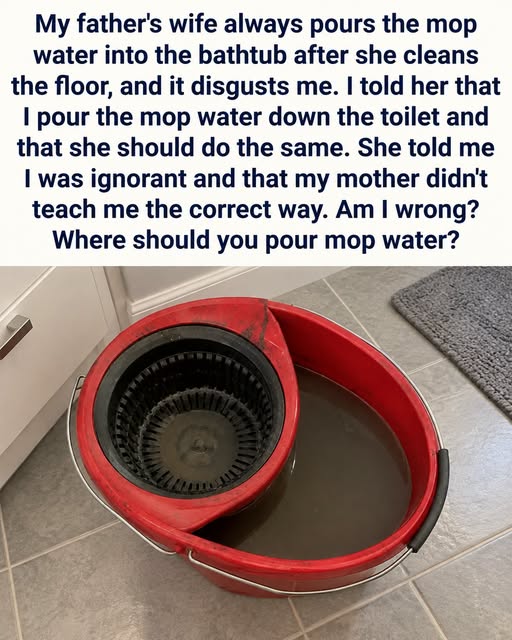
You’re standing there with a sloshing gray bucket and one surprisingly difficult choice.
Toilet or tub?
Suddenly, a basic household chore feels like a test you were never taught how to pass.
You’ve just finished mopping the kitchen, hallway, bathroom, or entryway, and now you’re standing there holding a bucket full of cloudy water. It contains dirt you can actually see, but also plenty you can’t.
Hair.
Dust.
Tiny particles of food.
Soap residue.
Pet hair.
Grime from beneath furniture.
And probably things you don’t even want to think about.
So where does it go?
Pick the wrong place, and you could be dealing with a clogged drain, lingering grime, an unpleasant smell, or a bathtub that needs to be cleaned all over again before anyone can use it.
The truth is, where you dump that water says more about hygiene, plumbing, and quiet house rules than you might think.
Dirty mop water isn’t just “a little used water.”
It’s essentially a cocktail of everything your mop collected from the floor.
Depending on where you’ve been cleaning, that can include grit, hair, cleaner, bacteria, dust, food particles, and whatever happened to live underneath your refrigerator, sofa, cabinets, or other furniture.
That’s why the toilet is usually the safest everyday choice when a utility sink isn’t available.
Toilets are designed to move waste and water through relatively large passages into a sanitary sewer system or, in many homes, a septic system.
That doesn’t mean you should treat your toilet like a trash can.
You still shouldn’t pour solid debris, paper towels, rags, or large clumps of hair into it.
But for ordinary mop water containing suspended dirt and small particles, the toilet is generally better equipped than a typical household drain.
The bathtub is a different story.
Its drain is designed primarily for water from bathing.
It’s smaller.
It can collect hair.
It can accumulate soap residue.
And it sits in the exact place where people wash themselves.
Think about that for a moment.
You pour dirty floor water into the tub, watch it disappear down the drain, and then the next person steps into that same tub to take a shower.
Even if the water drains completely, residue can remain around the drain or along the surface.
That means you’re potentially creating another cleaning job for yourself.
You may have to scrub the tub.
You may have to disinfect it.
You may have to rinse the entire surface before anyone uses it.
And if the mop water contains a lot of hair or debris, you may also be introducing material into a drain that was never intended to handle much of it.
That’s why the bathtub is usually a last resort rather than the first choice.
A utility sink or laundry sink, if you have one, is generally the most convenient option.
Those sinks are designed for messy household tasks.
They’re often deeper.
They can handle dirty water more comfortably.
And they’re separate from the places where you prepare food, brush your teeth, or bathe.
If you have a laundry room with a utility sink, that’s often the ideal place to empty a mop bucket.
It keeps the mess contained and makes cleanup easier.
Before pouring the water anywhere, however, take a second to look inside the bucket.
If you can see chunks of dirt, clumps of hair, food particles, leaves, or other debris, strain those out first.
A small mesh strainer or disposable filter can help.
The goal isn’t to make dirty mop water perfectly clean.
It’s simply to prevent larger solids from entering your plumbing.
And there’s another important consideration: what cleaner did you use?
Not every cleaning chemical should be poured indiscriminately down every drain.
If you’re using a standard household floor cleaner according to its label, disposal through an appropriate household drain is generally straightforward.
But concentrated chemicals, strong disinfectants, solvents, bleach mixtures, or other harsh products require more caution.
Follow the product label and local disposal guidance rather than assuming every chemical belongs in the toilet.
And never mix cleaning chemicals just because you’re trying to make your mop water “stronger.”
Certain combinations can produce dangerous fumes.
Your mop bucket doesn’t need to become a chemistry experiment.
There’s also one place that should generally be off your list entirely:
The kitchen sink.
It might seem convenient because it’s right there.
It’s deep.
It’s easy to reach.
And the water drains quickly.
But it’s also the place where you wash dishes, rinse food, fill drinking glasses, and prepare meals.
Dirty floor water has no business being poured into a food-preparation sink if you have another reasonable option.
Even if you clean the sink afterward, there’s simply no good reason to introduce floor grime into an area associated with food.
The yard isn’t a great alternative either.
Pouring mop water outside may seem harmless because “it’s just water.”
But it’s not just water.
It may contain detergent, disinfectant, dirt, pet waste residue, or other substances that you don’t want flowing into soil, gardens, or storm drains.
Storm drains can lead to waterways rather than wastewater treatment systems, depending on the local infrastructure.
So if your mop water contains cleaning chemicals, don’t assume that dumping it outside is environmentally harmless.
Wherever you pour it, think about what you’re actually sending down the drain.
And if you’re cleaning someone else’s house, there is another rule that matters just as much as plumbing.
Respect.
In a shared space or someone else’s home, don’t assume that your preferred disposal method is theirs.
Some homes have septic systems.
Some have older plumbing.
Some have specific rules about what can go into their drains.
Some people simply have a particular utility sink or floor drain they prefer you to use.
If you’re unsure, ask.
“Where do you usually dump the mop water?”
It’s a simple question.
It can prevent an awkward conversation later.
If you’re staying in a rental, helping a relative, cleaning an Airbnb, or working in a shared building, follow the property’s instructions whenever they’re available.
And once you’re finished, clean the area around the drain or sink if you’ve splashed water or left residue behind.
The goal isn’t merely to make the dirty water disappear.
It’s to finish the job without creating another mess.
A simple rule works in most ordinary homes:
**Utility sink first.**
If you don’t have one, **toilet second.**
**Bathtub only in a pinch**, followed by a proper rinse and cleaning if necessary.
And **never the kitchen sink or yard simply because they’re convenient.**
That gray bucket may look like the least important part of cleaning the house.
But where you empty it can affect your plumbing, your hygiene, your cleaning routine, and even the people who use the space after you.
So next time you’re standing there with a full mop bucket, don’t just ask, “Where can I dump this?”
Ask, “Where was this water meant to go?”
That one question usually makes the right choice much easier.