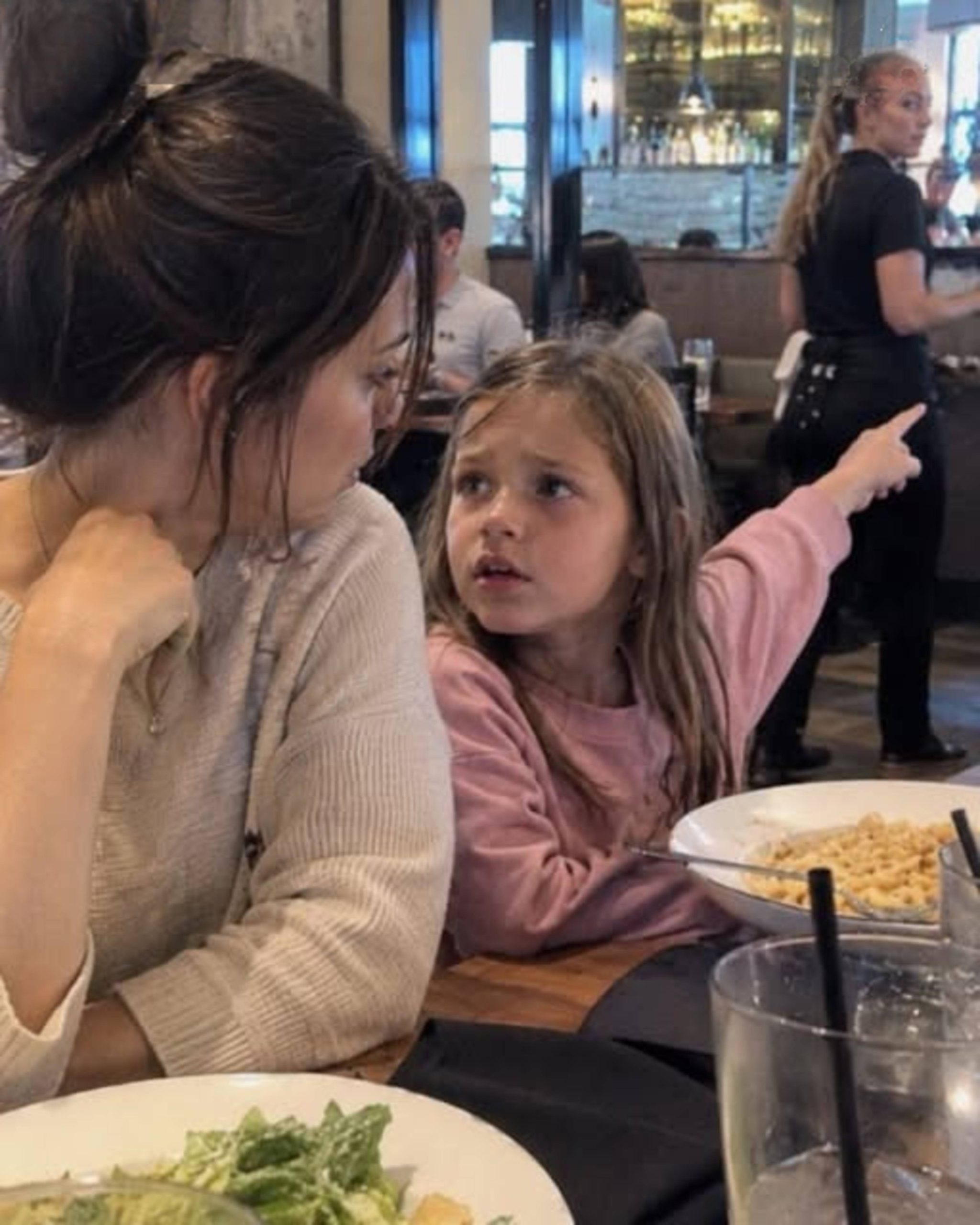
A simple mall lunch turned unsettling when Dayna’s six-year-old daughter, Blake, recognized a waitress and casually asked why she no longer came to their home. At first, Dayna smiled, assuming it was the kind of innocent observation children make without understanding how their words might sound to adults. But that smile slowly disappeared when Blake began sharing details—small, specific details about their home, their family, and the woman standing behind the restaurant counter—that no child should have been able to invent.
I was 36, finally enjoying a rare day off.
That might not sound like much to someone who has never felt like every hour of every day belonged to someone else. But for me, it felt almost unreal. Between keeping the house running, making sure Blake got to school on time, helping her with homework, remembering appointments, buying groceries, answering endless messages, and filling in wherever Jacob needed support with his business, quiet days had become something I mostly watched other people have.
Most mornings began before I was fully awake. By the time I had my first cup of coffee, I had already packed lunches, cleaned something, answered a question about school, and reminded Jacob about something he had forgotten. There was always another task waiting.
So when that particular morning arrived and there was nowhere I absolutely had to be, I found myself lying in bed a few minutes longer than usual.
Jacob was already getting dressed.
“Big client meeting,” he said while buttoning his shirt in front of the mirror. “I’ll probably be tied up most of the day.”
I was still sitting on the edge of the bed, half-asleep, rubbing one eye as I watched his reflection.
“You’ve had a lot of those lately.”
The words came out more quietly than I intended.
He paused for just a second.
Then he glanced at me through the mirror.
“That’s what happens when business is good.”
He said it casually, almost as though the answer should have been enough to end the conversation.
Maybe it should have been.
I wanted to say more. I wanted to ask why “business being good” had started looking so much like late nights, missed dinners, unexplained changes in routine, and a husband who seemed increasingly attached to his phone.
I had noticed things.
Not one huge thing.
Just little things.
Jacob sometimes took calls in another room. He started keeping his phone face down on the table. When a message came in, his eyes would immediately drop toward the screen, and sometimes he would turn his body slightly away from me before answering.
If I walked into the room while he was texting, the screen seemed to disappear almost instantly.
Maybe I was imagining it.
Maybe marriage simply became like that after enough years. Work became stressful. Responsibilities multiplied. People became tired.
I told myself those things because the alternatives were harder to think about.
Instead, I nodded.
“Okay.”
He picked up his watch from the dresser and fastened it around his wrist.
Then he walked over and kissed my forehead.
It was quick.
Distracted.
Almost automatic.
“Love you.”
“Love you too,” I replied.
The bedroom door closed behind him.
For a few seconds, I remained sitting there, staring at the empty doorway.
Then I took a breath and forced myself to move on.
By ten, I had decided that Blake and I deserved a day out.
She was six, full of questions, dramatic sighs, sudden bursts of energy, and the kind of brutal honesty that could flatten a grown adult in three seconds without her even realizing she had done it.
When I told her we were going to the mall for lunch and a little shopping, she jumped so hard that one of her slippers flew across the room.
“Really?”
“Really.”
“Can we get lunch there?”
“That’s generally what people do when they go to the mall for lunch.”
She ignored my sarcasm completely.
“Can I wear my sparkly shoes?”
I looked down at the shoes she was already holding.
“To walk around the mall?”
“They make me faster.”
“Faster?”
She nodded with complete seriousness.
“Very fast.”
I laughed.
“All right. Sparkly shoes.”
She immediately disappeared into her room.
A few seconds later, she came running back wearing the shoes, carrying her tiny pink purse, and wearing an expression that suggested she was prepared for a major adventure.
“I will only complain after 30.”
“Thirty what?”
“Minutes.”
I raised an eyebrow.
“That’s your promise?”
She held up one finger.
“I will only complain after 30.”
I laughed for the first time that morning.
“Fine. Thirty minutes.”
She grabbed my hand.
“Let’s go!”
For a while, everything felt completely normal.
And I needed that.
Blake skipped beside me through the mall, holding my hand with one hand and swinging her tiny pink purse with the other. Every few steps, she jumped over a tile line or spun around to look at something in a store window.
She had a way of making ordinary things feel important.
We stopped at a store filled with hair clips and colorful accessories. Blake picked up one shaped like a butterfly, then another shaped like a flower, and then somehow convinced herself that she needed both.
“You already have a drawer full of these,” I reminded her.
“They’re not the same.”
“They look exactly the same.”
“They are emotionally different.”
I stared at her.
“Where did you learn that?”
She shrugged.
“School.”
I laughed again.
We smelled candles we had absolutely no intention of buying. Blake insisted that one smelled like “Christmas and pancakes,” while another smelled like “a grandma’s purse.”
Then we wandered into a clothing store.
She immediately found a purple dress with puff sleeves.
“Mom.”
“No.”
“You don’t even know what I was going to say.”
“You were going to ask for the dress.”
She hugged it against herself.
“It’s beautiful.”
“It’s very fancy.”
“That’s because I’m fancy.”
I looked at her sparkly shoes.
“You still spill yogurt on yourself.”
“Fancy people can spill yogurt.”
I couldn’t argue with that.
We eventually left the store without the dress, although Blake made sure I understood that this was an injustice she would remember.
As we continued through the mall, she pointed out toys, decorations, a giant stuffed animal almost as big as she was, and a bakery display that somehow became the most important thing she had seen all morning.
Then came lunchtime.
We chose a casual restaurant inside the mall, the kind of place where families came and went constantly. There were parents with toddlers, teenagers crowded around tables, elderly couples sharing meals, and workers moving quickly between tables carrying trays and glasses.
The smell of grilled food, fries, coffee, and warm bread filled the air.
Blake slid into the booth across from me.
“I want fries.”
“You always want fries.”
“Because fries are good.”
“And something else.”
She thought about it.
“Chicken.”
“Good.”
“And dessert.”
“We’ll see.”
She gave me a look.
“That’s what you always say when the answer is no.”
I smiled.
“I haven’t decided yet.”
A waitress approached our table with two menus.
“Hi there. How are you ladies doing today?”
I looked up.
“Good, thank you.”
The waitress smiled and placed the menus in front of us.
Then she turned toward Blake.
“And what can I get you?”
Blake stared at her.
Not casually.
Not the way children usually look at strangers.
She stared for several seconds.
The waitress noticed.
“Are you okay, sweetheart?”
Blake tilted her head.
Then she said something that made my entire body go still.
“Why don’t you come to our house anymore?”
The waitress froze.
I looked at Blake.
Then at the woman.
“What?”
Blake swung her legs beneath the table.
“You used to come to our house.”
The waitress’s expression changed instantly.
It was subtle.
So subtle that another person might not have noticed.
But I did.
Her smile disappeared.
Her eyes widened.
And for a moment, she looked directly at me.
I felt a strange chill move through my chest.
“Blake,” I said gently, “I think you’re mistaken.”
She frowned.
“No, I’m not.”
The waitress looked uncomfortable.
“I think maybe she has me confused with someone else.”
But Blake shook her head.
“No.”
Then she smiled as though she had just remembered something important.
“You used to sit in Daddy’s office.”
The air seemed to disappear from the booth.
The waitress’s face went pale.
I stared at my daughter.
“What did you say?”
Blake looked at me, completely confused by my reaction.
“You know her, Mommy.”
“No,” I said slowly. “I don’t.”
Blake pointed toward the waitress.
“She used to come when Daddy was home.”
The waitress lowered her eyes.
My heart began beating harder.
There was something in Blake’s voice that made it impossible to dismiss what she was saying as a random childhood misunderstanding.
Children forget names.
They confuse faces.
They misunderstand adult conversations.
But they remember places.
They remember routines.
And Blake was suddenly remembering things I had never heard her mention before.
I looked back at the waitress.
She was no longer looking at either of us.
She was staring down at the order pad in her hand.
“Ma’am,” I said quietly, “have you met my daughter before?”
The waitress swallowed.
“I…”
She stopped.
Blake interrupted.
“You had the blue cup.”
I felt my stomach tighten.
“What blue cup?”
Blake looked at me as though the answer was obvious.
“The one at home.”
She pointed toward the waitress again.
“She always drank from it.”
The waitress’s fingers tightened around the order pad.
And that was the moment my rare, peaceful day off stopped feeling peaceful at all.
Because I suddenly realized that Blake wasn’t simply recognizing a woman from somewhere.
She was recognizing someone from inside our home.
And whatever connection existed between that waitress and my family, I had a terrible feeling that Jacob knew exactly what it was.