She walked out—and the entire arena seemed to hold its breath.
After years away from the stage, Céline Dion stood beneath the blinding lights of Paris La Défense Arena, surrounded by thousands of people who had spent years wondering whether they would ever hear her sing live again.
For a moment, she simply stood there.
The roar of the crowd was enormous, but there was something fragile underneath it. Fans knew what it had taken for her to reach that stage. They knew about the years of uncertainty, the devastating health battle, the performances she had been forced to cancel, and the career she had temporarily placed on hold.
This wasn’t simply another concert.
It felt like a reunion.
At 58, facing stiff-person syndrome and the unpredictable limitations it had placed on her body, Dion had every reason to be uncertain about what came next. Her illness had changed things she once took for granted. Movement could become difficult. Her voice could feel different. The future that had once seemed so predictable suddenly wasn’t.
Yet there she was.
Standing in front of an arena filled with people who had waited for her.
And when the music began, the emotion became impossible to contain.
Dion’s return wasn’t perfectly polished in the way a comeback story is supposed to be. Her voice carried the weight of everything she had endured. Her body was fighting its own battle. And rather than hide that vulnerability, she allowed the audience to see it.
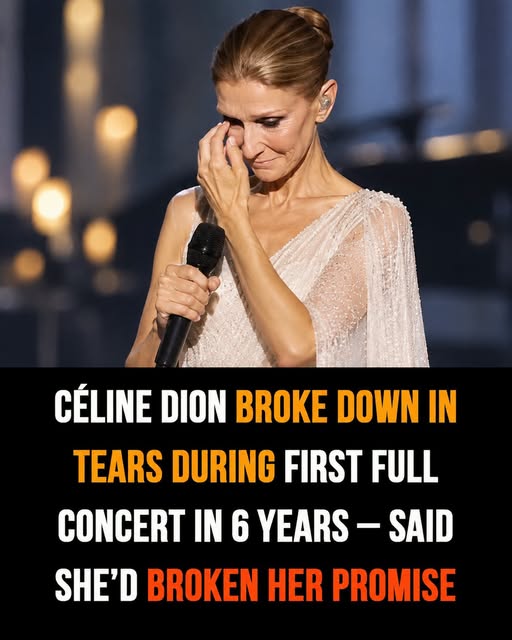
During “On ne change pas,” the emotion finally overwhelmed her.
She broke down.
For a few seconds, the superstar disappeared.
There was only a woman standing beneath the lights, wiping away tears in front of thousands of people.
The crowd responded immediately.
Applause thundered through the arena.
Not impatient applause.
Not polite applause.
The kind that seems to say, *You’re safe here. Take your time.*
The sound grew louder, surrounding her as she tried to collect herself.
And somehow, the moment that might have once felt like weakness became one of the most powerful parts of the night.
Céline Dion had spent decades being expected to control everything—the voice, the emotion, the performance, the spectacle.
But that night, she didn’t need to control the tears.
She let them come.
She wiped her face and continued.
For the people in the arena, it was more than hearing a famous singer perform one of her beloved songs. It was watching someone reclaim a piece of her identity after years in which illness had threatened to define what she could and couldn’t do.
She later spoke openly about her health and the long, lonely road that had brought her back.
There was no pretending those years had been easy.
Stiff-person syndrome had forced her to confront a reality she had never expected: sometimes wanting to perform isn’t enough to make the body cooperate.
There were treatments.
There was rehabilitation.
There were setbacks.
There were days when the possibility of returning to the stage probably felt impossibly far away.
And there was the psychological weight of disappearing from a world that had known her as one of its most powerful voices.
Fans could only wait.
They couldn’t know exactly what she was experiencing behind closed doors.
They could only hope.
And that hope became part of the meaning of her return.
Dion thanked the people who had remained patient while she was away. She acknowledged the fans who continued to support her without knowing when—or whether—they would see her again.
Their loyalty had given her something she could carry through the hardest moments.
A reason to keep imagining the stage.
A reason to keep fighting.
A reason to believe that the story might not be finished.
When she looked out at the crowd, it was clear that the relationship between performer and audience had changed.
For decades, fans had come to concerts expecting Céline Dion to give them something.
Her voice.
Her energy.
Her unforgettable songs.
But this time, they were giving something back.
They gave her patience.
They gave her silence when she needed it.
They gave her applause when the emotion became too much.
They gave her permission to be human.
And perhaps that was why the moment felt so overwhelming.
The woman who had spent a lifetime singing about love, loss, courage, and longing was suddenly living those emotions in front of everyone.
She didn’t need to prove that she was exactly the same person she had been before her illness.
She didn’t need to pretend nothing had changed.
Everything had changed.
And she was still there.
That was enough.
The night became less about returning to the past and more about reclaiming the future.
A comeback isn’t always about restoring what once existed.
Sometimes it’s about discovering what is still possible after everything has changed.
For Céline Dion, stepping back onto that stage meant accepting that her journey would look different now.
There might be uncertainty.
There might be difficult days.
There might be limitations.
But there would also be music.
There would be people waiting.
And there would be a voice that still had something left to say.
As the arena filled with applause, the years away seemed to collapse into a single moment.
The illness.
The fear.
The silence.
The waiting.
All of it had led here.
She wiped away her tears, took a breath, and continued.
And in that instant, the tears weren’t a sign that she had been defeated.
They were proof of how much the moment meant.
Céline Dion didn’t return to the stage because nothing had changed.
She returned because everything had changed—and she was determined to find out what she could still do.
The crowd didn’t simply witness a performance.
They witnessed a woman refusing to let the hardest chapter of her life become the final one.
Her story isn’t finished.
Her voice isn’t finished.
And beneath those lights in Paris, surrounded by thousands of people who had waited for her, Céline Dion gave them something more powerful than a perfect comeback.
She gave them the truth.
Sometimes courage doesn’t look like standing without fear.
Sometimes it looks like standing there with tears in your eyes, knowing exactly how hard it was to get back—and singing anyway.