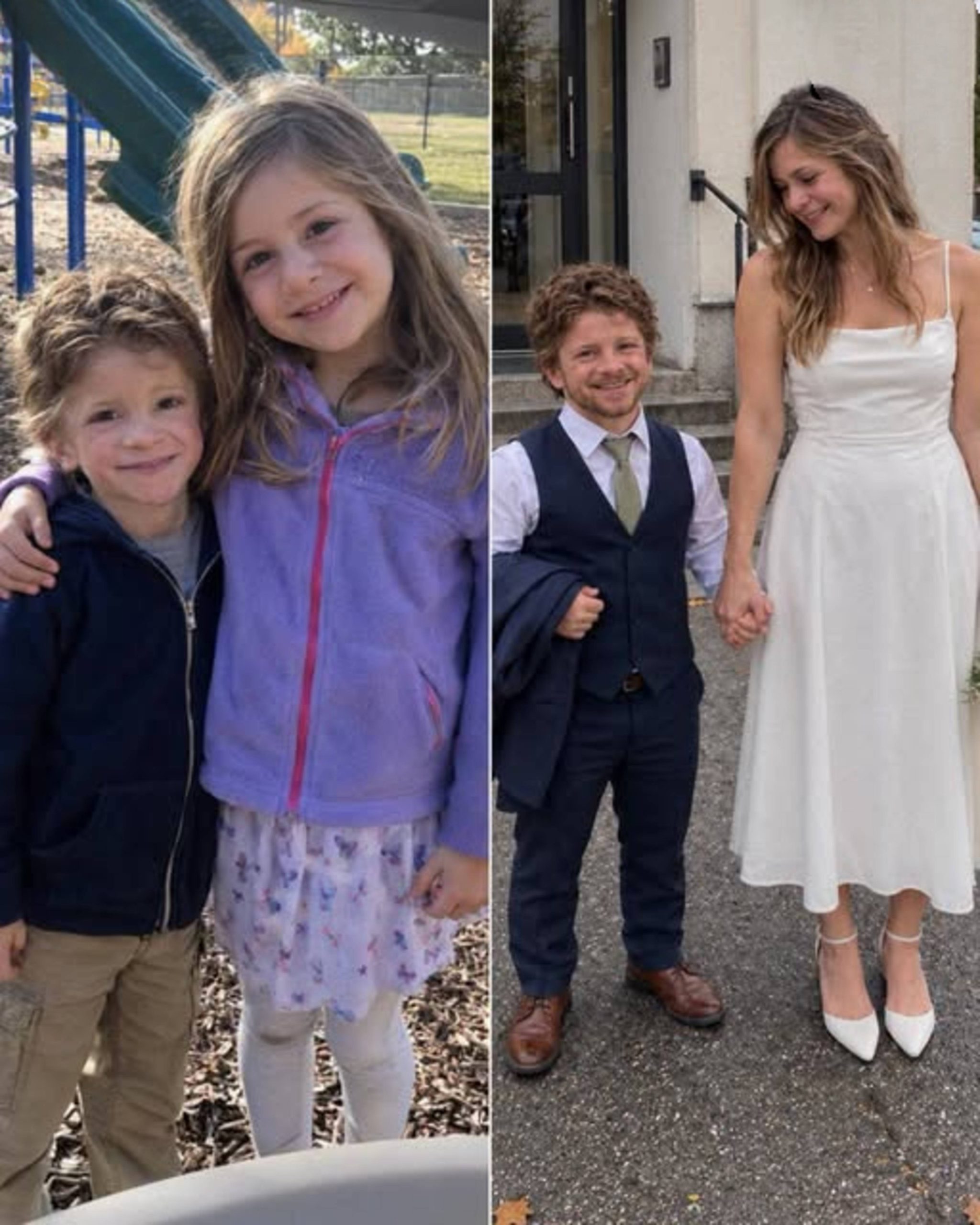
Noah had spent years being mocked for the body he never seemed to grow out of, but nothing hurt him quite like hearing my own family say I was wasting my life on him. To them, loving Noah was something I would eventually regret. They saw his size before they saw his heart, his differences before they saw the person I had known since childhood.
But I had known Noah long before anyone else decided what he was worth.
And on our wedding day, when he quietly tried to set me free, I finally told everyone the truth.
When Noah and I were six, we made a marriage pact behind the monkey bars.
We were sitting in the dirt during recess, our knees dusty, our lunch boxes forgotten beside us. Neither of us really understood what marriage meant. We only knew that grown-ups talked about it as if it were the ultimate promise between two people.
So, naturally, we decided to make our own.
It was written in purple crayon on a page torn from my spelling notebook.
“If we are both still single when we are 30,” I read aloud, carefully sounding out every word, “we promise to marry each other.”
“You spelled promise wrong.”
“I did not.”
“You wrote promiss.”
“You know what I mean.”
He sighed like an exhausted lawyer, then took the crayon from my hand and signed his name beneath mine.
His handwriting was crooked and enormous for such a tiny piece of paper.
I signed mine underneath.
After that, we exchanged pink plastic rings from a vending machine outside the grocery store. Mine had a tiny fake stone. His was slightly too big for his finger and kept slipping off.
We locked pinkies.
“Thirty is ancient,” I said.
“Basically dead,” Noah agreed.
Then we ran back to class and forgot about it.
At least, we thought we did.
Two years later, Noah stopped growing.
He had always been small, but by fourth grade, the difference became impossible to ignore.
His classmates grew taller.
Their faces changed.
Their voices deepened.
Their shoes became too small every few months.
Noah stayed almost exactly the same size.
At first, none of us understood what was happening.
Teachers quietly spoke to his parents. Doctors ran tests. Adults exchanged concerned looks whenever they thought the children weren’t watching.
Noah noticed everything.
He noticed the way people stared.
He noticed when someone whispered.
He noticed when children compared their heights against his.
And eventually, the teasing began.
At first, it was simple childhood cruelty.
Someone called him tiny.
Someone else called him a baby.
Then the jokes became more creative, and much less harmless.
Kids would stand beside him and exaggerate how tall they were. They would ask whether he needed a booster seat. They would pretend not to hear him because they thought his voice made him sound younger.
Noah laughed along sometimes.
That was his survival trick.
If he laughed first, maybe it wouldn’t hurt as much.
But I knew him too well.
I could see the difference between his real laugh and the one he used when he wanted people to stop looking.
I started sitting beside him at lunch.
When someone made a joke, I would stare at them until they became uncomfortable.
When someone asked why I was always with him, I shrugged.
“Because he’s my friend.”
That answer seemed sufficient when we were children.
As we grew older, it became much harder.
By middle school, most of our classmates had passed Noah in height by an enormous margin.
He was still almost the same size he had been years before.
The teasing followed him everywhere.
Hallways.
Classrooms.
Sports fields.
Parties.
Even strangers sometimes stared.
And then there were the adults who thought they were being helpful.
They would tell him he needed to be confident.
They would tell him not to let people get to him.
They would say things like, “You’re different, but that’s okay.”
As though he didn’t already know.
What Noah wanted wasn’t a speech about being different.
He wanted people to stop treating him like he was less.
I watched him become more guarded with every year.
He stopped volunteering answers in class.
He avoided crowded events.
He learned how to make himself invisible.
But there was another side of Noah that most people never bothered to see.
He was incredibly funny.
He remembered tiny details about everyone he cared about. He could make me laugh when I was furious. He listened when people talked. He was patient in a way most people twice his age weren’t.
And he never made me feel like I had to explain why I loved being around him.
We grew up together.
Our childhood pact became an inside joke.
Every few years, one of us would bring it up.
“Still thirty?” I would ask.
“Still thirty,” he’d answer.
By sixteen, we were laughing about it.
By twenty, we weren’t.
Because somewhere along the way, I realized that the boy behind the monkey bars had become the person I trusted most in the world.
And Noah realized it too.
But he was afraid.
He worried that I was staying because of a childhood promise.
He worried that people would say I felt sorry for him.
He worried that I was sacrificing my future.
My family certainly thought I was.
As the years passed, their comments became increasingly difficult to ignore.
“You’re young,” my mother would say. “You have your whole life ahead of you.”
My father was more direct.
“You shouldn’t build your future around someone else’s limitations.”
They never said Noah’s name with cruelty.
That almost made it worse.
They spoke as if they were protecting me.
As if loving him were a mistake I simply hadn’t recognized yet.
Whenever Noah was around, they were polite.
Whenever he left, the criticism started.
They questioned our relationship.
They questioned my choices.
They questioned whether I understood what marriage would mean.
Eventually, they started saying I was wasting my life.
That was the one thing I couldn’t forgive.
Because they didn’t understand that Noah wasn’t an obligation I had chosen.
He was home.
Still, even after all those years, Noah carried the same fear.
So when our wedding day finally arrived, I should have known something was wrong when he kept avoiding my eyes.
The ceremony was beautiful.
There were flowers everywhere.
Friends and family filled the room.
Someone cried before we even reached our vows.
I remember thinking about the playground.
The purple crayon.
The spelling notebook.
The ridiculous pink plastic rings.
We had actually made it to thirty.
And then, just before the ceremony, Noah took my hands.
His were shaking.
“I need to tell you something.”
I smiled.
“What?”
“You don’t have to do this.”
I thought I had misunderstood him.
“Do what?”
“Marry me.”
For a second, I couldn’t speak.
He looked down.
“You have spent your whole life defending me. Your family thinks you’re sacrificing everything. Maybe they’re right. Maybe you deserve someone who doesn’t make your life harder.”
My heart broke.
Not because he wanted to leave me.
Because he genuinely believed I would be better off without him.
He continued before I could answer.
“I love you too much to let a promise two six-year-olds made behind a playground trap you.”
I squeezed his hands.
“You’re not trapping me.”
He shook his head.
“You don’t have to prove anything.”
And that’s when I understood.
Noah had spent his entire life being told that he was a burden.
Even on the day he was supposed to feel most loved, he was still trying to protect me from the supposed burden of loving him.
So I walked back into that room and looked at everyone.
My family.
His family.
Our friends.
Every person who had ever assumed they knew what was best for me.
Then I told them the truth.
I wasn’t marrying Noah because of a childhood promise.
I wasn’t marrying him because I felt sorry for him.
I wasn’t sacrificing my future.
I was choosing him.
Because I loved him.
Because he made me laugh.
Because he knew me better than anyone.
Because he had been there through every version of me.
Because when life became difficult, he never asked me to become smaller so he could feel bigger.
And because the person everyone else had spent years measuring by height was the person who had given me the greatest sense of security I had ever known.
I looked at Noah.
Then I smiled.
“Remember what you said when we were six?”
He laughed through tears.
“Thirty is ancient.”
I nodded.
“Well, we’re ancient now.”
Everyone laughed.
Even my father.
And Noah finally smiled the way I remembered from childhood—not the careful smile he used to survive other people’s cruelty, but the real one.
The ceremony continued.
And when we exchanged rings, I thought about those cheap pink plastic rings from the vending machine.
They had cost almost nothing.
They had meant everything to two little children who didn’t understand what love was yet.
Maybe we didn’t know what marriage meant when we made that promise.
But somewhere along the way, we learned.
Marriage wasn’t about rescuing someone.
It wasn’t about sacrificing yourself.
It wasn’t about proving anything to other people.
It was about choosing the person who stood beside you when nobody else was watching.
The person who knew your fears and stayed.
The person who had seen you change and loved every version of you.
Noah’s body had become the first thing people noticed.
But it had never been the thing I loved.
I loved the person inside it.
And after years of watching strangers measure his worth by something as meaningless as height, I finally understood something I wished everyone else had understood sooner.
People spend enormous amounts of time measuring things that don’t matter.
Height.
Weight.
Appearance.
Money.
Status.
And then they wonder why they still can’t measure happiness.
That little piece of purple-crayoned paper had survived childhood, embarrassment, arguments, growing pains, and years of other people’s opinions.
The original page was long gone.
The plastic rings were gone too.
But the promise had survived—not because two six-year-olds had written it down, but because two adults had eventually chosen the same thing freely.
Noah hadn’t needed me to rescue him.
And I hadn’t needed anyone’s permission to love him.
On our wedding day, he tried to set me free because he thought loving him meant giving something up.
Instead, I finally made him understand the truth.
I wasn’t giving up my life.
I was choosing the person I wanted to share it with.
And sometimes the greatest love stories aren’t about overcoming someone’s differences.
They’re about realizing those differences were never the reason they were worthy of love in the first place.