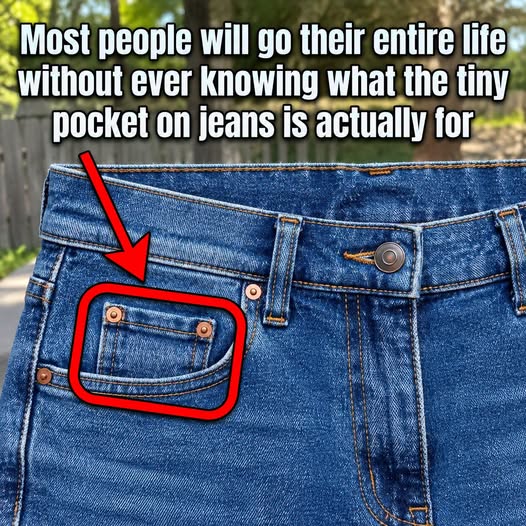
Most people never question the tiny metal studs on their jeans—until the day a favorite pair tears.
Those little metal dots can look like simple decorations, leftover pieces of an old-fashioned design that somehow became fashionable. But they were never created merely to make denim look tougher.
They were born from desperation, hard labor, torn fabric, and a very practical problem that workers faced every day.
In the late 19th century, miners, railroad workers, and other laborers spent long hours doing physically demanding work in clothing that had to survive constant strain. Their pants were exposed to dirt, tools, heavy movement, and repeated pulling at the seams.
And sooner or later, something gave way.
Pockets were especially vulnerable.
Workers carried tools and other heavy objects in them, while climbing, bending, lifting, kneeling, and moving through demanding environments. The fabric around the pockets endured enormous stress, and once a seam began to weaken, a small tear could quickly become a much larger failure.
For the people wearing those clothes, this wasn’t a fashion problem.
It was a work problem.
A ripped pair of pants could mean discomfort, inconvenience, another repair, or the expense of replacing something that was already difficult to afford.
One tailor became particularly frustrated with the problem.
His name was Jacob Davis.
Davis had seen enough torn clothing to understand that simply sewing the same weak points over and over wasn’t a permanent solution. If the fabric repeatedly failed in the same places, perhaps the answer wasn’t better stitching alone.
Perhaps the stress needed to be distributed differently.
So he experimented.
Instead of treating the tear after it happened, he looked for a way to prevent the tear from happening in the first place.
His solution was remarkably simple.
Metal.
Davis began reinforcing the areas of clothing that experienced the greatest strain with metal fasteners, placing rivets at key stress points such as pocket corners and seams.
The idea was straightforward: strengthen the weakest locations before they failed.
It was a small change.
But it could make an enormous difference.
The metal rivets helped hold the layers of fabric together and distribute the force that would otherwise concentrate on a single stitched seam. Rather than allowing the fabric to pull apart at its most vulnerable points, the reinforced connection gave the garment additional strength.
For workers whose clothing had to survive brutal conditions, that mattered.
But Davis also understood that a good invention needed more than an idea.
He needed a way to protect it.
That’s where Levi Strauss entered the story.
Davis approached Strauss, a successful businessman whose company was already involved in selling clothing and dry goods. Together, they pursued a patent for the riveted clothing design.
The partnership transformed a practical workshop solution into something much bigger.
The riveted work pants became associated with durability.
The material was tough.
The construction was reinforced.
And the little pieces of metal became part of the garment’s identity.
What began as an attempt to stop workers’ pants from ripping eventually helped create one of the most recognizable forms of clothing in the world.
Jeans.
The fascinating part is that the feature most people now see as ordinary was once a technological solution to a very specific problem.
Those rivets weren’t added because someone thought they looked cool.
They were there because fabric was failing.
And workers needed their clothing to hold together.
The choice of metal was important too.
Copper became strongly associated with the riveted construction because it was durable and well suited to the task. Metal fasteners could reinforce areas where ordinary stitching was vulnerable, helping garments survive repeated stress.
The result was clothing designed around the reality of work rather than appearance.
That practical philosophy became central to denim’s identity.
A pair of jeans could become dirty.
It could become faded.
It could develop creases, scratches, and worn patches.
And instead of making the garment look ruined, those marks often became evidence that it had been used and lived in.
The rivets fit perfectly into that philosophy.
They were visible reminders that the garment had been engineered to withstand punishment.
Over time, however, the meaning of jeans changed.
What was once workwear became everyday clothing.
Then fashion.
Then a global industry.
Jeans moved from mines and workshops into offices, schools, restaurants, concerts, streets, and eventually luxury fashion collections. Different cuts, washes, colors, and designs appeared, but the tiny metal rivets remained recognizable.
The original reason for them can easily disappear when something becomes ordinary.
That’s what makes these little studs so interesting.
You probably don’t think about them when you put on jeans.
You may never notice them at all.
They’re simply there.
Until one day you put something heavy into your pocket.
Or sit down awkwardly.
Or pull on the waistband.
Or discover a small tear developing near a pocket.
Then suddenly, that little piece of metal makes sense.
It is a physical reminder that someone once asked a very simple question:
**Why does this keep breaking?**
Instead of accepting the problem as inevitable, Jacob Davis looked for a different answer.
The lesson extends far beyond clothing.
Many useful inventions begin this way.
Someone notices the same failure happening repeatedly.
Other people have learned to live with it.
But one person becomes frustrated enough to ask whether the failure can be prevented rather than repaired.
That mindset can turn an ordinary inconvenience into an innovation.
In this case, the innovation was tiny.
Almost invisible.
A few pieces of metal attached to fabric.
But the consequences were enormous.
The rivet helped strengthen work clothing, and the resulting design became part of the foundation of modern denim culture.
Today, jeans are worn by people who have never worked in a mine or spent a day repairing railroad tracks.
A teenager can wear them to school.
An office worker can wear them on a casual Friday.
A musician can wear them onstage.
A designer can send them down a runway.
And someone can spend hundreds of dollars on a pair whose original purpose was simply to survive hard labor.
That transformation is almost poetic.
Something invented for people who needed clothing to endure became a symbol of style.
Yet beneath all the fashion, branding, and different designs, the original idea remains.
Strengthen the weak point.
The next time you look at a pair of jeans, take a closer look at those tiny metal studs around the pockets.
They aren’t random decorations.
They represent a problem that workers faced more than a century ago, a tailor who refused to keep repairing the same failures, and a partnership that turned a practical invention into a worldwide clothing phenomenon.
The rivet is small.
The history behind it isn’t.
And perhaps that’s the most interesting thing about everyday objects: the details we barely notice can carry the stories of the people who designed them.
Those tiny metal dots helped solve a problem that once plagued hardworking people every day.
Today, they quietly sit on millions of pairs of jeans around the world.
A little piece of metal.
A simple idea.
And a reminder that sometimes durability begins with nothing more complicated than noticing where something keeps breaking—and deciding it doesn’t have to.