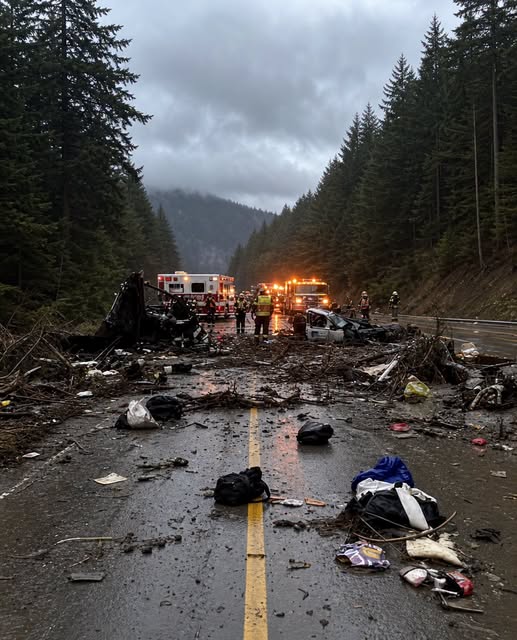
The mountain gave way without warning.
Cars, families, lives — swallowed in seconds by a roaring wall of mud and rock on Highway 99. Three men and a woman were confirmed dead. One man remained missing. Families waited desperately for answers that might never come, while rain continued to fall and hope grew thinner with every passing hour.
They had been driving a familiar road, a twisting ribbon of pavement through the mountains near Lillooet, when the storm turned lethal. Days of relentless rain had saturated the ground and weakened the slopes above Duffey Lake Road. Then, without warning, the hillside collapsed.
Tons of mud, rocks, trees, and debris thundered downward, tearing across the highway and burying whatever happened to be in its path.
For the people caught in the disaster, there was almost no time to react.
A normal journey became a fight for survival in seconds.
When emergency crews arrived, they faced conditions almost as dangerous as the landslide itself. The debris remained unstable. More rain threatened additional collapses. Visibility deteriorated, and every movement across the wreckage carried the possibility of another section of mountain breaking loose.
Still, rescuers went in.
They searched through mud and twisted debris, working against darkness, weather, exhaustion, and the terrible possibility that they were already too late.
One by one, the victims were recovered.
First came a woman on Monday.
Then three men in the days that followed.
Each recovery brought a measure of certainty to families who had been trapped in agonizing uncertainty, but it also delivered a devastating finality.
One person was still missing.
Crews continued searching, hoping against the odds that the mountain might eventually give up another survivor.
But the ground kept shifting.
The rain kept coming.
And eventually, authorities were forced to make the decision no rescue team ever wants to make: the search had to be called off.
Not because anyone had stopped caring.
Not because rescuers had run out of determination.
But because the mountain itself had become too dangerous to challenge.
For the families waiting at home, that decision offered little comfort.
There was no final goodbye.
No clear moment of closure.
Only an empty space where a loved one should have been.
Highway 99 was closed as crews assessed the destruction and worked to understand what had happened. The road that thousands of people had traveled countless times had suddenly become a reminder of how quickly familiar landscapes can turn deadly.
And this disaster raised questions far beyond the immediate tragedy.
How can communities prepare for slopes that appear stable until the moment they collapse?
How do authorities protect travelers when extreme rainfall changes the risks within hours?
And as severe weather becomes an increasingly familiar threat, what lessons can be taken from a disaster in which nature gave almost no warning?
For the families of the victims, those questions are secondary.
They lost people.
They lost futures.
And one family was left waiting for someone who may never be brought home.
The mountain remains.
The highway will eventually be repaired.
Cars will one day travel that stretch of pavement again.
But for those who lost someone beneath the mud, that road will never simply be a road again.
It will always be the place where the mountain came down.