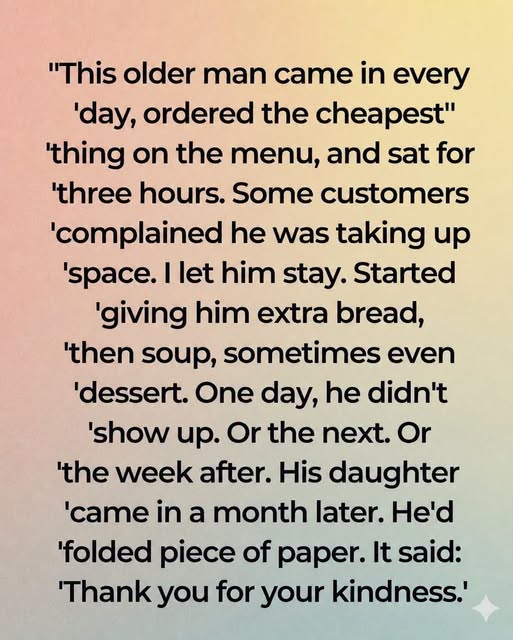
The complaints started quietly, almost politely, and then sharpened into something uglier.
An old man. One coffee. One croissant. Three hours at “their” table.
At first, customers only whispered about him. They glanced toward the window, checked their watches, then looked at me as if I were supposed to understand the problem without being told. Soon, the whispers became comments. Then came the direct complaints.
They wanted him gone.
I needed their money.
And every morning at exactly 7:45, Elias walked through the café door wearing the same worn coat, carrying the same careful expression, and placing the same exact change on the counter. He ordered one coffee and one croissant, then made his way to table seven by the window.
He never demanded anything.
He never complained.
He never caused trouble.
He simply sat there.
Sometimes he read an old newspaper. Sometimes he stared through the glass at people rushing down the sidewalk. Other mornings, he barely touched his coffee. He would hold the cup between both hands, letting the warmth sit against his fingers as though it were something more than coffee.
To most customers, he was occupying valuable space.
To Elias, that table was something else entirely.
I didn’t understand that at first.
I saw the numbers. A table occupied for three hours by someone who spent only a few dollars meant missed customers, especially during the morning rush. I had employees to pay, rent to cover, supplies to order, and bills that did not care about anyone’s grief.
So when the complaints started coming more frequently, I began wondering whether I should finally ask him to leave.
Then one morning, Elias told me about Margaret.
He was staring at the little vase near the window when he quietly said that green had been her favorite color.
He paused.
“It would have been her birthday,” he added.
There was no dramatic breakdown. No tears spilling across his face. He said it almost apologetically, as if grief were an inconvenience he was embarrassed to bring into someone else’s café.
That detail lodged itself in my chest.
Margaret.
A favorite color.
A birthday that would never be celebrated.
Suddenly, the three hours at table seven looked different.
While customers were measuring Elias’s worth in dollars per hour, Elias was measuring his days by the distance from the life he had lost.
He explained that the house had become difficult to stay in after Margaret died. Every room carried a memory. Her chair was still there. Her things were still there. The silence seemed to follow him from room to room.
“The café makes it feel less empty,” he admitted.
That sentence stayed with me.
He wasn’t coming for the coffee.
Not really.
He was coming because there were voices here. Cups clinking. Doors opening. Someone laughing near the counter. A barista calling out an order. Ordinary sounds that reminded him that the world was still moving, even though his own life seemed to have stopped.
And every morning, table seven gave him a few hours where he didn’t have to sit alone with the silence.
Still, not everyone understood.
One morning, a regular customer approached me, visibly irritated.
“You need to do something about the old man hogging the window.”
I looked toward table seven.
Elias was tracing the rim of his coffee cup with one finger.
He hadn’t heard.
Or maybe he had.
For a moment, I felt caught between two versions of the café.
One was a business. Tables had value. Customers had expectations. Empty chairs meant lost revenue.
The other was a place where people came not only to eat and drink, but to exist beside other human beings.
And suddenly I realized the decision wasn’t really about Elias.
It was about what kind of place I wanted this café to be.
I walked back toward the customer and calmly told him that table seven belonged to whoever needed it most.
He stared at me.
I expected an argument.
Instead, he looked toward Elias, then quietly picked up his coffee and moved to another table.
Something changed after that.
Not dramatically.
Not all at once.
But people began noticing Elias differently.
One regular left a book on his table.
Another brought an extra pastry and told him it was “too much for one person anyway.”
Someone left a small handwritten note beside his coffee.
Then another appeared.
Soon, table seven became a strange little corner of kindness.
Elias still came every morning at 7:45.
He still ordered one coffee.
Still bought one croissant.
Still sat by the window.
But now, sometimes, someone would stop and talk to him.
Sometimes they asked about his morning.
Sometimes he told stories about Margaret.
Sometimes he simply smiled and listened.
The café didn’t suddenly become more profitable.
There were still slow days. Bills still arrived. Customers still complained about prices, waiting times, and crowded tables.
But something more important had changed.
The room felt different.
People seemed to look up from their phones more often. Conversations lasted a little longer. Customers began recognizing one another. Table seven stopped being viewed as wasted space and started becoming a reminder that not every empty chair needs to be filled by someone spending money.
Some seats are there simply because people need somewhere to belong.
And Elias taught us that without ever asking anyone to teach him.
One morning, months later, he arrived carrying a small green flower.
He placed it beside his coffee.
“Margaret would have liked this,” he said.
I looked at the flower, then at the window, and finally at the old man sitting beneath the morning light.
For the first time, I understood what he had been waiting for all along.
Not Margaret to return.
Not the grief to disappear.
He was waiting for the world to feel livable again.
And perhaps, in some small way, it had.
Because profits hadn’t soared.
The café hadn’t become famous.
Nothing about the business had transformed overnight.
But something better had grown there.
A feeling.
The feeling that for a few hours every morning, no one had to be completely alone.
And sometimes, that is worth far more than the price of a coffee and a croissant.