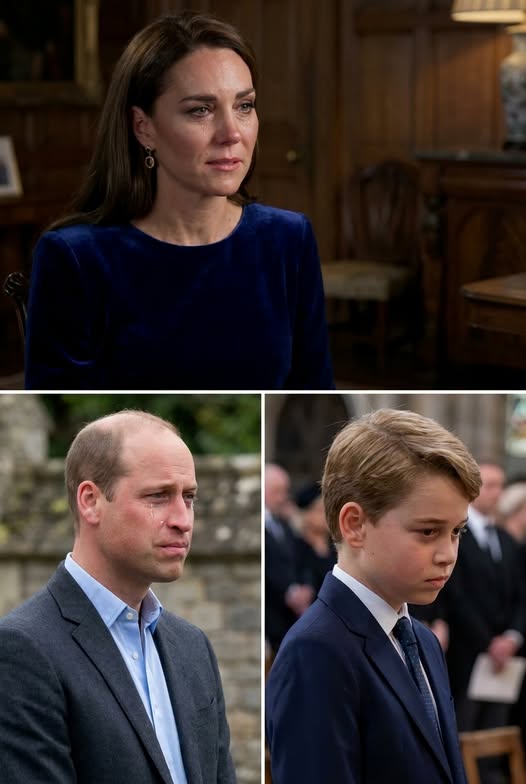
Kate’s answer was only two words, but for a moment, the room seemed to stop.
At a glittering Cancer Research UK anniversary, surrounded by cameras, formal protocol, familiar faces, and the polished atmosphere of a royal engagement, something unexpectedly raw slipped through. It wasn’t a grand declaration. It wasn’t a carefully prepared speech. It was simply a wish, a fear, and a quiet hope wrapped inside two ordinary words.
“Me too.”
The words were small, almost easy to miss. But the emotion behind them was anything but.
There was something deeply human about hearing Kate express a hope that so many people who have faced serious illness can understand: the desire to have the person you love beside you when life becomes frightening and uncertain. After everything she and William have endured together, that simple wish carried a weight that went far beyond royal protocol.
Her brief exchange with Ronan Keating mattered because it revealed the feeling behind a seemingly simple hope—that Prince William could be there, beside her, on a night already loaded with memory and meaning.
This was not just another royal engagement.
Kate was standing in a room dedicated to cancer research after having faced the disease herself. Around her were stories of families who had experienced the same frightening vocabulary: diagnosis, treatment, uncertainty, waiting, hope, and the long process of trying to return to something that feels like normal life.
For Kate, those words were no longer abstract.
They had become part of her own family’s story.
The cameras might have captured the elegant clothes, the smiles, the handshakes, and the formal conversations. But underneath all of that was someone who understood what it means to live through a period when the future suddenly becomes difficult to imagine.
And that is why the smallest comments can sometimes reveal the most.
Speaking with Sebastien Bowen, widower of Dame Deborah James, Kate again seemed to draw a line between public duty and private pain. The conversation touched something much more personal than the usual language of royal appearances. It reflected the reality of having someone beside you during nights when fear refuses to disappear and days when you have to find the right words for children who are too young to fully understand what is happening.
William’s support, in that context, was not a fairy-tale romance.
It was something quieter.
It was presence.
It was being there when there were no perfect answers. It was helping hold a family together when circumstances became difficult. It was navigating conversations with George, Charlotte, and Louis while trying to protect their childhood and, at the same time, remain honest about a reality they could not completely hide.
The glimpses the couple have shared of that period have made their story feel less like the polished image of a future king and queen and more like the experience of an ordinary family confronting extraordinary circumstances.
They have spoken carefully about how they approached their children, giving them information in ways they could understand while trying to preserve a sense of security around them.
And William, according to the picture Kate has offered publicly, quietly helped hold the centre.
There is something powerful about that image.
Not a prince making a dramatic entrance.
Not a husband delivering a perfect speech.
Just someone staying close when the person he loves is going through something frightening.
That kind of support rarely makes headlines because it is not spectacular. It happens in quiet rooms, during difficult mornings, after exhausting appointments, and in the ordinary moments when life has to continue despite everything that has changed.
For parents, there is another layer of fear.
Illness does not only force you to think about yourself. It makes you think about your children. You wonder what they understand. You wonder what they are afraid to ask. You wonder how much truth is enough, how much reassurance is possible, and how you can make a frightening situation feel less frightening for them.
Kate and William have offered only glimpses into those private conversations, and perhaps that is exactly why those glimpses resonate.
They have not needed to reveal everything.
Sometimes a few words are enough to show the depth of what happened.
So when Kate quietly said “Me too,” it was easy to hear something much larger underneath it.
It was not simply about whether William would be physically present at one particular event.
It was about wanting the person who stood beside you through the hardest chapters to still be there for the chapters that come afterward.
After diagnosis.
After treatment.
After the fear.
After the uncertainty.
After all the days when the future seemed impossible to predict.
There is a particular kind of relief that comes when you realize you are moving forward together. But even after the worst moments have passed, the memory of them does not simply disappear. It changes how you see ordinary things. A family dinner can feel more precious. A walk together can mean more. A quiet evening at home can suddenly feel like a gift.
That small “Me too” carried something of that emotional history.
It was less about royal absence and more about companionship.
Less about the cameras and more about the person standing beside them when the cameras disappear.
And perhaps that is why those two words felt so much bigger than they were.
They sounded like the voice of someone who had been reminded that life can change without warning—and who now understands, perhaps more than ever, how much it matters to have the people you love close.
After everything, the hope was remarkably simple.
To keep moving forward.
To keep raising their children.
To keep finding ordinary moments inside an extraordinary life.
And, whenever possible, to face whatever comes next side by side.
Sometimes the most revealing moments are not the speeches carefully written in advance.
Sometimes they are the two quiet words that escape before anyone has time to polish them.
“Me too.”
Two words.
A lifetime of fear, love, gratitude, and hope sitting quietly behind them.