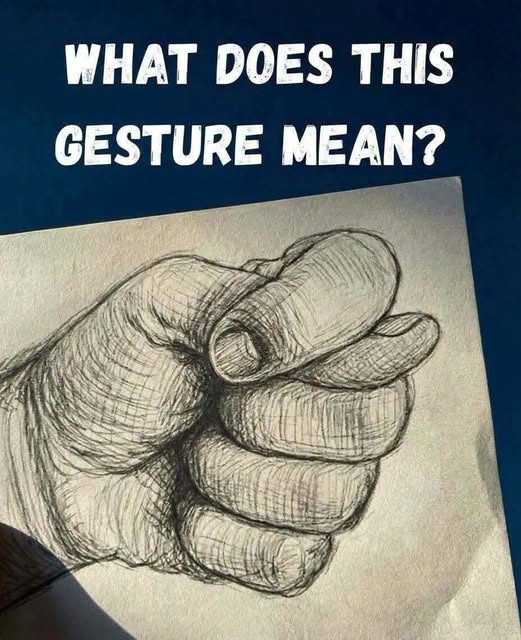
At first glance, it looks completely harmless. A closed fist, a thumb tucked away between the fingers—a gesture so small that you might overlook it entirely in a crowded room. Yet for centuries, this tiny twist of the hand has carried meanings far more powerful than its simple shape suggests. It has been used to express refusal, defiance, protection, and silent resistance. It could end an argument without a single word, signal disagreement without openly challenging someone, or serve as a quiet form of protection against things people feared but could not see.
Long before people communicated through texts, emojis, and instant messages, the human body itself was a language. Hands could speak when voices were dangerous, inappropriate, or simply unnecessary. The fig gesture became part of that silent vocabulary, passed quietly through generations and appearing in different forms across cultures. Grandparents could teach it to children without explaining every layer of its history, allowing the meaning to survive even as the original reasons behind it slowly faded.
What seems like nothing more than a simple hand shape is actually a quiet testament to how people once navigated tension, power, fear, and emotion without speaking. The fig gesture could communicate “no,” “enough,” or “I see what you’re doing” while avoiding the confrontation that spoken words might create. It occupied that fragile space between politeness and resistance, giving someone a way to push back while still maintaining a certain distance.
Its meaning was not always aggressive. In some traditions, the gesture also became associated with protection against bad luck, harmful intentions, or unseen forces. That protective symbolism gave the movement another emotional layer. The hand was no longer simply rejecting something—it could also be acting as a tiny, private shield. In moments when people felt powerless, a familiar gesture could provide the comfort of feeling that they were doing something, even if no one else could see it.
Over time, however, the seriousness surrounding the gesture began to soften. What had once carried weight could become part of jokes, teasing, family rituals, and childhood games. Children could copy the gesture without understanding the centuries of symbolism behind it, turning something once associated with refusal or protection into something playful and familiar.
That transformation says something fascinating about culture itself. Meanings rarely remain frozen. They change as generations reinterpret them, sanding down the sharpest edges while unknowingly preserving pieces of the original memory. A gesture can move from fear to protection, from defiance to humor, and from something meaningful to something almost forgotten.
Today, many people may see the fig gesture and think nothing of it. Some may recognize it only as an old-fashioned sign, while others may have never encountered its deeper meaning at all. Yet its survival is a reminder that human communication has always been more complicated than spoken language.
Our hands have been telling stories for thousands of years. They have expressed anger, affection, warning, agreement, refusal, and fear. Long before screens, keyboards, and emojis gave us endless ways to communicate instantly, a small movement of the fingers could carry an entire message.
And perhaps that is what makes the fig gesture so intriguing. It proves that silence does not necessarily mean having nothing to say. Sometimes, the smallest movement can speak the loudest.
A hidden thumb, a closed fist, and a gesture that lasts only a moment can preserve an idea long after the words that created it have disappeared. Even if most people no longer recognize what it once meant, the fig gesture remains a quiet reminder that our bodies have always been fluent—and that some of the oldest human messages are still hiding in plain sight.